


For so long, we could excuse Tucson’s flaws because it was cheap and easy to live here.
The roads sucked, but you could afford a house.
The pay was low, but so were the rents.
The schools were so-so, but the taxes were manageable.
Now Tucson isn’t cheap anymore, and this seems to be changing the bargain made by many residents. If this metro area can’t give us cheap living, then it owes us more of the services, amenities and opportunities that other American cities take for granted.
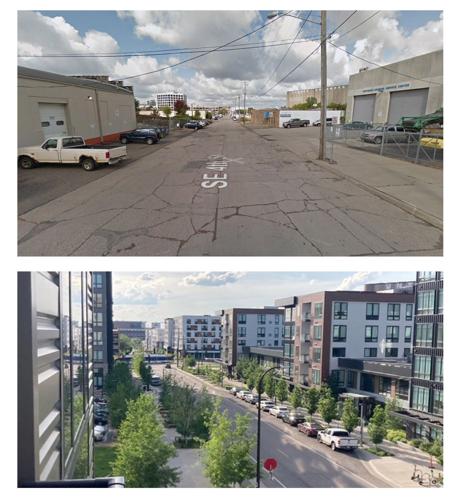
This occurred to me a couple of weeks ago when I was sitting in my parents’ living room in a senior complex near the neighborhood in Minneapolis where I grew up. What stunned me was seeing before-and-after photos of that precise street from just eight years ago compared to now.
Eight years ago, the street was more or less as it had been when I grew up — a desolate road with one-story light industrial buildings in the shadow of towering grain elevators along railroad tracks. I recall exploring the area with friends as a kid, coming across a huge pool of oil, throwing rocks in to figure out how deep it was, and deciding it was bottomless.

Top photo: A view down 4th Street SE in Minneapolis in 2014, shortly before work began on redeveloping the area known as Towerside. Bottom photo: A view down 4th Street SE, from approximately the same place but on the third floor of a newly built apartment building. The transformation occurred in part because a light-rail line was built through the area, but also because a developer bought up the property and worked with a citizens group on the redevelopment. The buildings include low-income, market rate and senior housing.
Today the transformation of that area is stunning. A half mile of the street is lined with apartment buildings from four to 10 stories tall. Trees are growing along the sidewalks. There’s a good-sized grocery store. It’s an all-new neighborhood, conceived out of community brainstorming, from practically nothing.
While this area is an especially dramatic example, Minneapolis changed zoning laws in 2018 in a way that encouraged the construction of more apartments, and they’ve sprung up everywhere. In part as a result of this increasing supply, rents in Minneapolis stabilized as they were skyrocketing around the country.
If they can have that, why can’t we?
Ideas become reality
Now, people will rightfully protest that Minneapolis and Tucson are very different cities. Yes, they are.
The Twin Cities are a regional hub with a metro population around 3.5 million — closer in scale to the Phoenix metro area. They also house both the main state university and the state Capitol, as well as many big, old, successful businesses like 3M. Compared to Tucson, the place is rich.
But that doesn’t mean we can’t take lessons or explore the contrasts. I’ve gone back to the Twin Cities a lot lately for family reasons, and what has struck me is how things seem to get done there. Ideas become reality readily rather than dragging on or dying out as they often do here.
If they want a new stadium or a light-rail line, it happens.
We in Tucson, on the other hand, have a very mixed record.
The project that sticks in my craw is the redevelopment of the so-called Arena Site on the western edge of downtown, on the east side of the I-10 frontage road and south of West Congress. In 2009 the city chose it as the site of a proposed new arena, eventually designed like the shell of a desert tortoise — a cool idea.
It didn’t happen, but the name “Arena Site” stuck, even as the existing Tucson Convention Center arena was revamped instead. For a few years, Greyhound had a temporary station on this site. In 2014, the Rio Nuevo board considered two proposals to develop it, one by Allan Norville’s Nor-generations LLC and one by Ron Schwabe’s Peach Properties.
Both were “mixed-use” projects, and Norville’s included a hotel, apartments, a parking structure, plaza and museum. I wrote a column in advance of the vote noting that Norville did not have a good record of getting things done, whereas Schwabe did. Norville’s bid won anyway, thanks to lopsided scoring by a single board member that assured the outcome.
Eight years later, the Arena Site is still empty. The Rio Nuevo board sued Nor-generations over the inaction in 2020, and early this year came to a settlement under which the company paid Rio Nuevo $1.3 million.
Nor-generations attorney Pat Lopez told me the company struggled with changing requests for the property, then the pandemic. Now it is looking to sell half the property to a new buyer who would develop it with the support of — you guessed it — Rio Nuevo.
So, in the same eight years it took to build a half-mile of apartments on both sides of that street in Minneapolis, nothing happened on those 8½ acres next to downtown Tucson.
Failures, successes
Any of us could go on to list other annoying examples of Tucson projects that didn’t happen or barely crawled along. My other favorite is the Grant Road reconstruction, which as far as I can tell my unborn grandchildren will be complaining about.
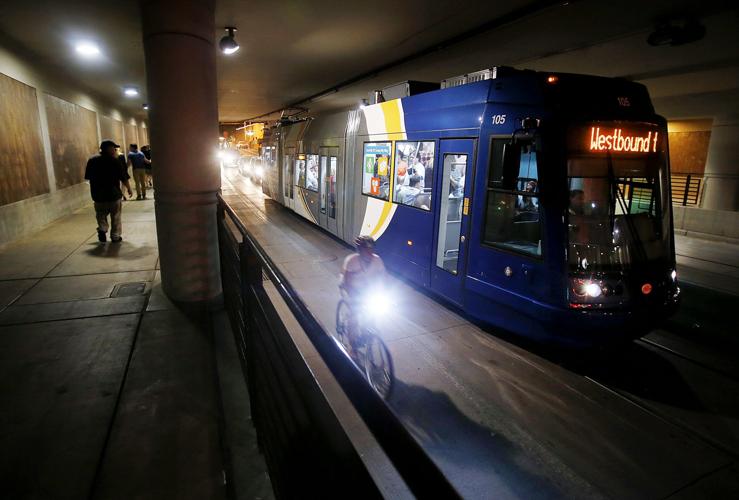
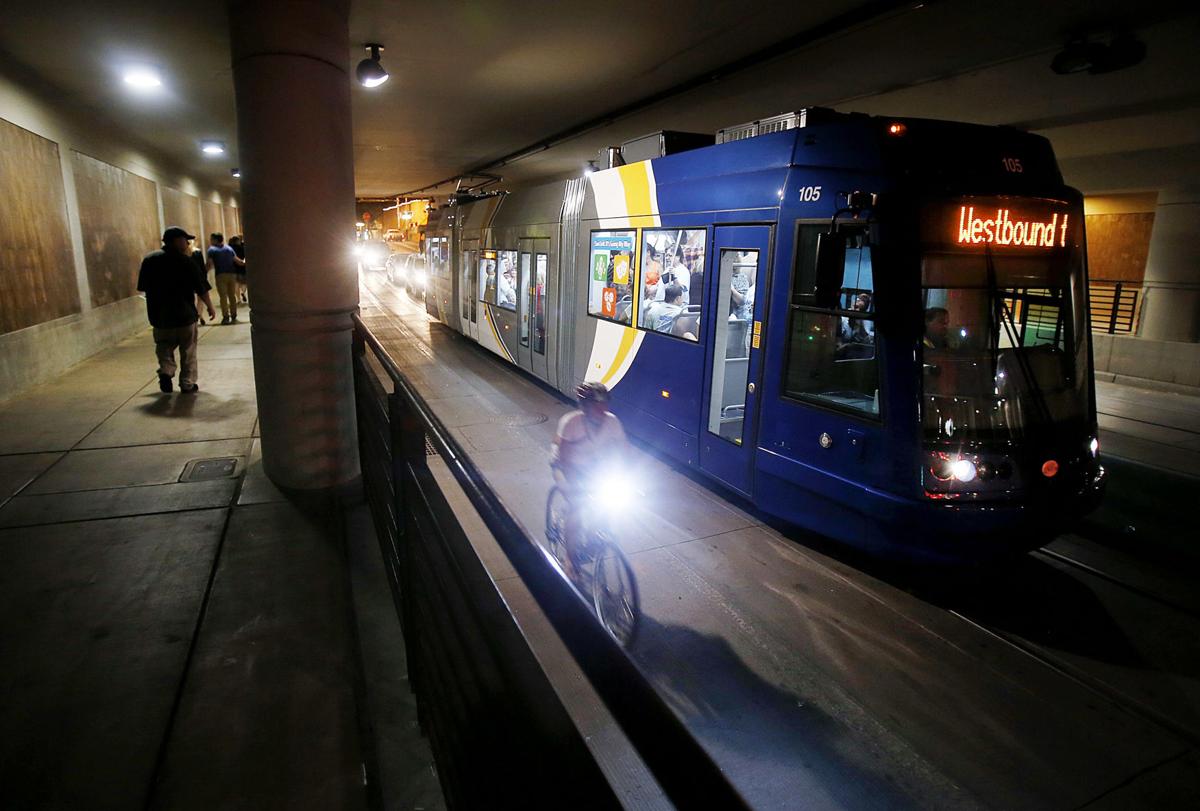
But it is unfair to just note Tucson’s failures. We have occasionally succeeded at big accomplishments. The streetcar is done and unleashed massive development. The Chuck Huckelberry Loop is a booming success. Water regularly flows in the Santa Cruz now thanks to city and county efforts.
Rio Nuevo itself has gone from a boondoggle to, on balance, a success, facilitating the redevelopment not just of the downtown area but also of East Broadway.
So we are sometimes able to carry out our big dreams. Nowadays, though, sometimes doesn’t seem good enough.
Local radio host and Menlo Park Neighborhood Association president Zach Yentzer says he senses a “restlessness” in Tucson that he didn’t sense a few years ago “for more abundant housing, better job opportunities and career mobility, and quality of life issues like addressing rising crime and homelessness.”

Zach Yentzer
At first, when I heard saw him say this on Twitter, I thought he was high on his own supply. That is, since Yentzer is restless, he surrounds himself with similarly restless people and sees it as more widespread than it really is. Plus, he acknowledged that he’s considering a run for office, so embracing “restlessness” for change could be a political platform.
Still the timing makes sense: Murders, homelessness and especially housing unaffordability are at unprecedented highs. And he isn’t alone. Lots of Tucson’s young adults lived through the shock of the Great Recession, the pandemic and today’s housing affordability crisis and want something better.
“I think there’s a lot of Tucsonans who are ready to see our community really prosper, really grow,” said Vanessa Gallego, a recycling company operator who chairs the city’s commission on climate, energy and sustainability.
She told me she’s been on the wrong side of the peaks and valleys of the housing market since 2006 and now finds herself priced out again.
“COVID lit this vision. With that change, we all started thinking about our lives, our community our spaces. We want change, and we want to change our communities.”
Do more, faster

Arizona Daily Star opinion columnist Tim Steller
So if we’re not going to be cheap, then we’ve got to be good. That means fixing our existing problems, of course.
We’re trying to fix Tucson’s roads by passing Prop. 411, the 10-year extension of a half-cent sales tax. And Mayor Regina Romero’s Million Trees Initiative is attempting to address the warming climate by planting trees to help cool Tucson’s hottest neighborhoods.
But beyond solving problems, the new deal also requires going farther and accomplishing big things.
Yentzer, who also leads the group Tucson Young Professionals, has been promoting Tucson as the “Space City of the Southwest.” He’s not the first to note our local expertise in the areas of space, optics and astronomy, of course, but he thinks we should go further than we have.
“This could revolutionize Tucson,” he said. “I’m just not sure we’re ready to embrace it.”
Justin Williams, who launched Startup Tucson and has been involved in high-tech economic development for years, intrigued me with his explanation of what really drives wealth in American cities. In short, it’s innovation, he says. We don’t get richer by catering to the parochial concerns of traditional small businesses like restaurants and tire shops, he said.
“The advocacy of a small business chamber in any given town is to lower taxes and deregulate the A-frame signs that they use to drive traffic into their businesses,” he said. “None of that matters.”
It’s education and innovation that matters for building local wealth, he said. Traditional small businesses will rise or fall with that wealth. And, believe it or not, dense development helps. Density, he said, “creates exchange of ideas,” which, along with education, drives innovation.
Tucson has, of course, created some of that by establishing the streetcar and easing the development that followed. We need to do more, faster.
Now that Tucson is expensive, the old deal is off.

