



Jerry Harris still hoists the hammer with a strong arm and brings it down confidently.
But he tries to limit the blows, as he told a gathering of artist blacksmiths at Brandi Fenton Park in January.

Arizona Daily Star columnist Tim Steller
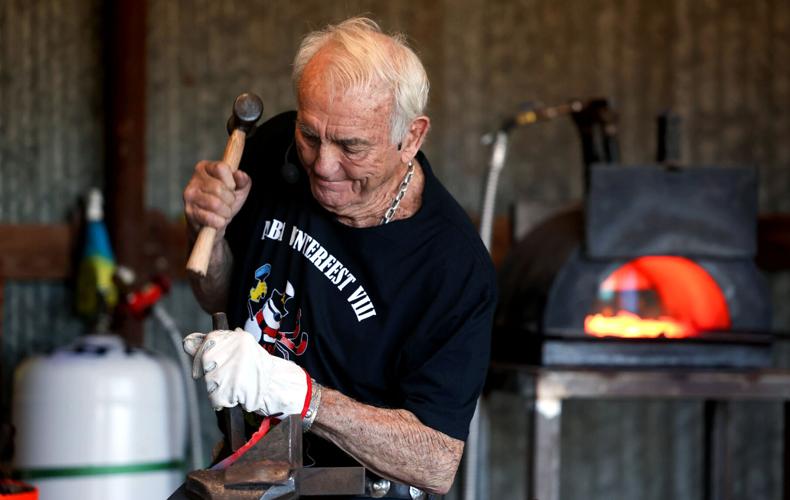
Holding up a steel hammer, Harris said, "I like this heavy one because I don't have to hit very hard to make the impression."
Harris was demonstrating how to make the wings for a sculpture of a bird, something he's done hundreds of times during decades as a metal artist in Tucson. But now he's older and no longer owns the power hammer he previously could use. The blows take a toll.
"I'm 86," Harris told the small crowd through a headset microphone. "I don't have the stamina or strength in my voice."
Still, Harris forges on, passing on the lessons he's learned to artist blacksmiths, and tooling around in his Midtown home with the metals that have defined his life.
There are maybe 300 artist blacksmiths in Arizona, said Bill Ganoe, who edits the newsletter of the Arizona Artist Blacksmiths Association, the group that organized that January event at Brandi Fenton. Maybe 25 or 30 of them do the work full-time, as Harris did over recent decades.
"He does some pretty spectacular work that most everyone recognizes as high-quality, good work," Ganoe said.

Jerry Harris, a blacksmith, leads a metal sculpture class last month during the Arizona Artist Blacksmith Association's Winterfest at Brandi Fenton Memorial Park's Sculpture Tucson.
I got to know Harris 10 or 15 years ago when he often visited the Metal Arts Village, 3230 N. Dodge Blvd. There was a coffee shop there at the time, where the Tucson Hop Shop is now, and I would go there after dropping off kids at school, and often see him there.
What I didn't get at the time was all the stories that preceded his career making sculptures out of steel. Even his wife, Sue Gilbert, hasn't tired of hearing them, as I found out when I interviewed Harris at their home last week.
"This is the man I married," Gilbert said, shaking her head in appreciation of his tales. "Holy mackerel."
South Tucson youth
Harris grew up in South Tucson in an era when horses and ranch life were a much bigger part of the local culture. His dad, Joseph "Jay" Harris, was city marshal, fire chief and played other roles in the little city. Crucially, he bought Jerry his first horse, Chester, when Jerry was just six years old.
"When I became a paper boy, delivering the Star, I delivered my paper on a horse in South Tucson," Harris said.
The streets were all dirt at the time, he recalled, except for South Fourth Avenue and South Sixth Avenue.
Those early years were Harris' entry into horse life. In high school, he started bringing metal into the picture, too.
"My best friend in high school was John Myrmo," said Harris, who graduated from Amphitheater High School in 1957. "I got out an hour before he did at Amphi. And I'd always go to the shop and watch his dad do blacksmith work."

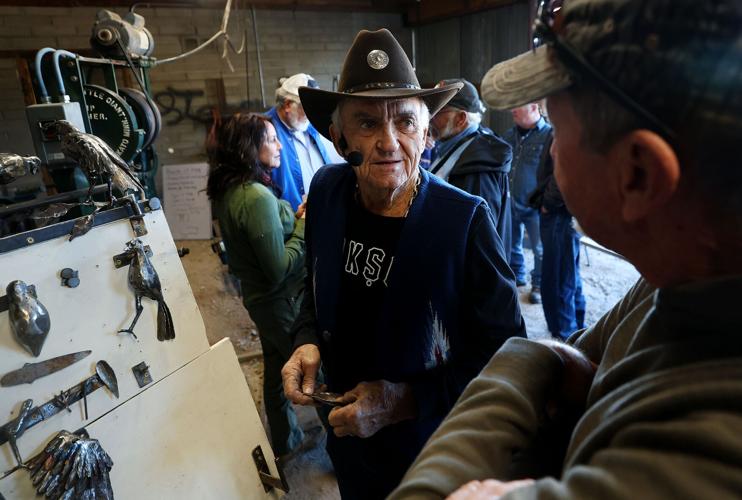
Jerry Harris, left, a blacksmith, speaks to Charlie Willsey, after a presentation last month at Arizona Artist Blacksmith Association's Winterfest.
"I was watching him take his red-hot iron and shape (metal). It's fascinating the way you can manipulate and make things," he recalled.
(Myrmo & Son, by the way, still exists at 2901 N. 1st Ave., specializing in structural steel.)
A football player, Harris spent a year at ASU, then led by the famed coach Dan Devine, but he didn't really like it. After that, he went to work at the Wood Brothers ranch, a sprawling place at the foot of Aravaipa Canyon. That's where Harris learned to shoe horses, a trade that would support him throughout his early adulthood, as well as herding, breaking horses and other cowboy skills.
Even when he spent a couple of spells as a Pinal County sheriff's deputy while, Harris recalled, he remained a farrier, too.
"When I had my patrol car, I carried my horseshoes in the patrol car," Harris said. "I'd get to a place like at Kearny that had all the horses in one spot outside of town. I just turned the radio up loud, and then I'd shoe horses. If I had a call, I'd go."
"If I could get one horse shod or two horses a week, I was making more money than I was doing as a deputy."
Playing cowboy polo
Over that period, Harris learned to play cowboy polo, what he termed the "beer" version of the "champagne" game played on vast green lawns.
"We were a little rougher and aggressive, and instead of having an open field like they would have, like a 300-yard field, our field was designed so it could be played in a standard rodeo arena."
The field is divided into five sections that the different players must stay within, and the ball is large, more or less the size of a soccer ball. Fast horses weren't prized as much as agile horses were, Harris said.
"The bigger horses, especially old, retired cutting horses, were perfect, because you can maneuver them, and they can get position, and you can actually take the ball and work," he said.

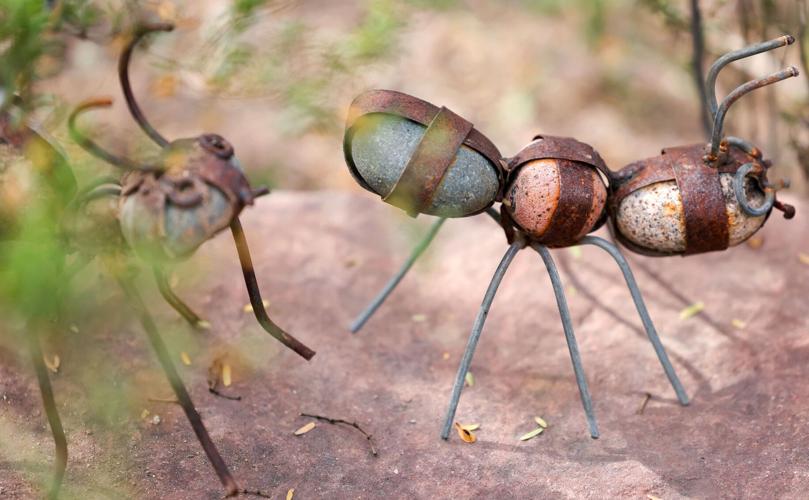
Two metal ant sculptures sit in the front yard of Jerry Harris' Tucson home.
Harris was good. A short story in the Deming, N.M., Headlight newspaper, dated Feb. 26, 1973, goes like this: "Albuquerque won first place in the recent cowboy polo tournament for which the Deming Cowboy Polo Club was the host at its arena west of Deming. Phoenix placed second, followed by Tucson and Deming. Jerry Harris of Tucson was chosen as best sportsman."
Harris moved to Colorado to play cowboy polo and worked in horseshoeing again. This time, he learned to make specialty shoes for horses needing corrective treatment. His classified advertisements in the Tucson newspapers after those years say "Horseshoeing, regular or corrective."
Eventually, he established his own blacksmithing shop on North First Avenue. Making security doors and other practical products, he started adding flourishes, like quail or agave. It caught on.
His big break came when a customer in El Encanto asked him to make a door, and Harris proposed a desert motif. She wasn't sure, Harris recalled, but liked the door so much she ordered seven of them. Then the customer, a writer, wrote a story about them in Sunset Magazine.
Harris got so busy, he said, "I actually had to hire a guy to just to make prickly pear pads and agave leaves and stuff."
Bone sculptures, then metal
The first art Harris recalled making was a sculpture of cow bones that he found while out riding sometime around 1970.
"I started building sculptures out of these old, dry, white bones," Harris said. "People thought they were clever enough to buy them."
But it wasn't until the late 1980s, after he bought a shop called The Village Blacksmith, that Harris began pouring himself into metal art. The first bird sculpture, he said, he built from the memory of an eagle that he once saw take off from Aravaipa Creek while he was riding. The sculpture had a 6 1/2-foot wingspan. Over time, he refined his technique.
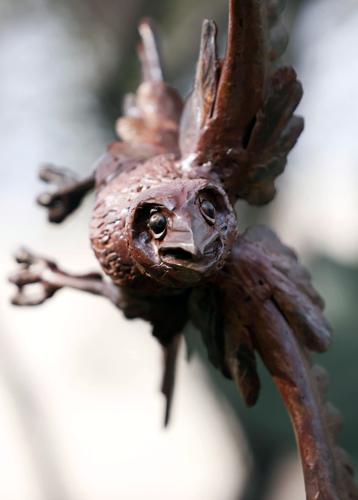
"I make all my birds life size, so I use a bird book to find the size, the length and the general conformation of the feathers," Harris told his artist audience as he pounded out feathers for a raptor on pieces of steel. "When you're finished you'll have 300 individual feathers."

A large bird sculpture by Jerry Harris is on display outside his Tucson home.
Asked by one of the audience members how long it takes him, Harris said, "Nowadays it takes me about a week. A decade ago it took me a day."
These days, Harris has also traded a horse for a three-wheeled bike. The pounding takes a toll, but the ride goes on.

