





A squadron of javelinas browses across a dusty patch of dried grass in trail-camera footage captured at sunset on Jan. 20.
If you turn up the volume and listen closely, you can hear the hum of traffic passing directly beneath the unruffled animals as they nose their way through the brush.
Since 2016, thousands of desert creatures large and small have safely crossed this six-lane stretch of North Oracle Road between Oro Valley and Catalina, thanks to the Sonoran Desert’s only dedicated highway overpass for wildlife.
The Ann Day Memorial Wildlife Crossing and its companion tunnel beneath Oracle, roughly three-quarters of a mile to the south, were built with $9 million in sales-tax revenue approved by voters in 2006 as part of the Regional Transportation Authority’s 20-year, $2 billion construction plan.
The crossings were designed to keep animals off the road, also known as Arizona Highway 77, while strengthening an important wildlife linkage between the Catalina and Tortolita mountains. The structures have worked so well that state wildlife officials recently decided they don’t need to monitor them anymore.
Arizona Game and Fish Department research biologist Colin Beach said the agency has removed all of its motion-activated trail cameras from the bridge and the tunnel.
On Thursday, he offered up a final tally after almost nine years of data collection: 27,297 individual crossings by more than 20 different animal species through the end of last year, divided almost equally between the overpass and underpass.
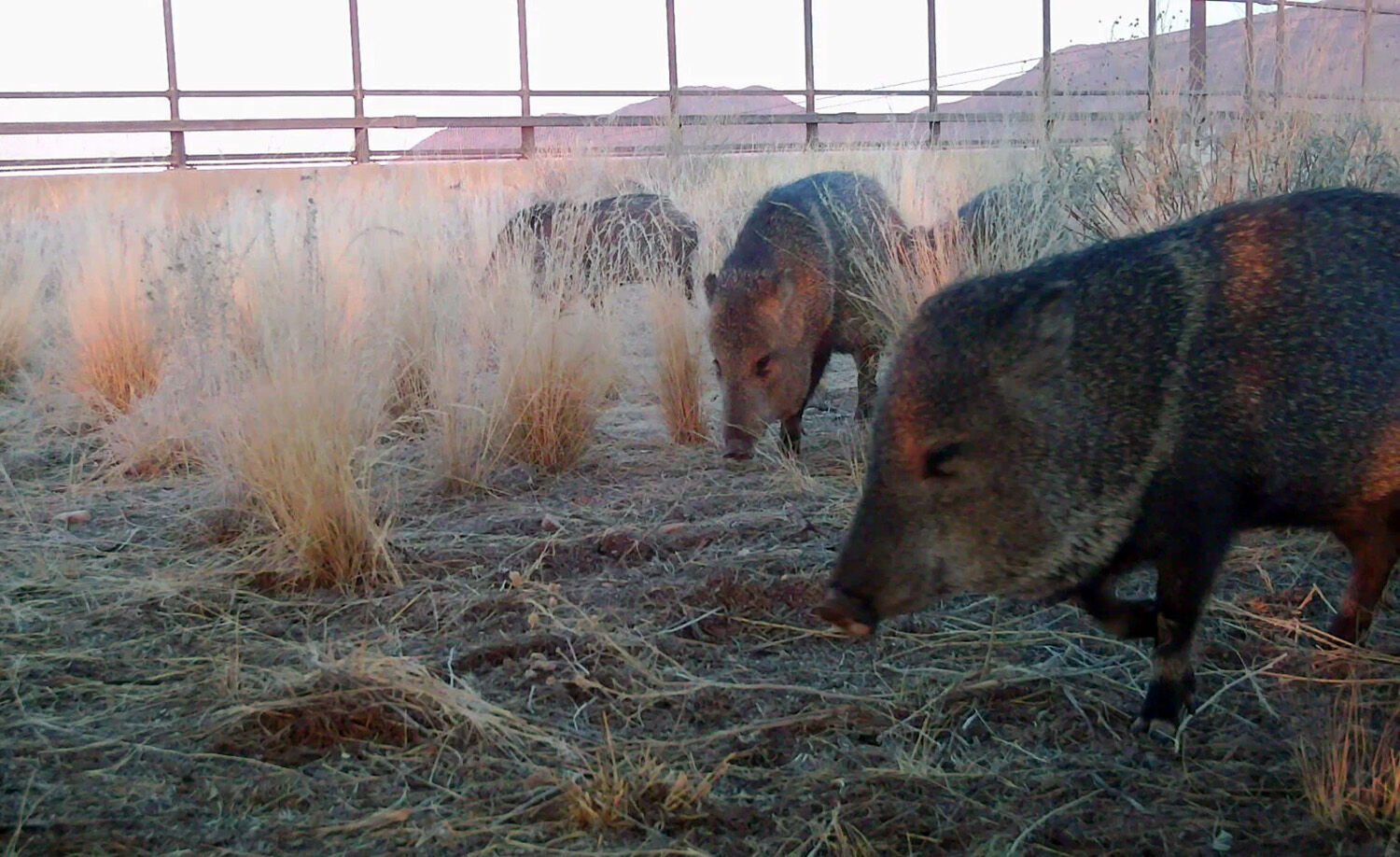
Javelinas root around the top of the Ann Day Memorial Wildlife Bridge across Oracle Road in an image captured in January by a motion-activiated trail camera.
“They’ve been very successful,” Beach said of the structures. “They pass a lot of wildlife.”
Now plans are in motion for an even more ambitious engineering feat: a wildlife bridge that could cost tens of millions of dollars and someday rank as the world’s longest, as it arches safely above six lanes of Interstate 10, two frontage roads and the Union Pacific Railroad tracks near the Avra Valley Road exit.
“That’s the next big project,” said Jessica Moreno, conservation science director for the local nonprofit Coalition for Sonoran Desert Protection. “It’s vitally important to have connected open spaces if we want to have wildlife.”
Ramping up
The first small piece of the project will soon be finished, courtesy of the Pima County Regional Flood Control District.
The Santa Cruz River Wildlife Ramp provides a gentle slope for animals that might otherwise be blocked by the steep levee wall on the river’s northeastern bank.
The bowl-shaped opening in the levee is engineered to let wildlife more easily cross the river from the Town of Marana’s nearby El Rio Preserve while still providing protection from a 100-year flood on the Santa Cruz. A pedestrian bridge carries the Chuck Huckelberry Loop over the entrance to the ramp.
Design work began in 2022, and construction got underway last fall.
Nanda Srinivasamurthy, an engineer with the Flood Control District, said he doesn’t know of another ramp quite like it anywhere in the country.
“As far as I know, this is the only one that is integrated into a levee and keeps all of the levee function while providing wildlife connectivity,” he said.

An aerial image taken May 19 shows a wildlife ramp now under construction to help animals cross a steep levee along the Santa Cruz River near the Avra Valley Road exit on Interstate 10.
The roughly $3 million project, paid for by the Flood Control District, is currently under budget and on track for completion before the end of the month, Srinivasamurthy said.
Once the ramp is done, animal activity on and around the structure will be monitored with trail cameras operated by the Coalition for Sonoran Desert Protection as part of its mission to preserve wildlife corridors.
There is a lot at stake along the stretch of land between Twin Peaks Road and Avra Valley Road, according to coalition co-executive director Kate Hotten.
“It is the only wildlife corridor left” between the Tucson Mountains and the Tortolitas, she said. If an I-10 crossing for desert bighorn sheep, deer and other animals is going to be built anywhere, it has to be there.
But it certainly won’t be easy. Hotten said the planning process alone for a wildlife crossing of such scale and complexity could last up to 5 years. Realistically, she said, a project like this might take 15 to 20 years to complete.
In the meantime, Hotten and others hope to see a temporary route for wildlife across I-10 using an abandoned railroad tunnel under the highway less than half a mile southwest of the Avra Valley Road exit. The old underpass would allow relatively safe passage from the new Santa Cruz River ramp to the frontage road and railroad tracks east of I-10 — at least until the Arizona Department of Transportation makes good on its plans to demolish the tunnel and bring the highway back down to ground level.
For the moment, though, the wildlife ramp is a pathway to nowhere. Any animals that use it will find themselves in a patch of brush and dirt surrounded by a fence that keeps them from continuing in the direction of the interstate.
Bridge toll
Money will also be a major hurdle.
Moreno said no detailed plans or cost estimates have been produced, but a wildlife bridge over the entire I-10 corridor, including the frontage roads and train tracks, would need to span a minimum of 570 feet.
By comparison, the wildlife bridge now being built across the 101 Freeway near Los Angeles will span 210 feet at a total cost of about $92 million.
Advocates for the I-10 crossing hope to convince voters to approve a sizable share of the necessary funding as part of RTA Next, the sales-tax-driven ballot initiative currently in development for future road projects in Pima County.
“The sell is, it’s the only chance we have,” Hotten said. “We have to try. We don’t have a choice.”
But the effort has already run into trouble. In the authority’s draft version of RTA Next, released in February, the budget for wildlife linkages and other environmental work was set at $25 million, half the amount recommended by the RTA’s Citizen Advisory Committee.
The coalition has been fighting to get the full $50 million restored ever since. “We would have to make some really hard choices” without it, Hotten said.
“Just as our roadway budgets incorporate landscaping and artwork, they should also include a budget for wildlife crossings,” Moreno added. “The Sonoran Desert can’t wait another 20 years.”
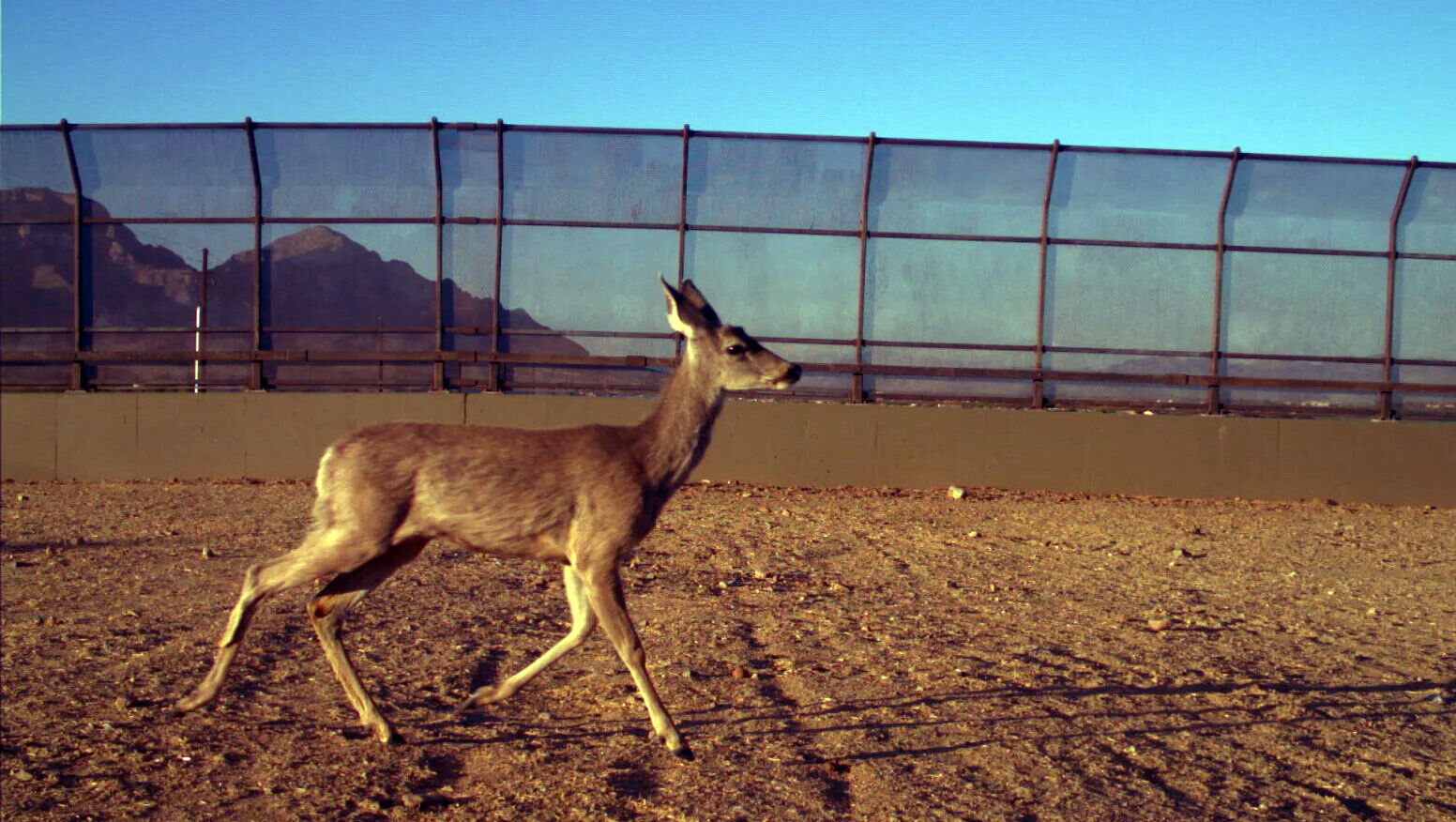
A mule deer trots across the Ann Day Memorial Wildlife Bridge shortly after it opened in 2016.
Now, a leadership shakeup at the authority is threatening to disrupt the RTA Next process and delay getting it on the ballot before March of 2026.
On Thursday, a panel of regional officials voted to fire the RTA’s long-time executive director, Farhad Moghimi, over his administration of the authority’s previous 20-year construction plan and the development of the new plan.
Wildlife bridge supporters also hope to tap funding sources beyond the local half-cent sales tax, including the Federal Highway Administration’s Wildlife Crossings Program and a new public-private fundraising effort launched by backers of the 101 Freeway wildlife bridge.
Hotten said the costs associated with projects like these don’t end with design and construction. They also require money for long-term maintenance that might not be covered by state and local transportation departments.
Crossing over
The Oracle Road crossings will likely serve as a model for whatever gets built across I-10.
Animals started crossing the dirt-covered overpass over Arizona 77 on the day it was finished, Moreno said, “and we had a tortoise trying to use it during construction.”
Beach from Arizona Game and Fish said the bridge saw 13,951 crossings and the tunnel saw 13,346 crossings during the first 8 ½ years they were in use.
Mule deer, coyotes, javelinas and bobcats are the most common commuters, though rabbits, quail, roadrunners, foxes, skunks, badgers and white-nosed coatis have also been documented.
A black bear was photographed on the overpass in 2023, and a mountain lion was recorded using the underpass in 2021 and 2022.
Beach said the crossings have also benefited plenty of smaller, slower animals that didn’t always trigger the trail cameras — things like tortoises and Gila monsters, whose size and pace make it almost impossible for them to safely cross a busy highway.
“These roads are hard barriers for some of these species,” he said.

The success of the Ann Day Memorial Wildlife Bridge across Oracle Road just south of Catalina has conservationists contemplating such an amenity someday for critters to cross Interstate 10.
Elsewhere along the wildlife linkage between the Catalinas and the Tortolitas, eight flood culverts have been upgraded with RTA funding to serve as animal underpasses — five beneath Tangerine Road between La Cholla Boulevard and Twin Peaks Road and three beneath La Cholla between Overton Road and Tangerine.
“It’s just a well-planned corridor,” Beach said.
And it got even better in 2023, when the last remaining gaps were closed in the fencing that keeps animals off of Oracle and funnels them to the two crossings there.
“We have hardly seen any roadkill since then,” Moreno said.
Late last month, Oro Valley Mayor Joe Winfield joined members of the Coalition for Sonoran Desert Protection at the town’s Big Wash Trailhead to unveil a new interpretive sign highlighting the movement of desert wildlife and the road crossings that help make it possible.
“We know the Oracle Road crossings reduced animal-vehicle collisions and re-connected two mountain ranges divided by a six-lane highway,” Moreno said in honor of the occasion. “We are delighted to show people that the project continues to be a resounding success.”

