


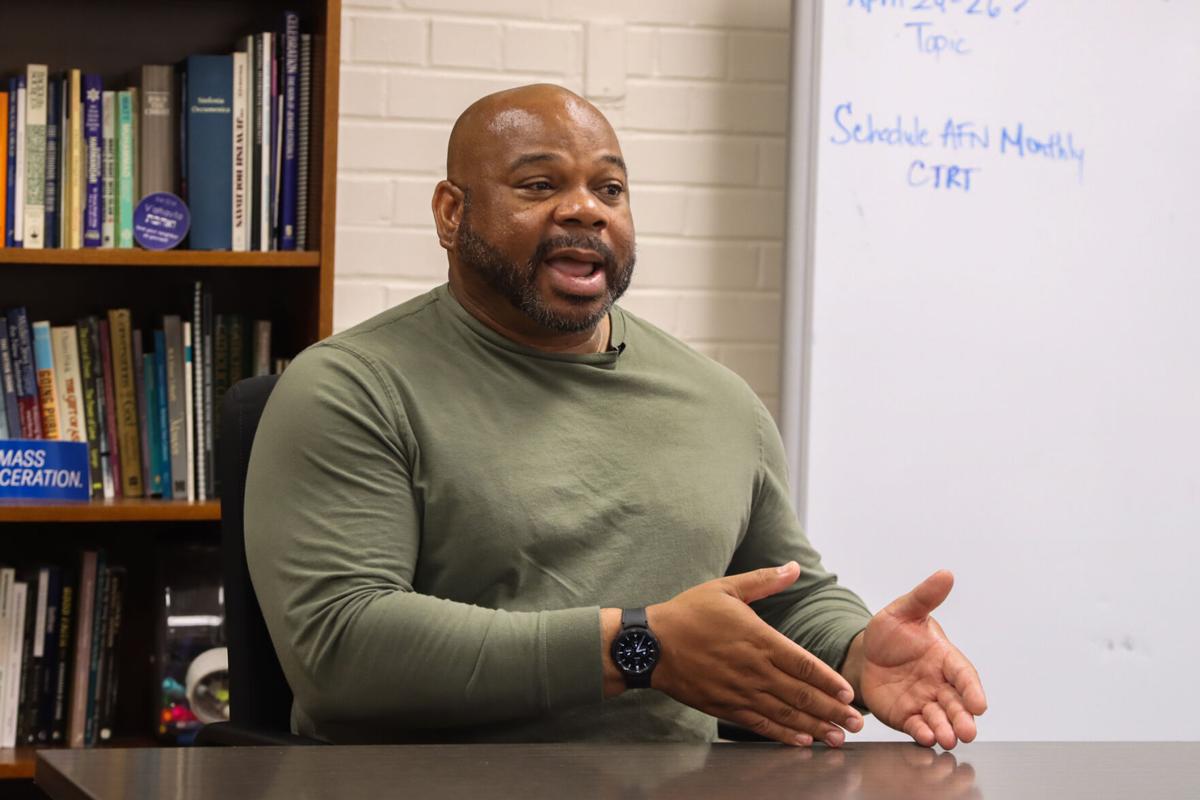
PHOENIX — Drayton Witt was stabbed 73 times and nearly killed while imprisoned by the state in Winslow before he was exonerated.
Now, state lawmakers are deciding whether he and others who were wrongly convicted should be entitled to compensation from taxpayers.
A proposal tucked into the proposed state budget would entitle Witt to seek financial relief equal to twice the median income for each of the 12 years he was locked up.
The measure written by Gilbert Republican Rep. Khyl Powell would also provide counseling and job training.
And it would preclude the state from seeking to reduce the payments by what was paid to house and feed Witt in prison.
If the measure becomes law, Arizona would join more than three dozen states that have enacted similar programs.
Powell said the aim is to make sure the state is accountable.
“If you take something from somebody that you can’t give back, how do you measure what you’ve taken?’’ he asked colleagues.
“It is a bill for erroneous convictions, compensation to those whose lives have been interrupted, disturbed, injured, in ways none of us could imagine,’’ he said. “All we’re suggesting here is for the state of Arizona to take full accountability for their mistakes.’’
And mistakes do get made, Powell said.
“I have not yet met an institution that’s perfect because it’s run or managed by imperfect human beings,’’ he said.
Witt said the financial compensation and training would help.
He said he started a small painting company since being freed in 2012, but it hasn’t been easy to rebuild his life.
“I would lose numerous jobs on a daily basis just simply from a Google search’’ which turned up his conviction, Witt told lawmakers.
Still, he said, it’s not simply about compensation.
“It’s more about integrity, holding people accountable,’’ Witt continued.
“At one point in time I voted for somebody to be put in a position of power to look out for my best interests,’’ he said. “And, instead, those people sent me up the river to die.’’
Khalil Rushdan spent 15 1/2 years behind bars in Arizona for a murder conviction for which he was exonerate.
While supporting the bill, he told lawmakers there are just some things that can’t be fixed with money.
“I lost a number of family members, wasn’t able to raise my daughter who was 6 years old when I went in,’’ he said. “Eight months after I was released, I ended up losing my mom,’’ after being able to see her just four times, Rushdan said.
“I’m still going through the healing process,’’ he said.
The payments wouldn’t be automatic. The legislation spells out that, in order to be considered for compensation, one of several things would have to happen.
One would be a pardon — but only one based on innocence.
Also eligible would be those whose convictions were reversed or vacated and the charges were dismissed or the person was found not guilty on retrial.
It also would apply to what is known in the law as an “Alford plea.’’
That’s where a defendant agrees to plead guilty despite maintaining innocence, but acknowledging that the prosecution has enough evidence to likely obtain a conviction. A defendant can take that plea to avoid a potentially harsher sentence if found guilty.
To deal with that, the legislation says a confession or admission of guilt in the original case cannot be used to charge the person with perjury.
Compensation would be 200% of median household income for each year incarcerated,, though claimants could request more. They also could get reasonable attorneys’ fees and costs of up to $25,000 and up to $100,000 for “reintegrative services and mental and physical health care cost incurred’’ between the time of release and the entry of a court judgment.
The measure also includes up to 52 hours of mental health treatment within 12 months of a court order at a rate of $250 an hour.
It also would offer up to 120 credit hours at any college, vocational school or trade school. Powell said that in particular is justified.
“Their absence of being in the community for 15 or 20 years may have injured their ability to provide for themselves,’’ he said. “So now they need additional training.’’
The bill also provides for up to four financial planning or literacy classes within the first year.
“We provide outlets for them to be fully restituted and be able to recover so that they then can become a productive member of society,’’ Powell said.
All that comes at a cost.
Legislative analysts said there have been 24 exonerations in Arizona since 1989, with an average time behind bars of 5.6 years. Assuming just 20% of those exonerated in that time period submit claims, that’s a one-time cost of $4.5 million.
That report also figures, based on historical averages, the annual cost going forward would be about $641,000.
No one spoke against the measure when it was first proposed earlier this legislative session. It now is being considered for inclusion as part of a final budget package.

