

PHOENIX — Arizona lawmakers are one vote away from adopting legislation to allow lawsuits against individual teachers by those who contend they are teaching or promoting antisemitism.
House Bill 2867 would create a first-of-its-kind law in Arizona that would make teachers personally liable for any financial damages won by the people who sue.
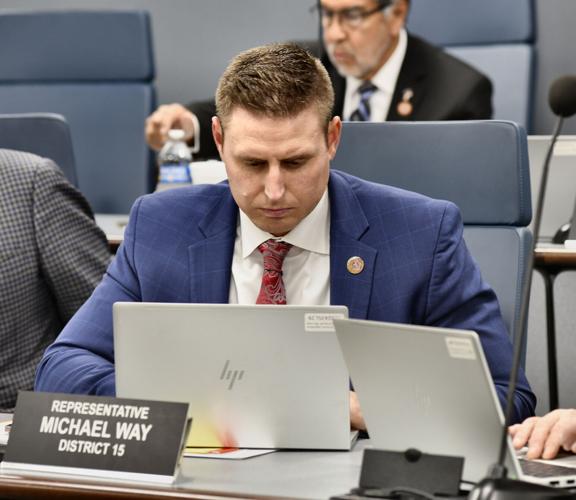
Rep. Michael Way said he proposed the legislation in response to a series of what he said are antisemitic incidents, especially following the October 2023 attack on Israel by Hamas that left more than 1,000 dead and resulted in hostages being seized.
The Queen Creek Republican particularly singled out the University of Arizona and Arizona State University, contending teachers were promoting antisemitic ideas, including giving students extra credit to participate in demonstrations against Israel. He said he also has “an inbox full of examples’’ of antisemitic incidents in public schools including “propaganda’’ on classroom walls.

Rep. Michael Way
But his measure, which has been approved by the House and awaits action by the full Senate, has run into opposition from lawmakers who say it is overly broad.
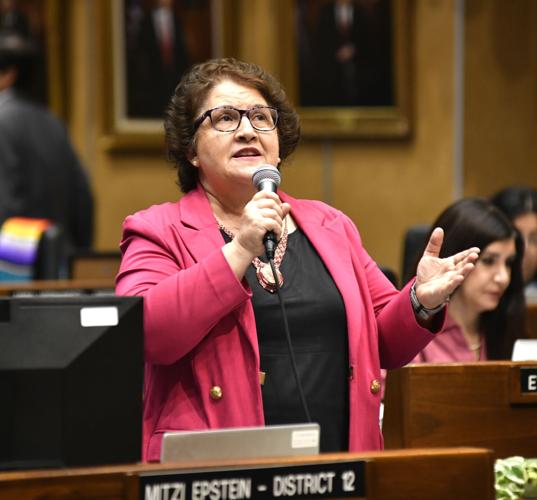
Tempe Democratic Sen. Mitzi Epstein said it improperly conflates criticism of Israel and its policies — including how it is conducting the war in Gaza — with antisemitism.
At least 51,000 people have been killed in the 18 months since the Gaza war began, according to unverifiable numbers from the Hamas-run Gaza Ministry of Health.

Sen. Mitzi Epstein
Marisol Garcia, president of the Arizona Education Association, has a concern about the process the legislation would set up.
She said HB 2867 bypasses the normal process that parents of public school students can use if they are concerned about something teachers have said or done.
That normally starts with seeking a meeting with school officials, she said. It ultimately could wind up with a teacher being disciplined, after an investigation, by the state Board of Education.
But under this proposal, Garcia said, “People could go straight from an accusation to a lawsuit,’’ putting the assets of teachers at risk for what might simply be a misunderstanding by a student of something heard in the classroom.
The measure cleared the House on a 38-20 margin. But it squeaked out of the Senate Education Committee on a 4-3 vote, raising questions of whether, as written, it goes too far — and whether it can get the 16 votes necessary to clear the Senate, where a vote is slated for later this month.
Way told lawmakers this all started with a communication he got from Michael Goldstein, one of his constituents.
“He and his wife explained they had been studying the Islamic and antisemitic infiltration that has been happening into American schools, both at the K-12 and higher education levels, and their indoctrination of American students for many years,’’ Way said.
That was exacerbated, he said, by demonstrations by Hamas supporters after the October 2023 attack on Israel and the response of the Israeli government in moving troops into Gaza to free hostages and eradicate the militant group.
“We watched as professors and students alike supported the efforts of this terrorist organization,’’ Way said. That led to a legislative hearing that December, where there was a consensus the Legislature should do something.
Epstein said she does not doubt there has been a spurt of anti-Israeli activity, at least on college campuses. And she said she agrees with a statement by one witness that hate against Jews does not end with Jews.
But she questioned the narrow focus of this measure.
“The hate that begins with (targeting) African-Americans never ends with African-Americans,’’ Epstein said. “The hate that begins with (targeting) people with disabilities never ends with people with disabilities. The hate that begins with (targeting) the LGBTQ community never ends with the LBGTQ community.’’
Way said he didn’t disagree. But he said his measure is crucial because antisemitism is an issue right now.
“Why hold this issue hostage to other issues?’’ Way asked.
Epstein was unconvinced. She suggested to Way that he agree to alter his legislation to include other groups who might be subject to hate speech and actions.
“I’d have to look at the language being proposed,’’ he responded. But Way did not respond to an inquiry by Capitol Media Services asking him if changes are needed.
All that still leaves the issue of whether the measure’s language targeting the teaching and promotion of antisemitism is in fact an effort to silence those who are critical of Israel.
“Fighting for the liberation of Palestinian people is not antisemitic,’’ said Evan Silverberg, an officer for Students for Justice in Palestine at ASU and, he said, a Jew.
“In fact, fighting against occupation, discrimination and genocide is perhaps the most Jewish thing that I know,’’ he told the Senate Education Committee. “Judaism and Zionism are not the same thing,’’ Silverberg said, referring to the movement that started in the 19th century to create a Jewish homeland in what was at the time known as Palestine and, more recently, to protect the Jewish state established in 1948.
But Beverly Goldstein, the wife of Michael, who first raised the issue, told lawmakers she sees it through a different lens.
She said her mother survived Auschwitz and lived through medical experiments conducted by Nazi doctor Josef Mengele. She said she also have family members in Israel who took cover in bomb shelters to survive the missiles that have been lobbed into Israel by Hamas.
“I feel like me and my family are being hunted down every day,’’ she said. “I have to live with this fear every day of my life.”
She lays at least part of the blame on what is happening in Arizona, saying there are 11 student organizations at ASU “that either are directly Palestinian or share campus events with Palestinian organizations.’’
“They are all anti-Jewish and anti-Israel,’’ Goldstein said.
She also said there have been “ongoing incidents of antisemitism on the U of A campus.”
Epstein told Goldstein she is sympathetic to the concerns. “The intention to fight antisemitism is noble,’’ she said.
“But, along the way, this bill would stop protests against something another country does, in this case, Israel,’’ Epstein continued. “To me, it’s awfully important that we do not quell free speech that’s critical of another country.’’
Marilyn Rodriguez, lobbying for the American Civil Liberties Union of Arizona, told lawmakers her organization sees the legislation as an extension of what she called President Donald Trump’s “nationwide attack on K-12 education and universities.’’
She pointed to the “unlawful arrest’’ in March by Immigration and Customs Enforcement of Mahmoud Khalil, a permanent legal resident, because of his role in the protests at Columbia University. And she said the Department of Justice also has launched investigations at 60 schools where students protested against Palestinian deaths.
“The federal government is attempting a full-scale assault on free speech on college campuses,’’ Rodriguez said. “And HB 2867 will make it easier for them to do it.’’
She called the targeting of criticism of Israel “the new McCarthyism’’ designed to weed out those not sufficiently loyal to the administration or its policies in the Middle East.
The legislation awaiting Senate action does not bar individuals from discussing or using instructional materials as part of a course about the history of Jews, Judaism or the state of Israel. It also includes more generic language saying it does not interfere with any rights individuals have under the state or federal constitutions. Rodriguez, however, said the law still could chill speech on these subjects, especially considering the personal financial risk.
“Teachers, administrators, professors and speakers would fear the possibility of lawsuits if a classroom discussion veers off course or a student expresses opinions that other students consider improper criticism of Israel,’’ she said.
Chandler Republican Sen. J.D. Mesnard, who voted for the bill in committee, said those concerns are unwarranted.
“I oppose legislation that tries to crack down on hate because it is a moving target and open to interpretation,’’ Mesnard said. But he said he doesn’t see anything in the legislation that shuts down speech.
“I do see where we prevent folks from inciting ... which is not First Amendment protected speech,’’ Mesnard said. He said no one has shown him any specific provision that runs afoul of constitutional rights.
Michael Goldstein, the attorney who initiated the legislation, said fears of litigation are overblown. He told lawmakers there is a “high burden’’ to maintain such a legal complaint.
“Nobody’s going to run to an attorney, an attorney’s going to take a case, without studying the facts of the case,’’ he said. More to the point, Goldstein said, a lawyer will look at the facts, compare them to what the law says is illegal, and determine if the case is winnable — especially an attorney who is taking the case on a fee-contingent basis, meaning the only way to collect a legal fee is to win.
Goldstein also said the measure provides a legal option for victims of antisemitism given what’s happening in Washington, D.C. now. He said the president is dismantling the U.S. Department of Education, meaning fewer people employed by the federal government who otherwise would be able to handle complaints by students that their civil rights were being violated.
Another issue is where to draw the line between what’s constitutionally protected and what would run afoul of the law.
The measure is built around a definition of anti-semitism that came from the International Holocaust Remembrance Alliance in 2016 and was adopted by the U.S. State Department. It specifically includes “the contemporary examples of anti-semitism identified in the adopted definition.’’
Examples include justifying the killing of Jews in the name of a radical ideology or an extremist view of religion. Also included is denying the intentional nature of the genocide of Jews at the hands of the Nazis during World War II. It also covers drawing comparisons of contemporary Israeli policy to that of the Nazis, as well as making “stereotypical allegations about Jews” collectively.
No date has been set for Senate debate.

