

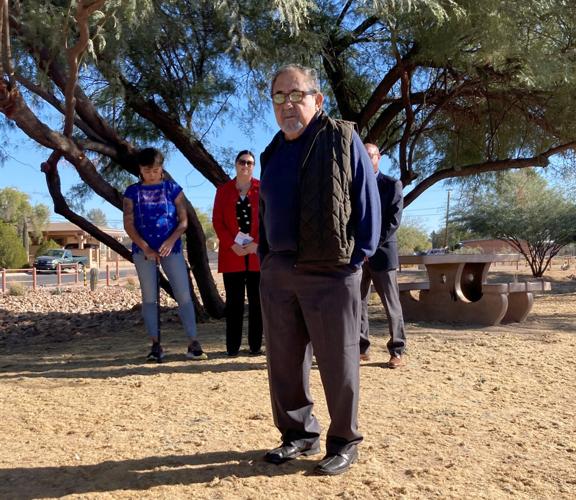


On the shortest day of this winter, just before Christmas, U.S. Rep. Raúl Grijalva gathered people on Tucson’s far south side to celebrate funding a new storm drain, of all things.
As a member of Congress, he had gotten $1.2 million in federal money to improve the drainage that flows off of Tucson International Airport and into the neighborhoods across South Nogales Highway, called Barrio Nopal and Elvira.
“It’s a project that I think is under the radar,” Grijalva said, with local officials and a few cameras gathered around. “’It’s a flood control project — what’s the big deal?’ The big deal is it’s an investment in our community. The big deal is it’s restoration and not fundamentally changing the face of the community, and it’s about safety and protection.”
It was his second event of the week celebrating funding he obtained as a member of Congress for his district. Two days before, he went to the Tucson Indian Center and announced $588,059 in federal funding for renovating and upgrading the center.
Earmarks are back. The once-maligned method for steering federal money to local projects returned to Congress in 2021, with new safeguards in place to minimize waste and corruption. Now the fruits are starting to appear across the landscape.
According to Government Accountability Office records, in fiscal years 2022 and 2023, Grijalva won about $21 million for projects in his district — though some of those requests were shared with other senators or representatives.
That wasn’t particularly high. Former Arizona Rep. Ann Kirkpatrick won $24,672,918 in funding, some of it in concert with other members of Congress, during those same years.
Sen. Mark Kelly had $42,986,000 in funding approved in those two years, while Sen. Kyrsten Sinema got the thumbs up on $12,185,000 worth of projects.
But you won’t see as many signs of the return of earmarks in Republican districts, at least not yet. Up until the current session of Congress, none of Arizona’s Republican U.S. representatives requested or received funding for what is now known as “community project funding.”
"The Congressman believes Congress spends too much money and that earmarks have a long history of being a part of the problem,: said Anthony Foti, spokesman for GOP Rep. Paul Gosar. "Until spending levels are lowered, he does not want to participate in earmarks."
Now, only one Arizona Republican is requesting any funding through this new process.
Rep. Juan Ciscomani, whose district covers much of the eastern and northern part of the Tucson area as well as southeastern Arizona, has requested around $35 million in federal funding for projects in his district.
Ciscomani’s spokesman said the congressman personally vets any project he puts on his list. The biggest request: $6 million to build a new fire station and community center in the Graham County town of Pima, Arizona.
Once the current, hotly contested round of appropriations is completed, he’ll undoubtedly end up with a fraction of that approved. Grijalva said it’s common that about one project out of 10 proposed actually wins funding.
Past uproars
So we should bemoan the return of earmarks, right?

Tim Steller, metro columnist for the Arizona Daily Star
This is how $220 million was set aside to help pay for a “bridge to nowhere” in Alaska. This bridge, if it were built, would have connected Ketchikan, Alaska to Gravina Island, where the local airport is and 50 people live. Uproar led to the project being scratched.
Maybe more seriously, former U.S. Rep. Randall “Duke” Cunningham of California used earmarks to get funding for a military contractor, who repaid him with $2.4 million in kickbacks. Cunningham ended up spending years in prison but was granted a pardon by Pres. Trump as his term wound down.
Members of Congress increasingly inserted funding for projects big and small during the 1990s and into the early 2000s. Many of them were worthy, but the system was open to abuse, because they could be inserted quietly and late into appropriations bills without even the requestor’s identity being clear.
Republican members of Congress shut that earmark system down in 2011.
The thing is, federal funding for local projects didn’t go away. As Molly Reynolds, senior fellow in governance studies at The Brookings Institution, told me, these funding choices were simply made by the executive branch instead.
“Even in a period of time when Congress itself wasn’t engaging in earmarking, the money was still being spent,” she said. “The decisions about where it was being spent were being made in executive branch agencies. Members would try to influence the spending in a less transparent way.”
So, members would write to agencies, cajole them, criticize them publicly, whatever they could do to get them to fund local projects in their districts.
In 2021, both the House and Senate were under Democratic control, and they came up with new rules to make earmarks less subject to abuse.
Now, members have to list every request they make on their website. They have to certify that they have no personal stake in the projects they request. And in the House, there are limits on how many requests a member can make, as well as how much they can ask for.
Also, funding can only go to government or nonprofit entities.
“Their reputation got destroyed because of the shenanigans that members of Congress involved themselves in,” Grijalva explained after his storm-drain event. Under the new regime, he said, “It’s been effective, because we’ve been able to direct it to projects that are under the radar.”
Popping up around the area
Look over the lists of proposed spending published by the senators and representatives, and you’ll be hard-pressed to find something outrageously inappropriate.
The smallest funding request that Ciscomani made was for $82,000 for the Marana Police Department to buy a 3D scanner for crime-scene documentation. It hasn’t been approved them.
Grijalva scored $2.9 million over a four-year period for the Mission Manor Aquatic Complex here in Tucson.
Sinema’s smallest funded request was $44,000 for police equipment for the town of Wellton. Her largest: $2.7 million for electric buses in the city of Phoenix.
Kelly’s funded requests range from $105,000 to buy cardiac monitors for the Fry Fire District, to $5 million to build a new Mountain Park Health Center in Glendale.
All these funded requests add up. Nationwide, in fiscal year 2023, they amounted to $15.3 billion for about 7,200 local projects. But of course that’s relatively insignificant when the federal government spends $6 trillion, as it did that year, even though we do have $34 trillion in debt.
So, as the new earmarks start popping up around the area, we should be alert to the abuse of the new process. For example, the fact that a group or company is a non-profit doesn’t mean they don’t have a money motive.
But if it’s spending we’re worried about, we have many bigger targets than this new “community project funding.”
Get your morning recap of today's local news and read the full stories here: tucne.ws/morning

