


Environmentalists, business groups and neighborhood activists are greeting Tucson’s new climate action plan with a mix of warmth, wariness and skepticism.
Many environmentalists and community activists, probably the large majority of those commenting on the plan, said they’re glad city officials are finally taking on the problem of both local and global intensification of extreme heat, a problem they’ve been warning about for more than two decades.
They’re pleased the plan wants to transform Tucson from a car-centered, sprawling city into one more reliant on walking and transit and one using far more solar energy and driving far more electric vehicles.
But some are wary of proposed actions in the plan aimed at increasing housing densities as a way to encourage less use of gas-powered cars and to make housing more affordable. Some business groups are concerned about plan proposals they say could raise housing prices.
A University of Arizona researcher otherwise supportive of the plan, Assistant Professor Neha Gupta, warns it will be a “big lift” across our society and culture to make the plan achieve its goals of carbon neutrality, in which Tucson produces no more greenhouse gas emissions such as carbon dioxide than are captured by trees and other sources.
The City Council unanimously adopted the plan on March 7, after many months of discussion and debate among a flood of different interest groups. The plan, which a city consultant produced for $400,000, contains 24 broad strategies and more than 120 proposed individual actions involving transportation, land and energy use and infrastructure, waste reduction, and overall community resiliency to enable Tucson to adapt to warming temperatures.
Supporters say they’re particularly pleased the plan heavily focuses on helping low-income neighborhoods and those dominated by people of color adapt to the area’s worsening heat through the planting of more trees, addition of other shade structures, and creation of neighborhood-based “resilience hubs,” centers where people can go to escape very hot summer days when temperatures climb well over 100 degrees.
“The Climate Action and Adaptation Plan is a living document that secures a better future for our community,” said Vanessa Gallego, owner of a longtime Tucson recycling business and chair until very recently of the City Commission on Climate Energy and Sustainability. “This plan is equity focused and centers on the most vulnerable. This is what carries the plan as a real change maker for communities such as the south side and west side, areas known for historical disinvestment and home to frontline climate change communities.”

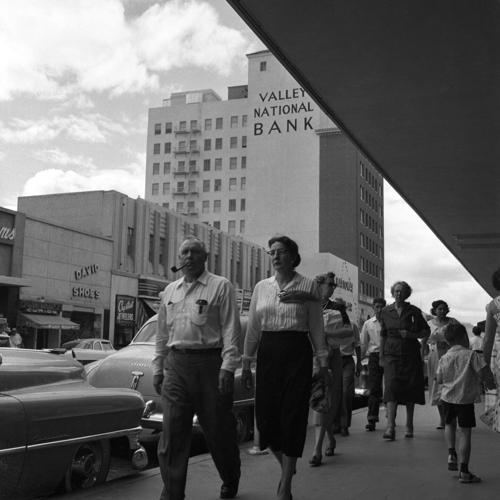
People crowd the sidewalk on Congress Street near Scott Avenue, ca. 1950s, when many retail businesses, employers, restaurants and housing was clustered at or near downtown Tucson.
Some activists also welcome the plan’s emphasis on the basic structure of car-dominated Tucson, with its goal of creating a “15-minute city.”
That vision proposes changing city zoning and other development policies to encourage higher densities, “infill” of partially developed urban areas, more affordable housing and improved access to city amenities via buses, bikes and walking.
Laura Dent, a member of the Mayor’s Climate Advisory Council, said “first and foremost, we should celebrate the thorough public input that is informing the plan,” in which the city sought comments from interest groups, advisory committees and the general public, among others.
“When many voices are represented, we create durable ideas and policy opportunities to build a cleaner future,” said Dent, coalition director for Activate 48, a nonprofit organization representing a variety of groups advocating for environmental justice and “climate resiliency.”
She also said the climate plan’s proposals to reduce use of gas-powered water heaters, stoves and clothes driers in privately owned homes and other buildings, in favor of electric appliances, and exploring the possibility of various community-run power generating options, will help address inequalities that have kept lower-income communities and communities of color from having the same access to renewable energy as the general public does.

Some alarm bells about housing density
At the same time, some neighborhood activists are wary that the plan’s advocacy of more housing density will boost not just inner-city development but property values, displacing homeowners with rising property taxes and renters with escalating rents. While some activists welcome the plan’s advocacy of loosening some zoning rules to encourage more infill development, others wonder whether that will really generate more affordable housing.
They’re also concerned denser inner-city housing will reduce that area’s already diminished supply of open space and intensify Tucson’s already problematic heat island effect with more buildings and pavement.
“Will relaxed zoning give us the increased housing that we need, especially affordable housing? I don’t think that’s going to happen,” said Raul Ramirez, vice president of the Menlo Park Neighborhood Association and a board member of the Tucson Barrio Association. “I understand supply and demand, but the development community is more interested in getting a 20% return on investment.
“Most housing will be market rate unless you offer other incentives for affordable housing. To feel that’s going to trickle down to meet the demand, I don’t think so, at least not in the next 5 to 10 years,” Ramirez said.
Ramirez said he expects the city's west and south side barrios will be targeted for new higher density development, and expressed concern that would create "more of a heat island there. Whatever development is taking place, there has to be enough open space too -- we have to sort of balance it."
as you develop more in these areas; you create more of a heat island; we have to have some sort of ; there has to be enough open space; whatever development is taking place; we have to sort of balance it; as we pushe for mor etrees being planted; too much water to get going; there’s a drought resistant type you still need to have some water source; not always 100”$ drought proof; gotta have some watersource
But to Miranda Schubert, founder of the group Tucson for Everyone, the plan represents a holistic look at the things that need to happen to break the development “status quo, or the community won’t be inhabitable in the future.”
“Our current reality is we’re perpetuating urban sprawl, spreading further and further out, forcing people to drive cars to get to where they need to go. We’re funding road widenings, too many highways,” she said.
Schubert’s group is a local chapter of a national movement known as Yes In My Backyard, as opposed to the anti-density, not in my backyard philosophy. A strong infill supporter, Schubert said: “I think the affordable housing crisis is really complicated. You can’t point to any one cause — a significant factor is that there’s just not enough housing in the places where people need it.”
Neighborhood activist Colette Altaffer, though, warns that increasing inner-city housing densities won’t stop urban sprawl. To do that would require the city to adopt urban growth boundaries limiting development outside them, she said, which voters overwhelmingly rejected in a 2000 statewide referendum.
“You can only create so much density. People will say ‘I’ve had enough’ and start to move out,” said Altaffer, who works with the group Tucson Residents for Responsive Government and the Barrio Neighborhood Coalition.
While Pima County government reined in some peripheral growth by buying open space through the Sonoran Desert Conservation Plan, “as long as people buy land and use the arguments of private property rights and supposedly have access to water,” Altaffer said, creating a truly compact city that limits sprawl won’t happen. To do that would require the city government to limit rezonings and say, “’We are not going to provide services and we are not going to annex,’” she said.

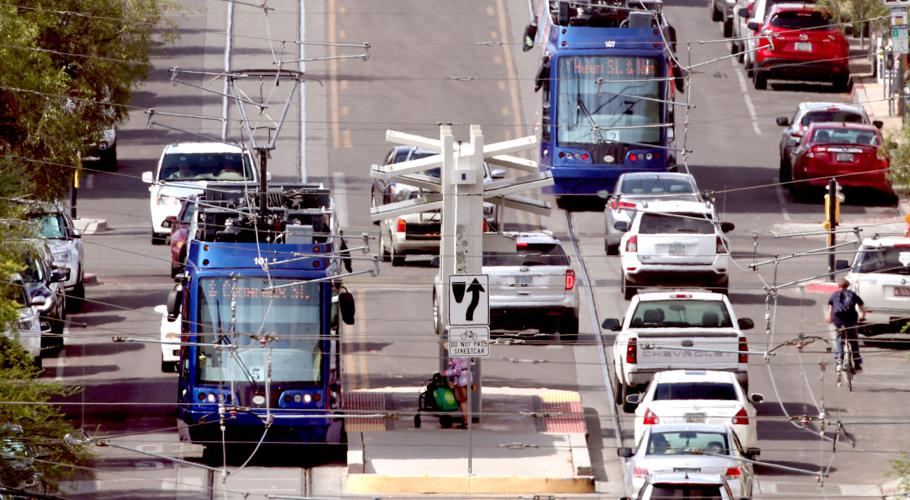
Two Sun Link streetcars pass each other along a 4th Avenue busy with vehicles, bicycles and pedestrians in 2019.
Businesses: Use incentives, not mandates
Leaders of several major business groups and companies, including Tucson Electric Power, the Southern Arizona Home Builders Association and the Tucson Metropolitan Chamber of Commerce, say they welcome the opportunity to work with city officials to help craft long-term climate fighting strategies. Unlike some national business leaders and some very conservative politicians, none question the reality of human-caused climate change and some stress the importance of reducing greenhouse gas emissions.
“Many of the Chamber’s members have acknowledged the need for policies that aim to reduce greenhouse gasses while also ensuring the economic vitality of our region’s future. There should be a balance since policies that over-regulate business in the name of climate action could do more harm than good,” wrote Chamber President and CEO Michael Guymon in a February letter to Mayor Regina Romero.
At the same time, the chamber and SAHBA expressed concerns about many of the plan’s proposed actions and policies in letters to city government.
Guymon questioned the rationale behind a plan recommendation that the city finance or give financial incentives to building owners to convert their natural gas-powered appliances to electric-powered. That’s presumably because electric-powered appliances will someday get more if not all their juice from renewable energy. Natural gas appliances generate methane, a greenhouse gas far more potent although less long-lasting than the carbon dioxide given off by burning of coal-fired electric power plants.
“Companies should have the market-based choice to install the systems that make economic and environmental sense. Many buildings with LEED certification for being “green” include gas-powered systems to power their operations,” Guymon wrote.
He also mentioned a plan policy to develop incentives, possibly including reduced permitting fees, for businesses installing solar-powered photovoltaic panels or energy storage systems.
“The city recently adopted code amendments to regulate that new commercial and multi-family development install electric-vehicle charging stations despite the industry’s request that those functions be incentivized, like this recommendation suggests. We request a firmer commitment from the city that incentives will be developed since recent history indicates the city is more interested in mandates and regulations,” Guymon wrote.
In his letter to the city, SAHBA President David Godlewski said the group has found that several proposed items will potentially raise housing costs and damage infrastructure. Among them are proposals for “climate resilient design codes,” to set standards for tree canopy, and rainwater harvesting “green infrastructure” for energy efficiency, “including but not limited to specifications for low-income weatherization, air conditioning, and enhanced filtration for wildfire smoke.”
He also cited a proposal for Tucson to collaborate with other cities to seek money to develop regional energy code standards that promote highly energy efficient and/or zero-emission buildings in new construction.
“At this point in time, we haven’t taken a position” on the overall plan, Godlewski told the Star. “We feel like there are still some unknowns, and we’re trying to get more information to know exactly whether it’s something we can support or have concerns about.”
But Ian McDowell, a vice president for Tucson-based Sundt Construction, said he supports many of the climate plan’s recommendations, as another member of the Mayoral Climate Action Advisory Council.
“Sustainability issues such as mass transit, walkability and bike paths make getting to work easier,” he said. Since having a good workforce is the most important factor in drawing prospective employers to this area, “making improvements in these areas can also serve to increase the number of people who are able to participate in the local workforce,” he said.
“Since many businesses are currently relocating from California (where climate change is deemed to be important by many residents), leadership in the climate arena could be a positive for our community,” McDowell said.
But ideally, he’d like to see “sustainability measures be incentivized for construction projects rather than mandated.”

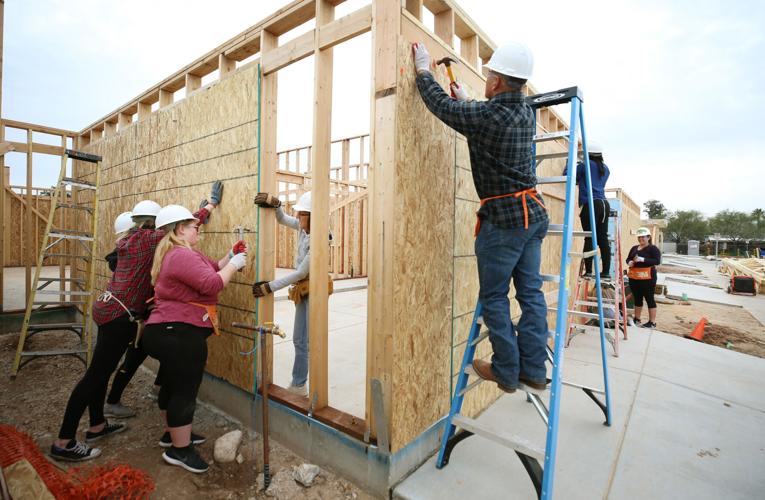
Staff and volunteers with Habitat for Humanity build in-fill homes on vacant land on East Yavapai Road in Tucson.
‘A big lift’ — can it be achieved?
Sierra Club leader Sandy Bahr, who also sits on the mayoral council, praised the plan’s focus on insuring that people most affected by warming weather in the urban core get the benefits of the various strategies it proposes. Overall, “I know there was a real effort to go out and listen to people in local communities.”
“Always, with any plan, the key to it is implementation. We’ve all seen really good plans that sit on the shelf. It’s really important and I think it’s incumbent on those of us who are advocating for plans and actions on climate, to make sure the city follows through and funds the plans,” said Bahr, director of the Sierra Club’s Grand Canyon chapter.
There’s quite a lot of federal money and provisions in the infrastructure law passed in 2021 and last year’s Inflation Reduction Act to help cities build climate-related infrastructure, whether it’s for transit or renewable energy or other things, Bahr said. It will take some time because federal officials are still developing mechanisms for allocating the huge amounts of federal money appropriated for these bills, but “I think Tucson, with this plan, will be well conditioned to take advantage of these dollars,” she said.
UA’s Gupta, another advisory council member, said she’s generally happy with the plan, adding, “It’s pretty thorough. It doesn’t seem cookie-cutter or boilerplate. They took time to incorporate local references and local studies into the plan.”
But it has the same issues seen in similar plans elsewhere — “how do we really bring our emissions all the way down to actually meet our carbon neutrality goals?” said Gupta, of UA’s Arizona Institute for Resilience. “That’s one of the hardest parts of any climate action planning. They’re throwing a lot at it. I’m not sure it will really get us where we want to go.”
The plan’s projections show that by 2030, for instance, greenhouse gas emissions across the community will be 13% higher than in 2019, even under a “business as planned” scenario in which the city adopts many of the measures called for in the new climate plan, Gupta said.
That could require the city to purchase “carbon offsets” in which Tucson would plant trees or take other restoration measures to compensate for the increased emissions, she said.
In response, Lane Mandle, chief of staff for City Manager Miguel Ortega, told the Star, “I cannot speak to emission trends but I can tell you that the city is not eliminating the possibility of carbon offsets.”
Overall, achieving carbon neutrality across an entire city “is a big lift,” Gupta said.
“It’s a very tough goal to actually achieve for cities across the world, even in places that are more political culturally aligned with these kind of goals,” she said. “It’s a big shift in terms of culture, operations and funding and can be a big lift for investment.”
But “I don’t want to come off as a naysayer. It’s an ambitious effort that we’ve gotten this far,” Gupta said.
Mayor Regina Romero and City Council passed Tucson's Climate Action and Adaptation Plan on Tuesday in a 5-0 vote. Video courtesy of City of Tucson.
Here's how to choose the right trees for your Tucson backyard
Fast-growing shade trees for your Tucson yard
UpdatedWe live in impatient times, and when we decide we want a tree in our yard we want it to grow quickly so we can enjoy its shade. There are quite a few local trees that grow fast, as well as some that are non-native. However, fast-growing trees come with some caveats.
First, while many of our native trees grow fast if watered a lot, it may not be the wisest course to take. Watering a tree too much can lead to the crown developing faster than the roots, and the wood being weaker than it should be. Both can spell problems once the tree is larger and the branches are heavier. Trees that have been over-watered can suffer wind damage and break off branches more easily. They can even be uprooted by winds and storms.
There’s also the question of water use. You may be willing to give that little tree extra water for a couple of years, but how about when it’s 30 feet tall? It’s best if the tree you plant gets used to our climate, so it can adapt and survive as it grows to full size.
I’ve put together a short list of some fast-growing trees that do well in our climate. There are some varieties in size, so hopefully you can find a tree for your space. Whichever one you choose for your yard, make sure you follow watering guidelines for trees in Tucson.
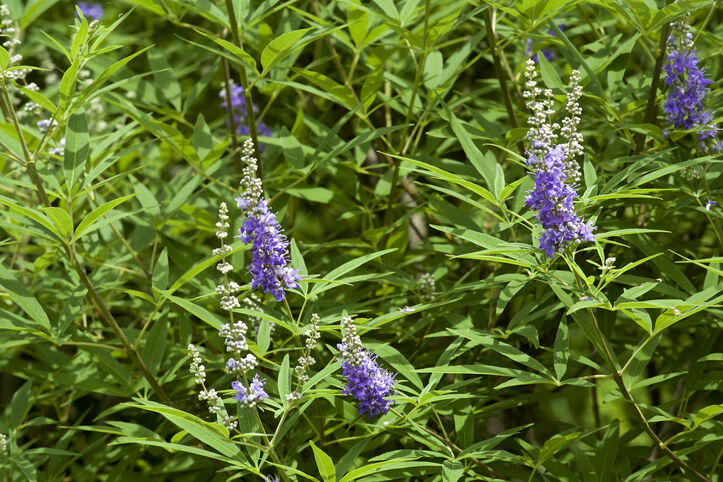
The chaste tree (Vitex agnus-castus) has lovely green foliage and attractive purple flowers. It sheds its leaves for winter.
Mesquite (Prosopis spp): We have three native species of mesquite in our area; velvet mesquite (P. velutina), screwbean mesquite (P. pubescens) and honey mesquite (P. glandulosa). The screwbean mesquite is slower growing and not as tall as the other species. Velvet and honey mesquite can grow up to 25-30 feet tall. They have a spreading shape which provides great shade, are winter-deciduous, and are quite thorny. They thrive in our desert and will not need supplemental water once established.
Desert willow (Chilopsis linearis): One of my favorite trees, desert willows are native to our riparian areas. They may need some supplemental water in hot, reflected sunny urban areas. Horticultural varieties from local growers provide a number of beautiful bloom colors, including light violet, hot pink and deep pink-red. They’re great wildlife trees and have no thorns. They are deciduous in the winter.
Arizona ash (Fraxinus velutina): This is another one of our native riparian trees. It will look best with some supplemental watering. It grows to 50 feet in height, so it will need lots of room. Don’t stake it if you plant one, and don’t trim the lower branches as the bark can become sunburned. It’s also thornless.

A palo verde in bloom against a blue-sky backdrop.
Blue palo verde (Parkinsonia florida): This large palo verde tree can grow to 30 feet tall and wide. It likes our hot summers and has gorgeous yellow flowers in the spring. Birds love it for habitat and nesting. It’s extremely drought-tolerant and can take reflected heat, but don’t forget to leave it plenty of room to grow.
Shoestring acacia (Acacia stenophylla): This lovely upright delicate tree is native to Australia. It’s drought-tolerant and a fast grower, reaching to 30 feet. It’s evergreen and thornless, and its long graceful leaves hang like tendrils. It also has creamy puffball-like flowers through the fall and winter. Make sure you move the watering to the outer margin of the dripline so that roots grow outward to stabilize the tree.
‘Red push’ pistache (Pistacia atlantica x integerrima): This horticultural hybrid grows as a single-trunked tree and does not produce nuts. Pistache trees are originally from China. This particular tree has spectacular crimson fall leaves and is winter deciduous. During the summer it has a nice thick leaf canopy. It will need some supplemental water.
Chaste tree (Vitex agnus-castus): This tree originates in Southern Europe, and is fairly drought-tolerant. It has lovely purple flowers which smell nice and attract pollinators. It has a nice shady canopy with lush green leaves, and is deciduous in the winter. It’s not very large, growing only to 15-20 feet or so, but is a very nice small shade tree. It produces some litter, but has no thorns. It will need supplemental water.
Shrubs and small trees to create privacy in your Tucson yard
UpdatedSometimes you want to make your garden a private retreat. In fact, one principle of landscape design is that a garden is defined as an enclosed space. While walls and fences can enclose your garden, many people prefer to have a more natural look, particularly if they want to blend their garden in with their surrounding landscape.
A great way to do this is to use plants to delineate your garden space. The plants I’ve chosen here are evergreen and the fast growers will give you privacy within a couple of years. The slower growers will take a few years, but are worth waiting for.
Fast growers (non-thorny)
Hopseed (Dodonaea viscosa): This shrub is native to many parts of the world, and has narrow bright green leaves. It makes for a great informal hedge, and can grow to the size of a small tree. You can prune it (but don’t shear it like a formal hedge) to the shape you want, but make sure you leave enough space for it (at least 6 feet of width and 8 feet of height).
Texas rangers (Leucophyllum spp):These plants are near-natives from the Chihuahuan desert, so they’re drought tolerant and very hardy. There are a number of species and varieties, so make sure you investigate their final size to ensure you will get the look you want. If you choose the correct plant, you will not need to prune them, and after establishment they should not need additional watering.
Quailbush (Atriplex lentiformis): This native shrub has small grayish leaves and grows quite quickly and densely. As you might guess, it is a great attractant for our desert quail as well as other birds. It needs a fair amount of space — it can grow up to 10 feet tall and wide.
Mexican bird of paradise (Caesalpinia mexicana or Erythrostemon mexicanus): These small trees are one of my favorite plants. They have beautiful deep green foliage and spectacular, tropical yellow flowers that attract all sorts of pollinators, from butterflies to hummingbirds. It’s a near-native from Mexico and hardy to 15 F. It can grow in tree-shape or shrub shape, depending on how you prune it. It can get 15 feet high, but doesn’t take up much space at ground level. It likes a bit of supplemental water.
Bush dalea (Dalea pulchra): This native plant has lovely, airy light gray-green leaves and deep purple flowers that bees love. It usually grows about 5 feet tall and wide, but can grow up to 8 feet high. Once established it will not need additional water.
Evergreen sumac (Rhus virens var. virens): This shrub can grow 10 to 15 feet tall and nearly as wide; it’s native to Arizona, New Mexico, Texas and Mexico. It naturally grows on rocky hillsides, so it can adapt to any well-draining soil. It also likes full sun, but can tolerate part shade. It’s a great wildlife plant, attracting birds and small mammals with its fruit and pollinators with its flowers.
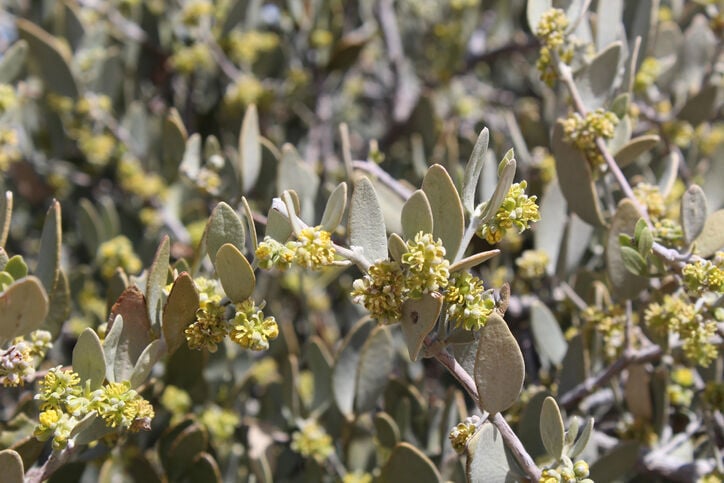
Jojoba (Simmondsia chinensis) is a native shrub that is slow-growing and very drought-tolerant.
Slower growers
Arizona rosewood (Vauquelinia californica): This beautiful native will grow to nearly 30 feet if given time. It’s a great alternative to oleander; it’s leaves and flowers are similar in form but it’s a native that’s very wildlife-friendly and is non-poisonous. More frequent regular irrigation will speed up its growth. It likes full sun, and is thornless.
Desert lavender (Hyptis or Condea emoryi): This native can be somewhat less dense, particularly if it’s planted in shade and gets leggy. It’s greyish foliage has a pleasant scent when you brush against it and is thornless, so it’s a good candidate for areas where people walk or congregate. It’s also a great habitat and food plant for native pollinators thanks to its lovely purple flowers. It can grow up to about 8 feet tall.
Jojoba (Simmondsia chinensis): A thornless, native shrub, the jojoba has beautiful oval grey-green leaves and produces nuts that we harvest for their oil. It can suffer some foliar damage in temperatures below 20 F, but the roots will usually survive (particularly in established plants). It grows into a very thick hedge up to 8 feet tall and wide.
Little leaf ash (Fraxinus greggii): This large shrub can also be grown as a small tree with appropriate pruning. As with many native slow-growers, it will grow faster with additional regular irrigation. It is thornless and has bright green leaves with grey attractive bark. It can grow up to 20 feet tall and about 10-15 feet wide.
Sugar bush (Rhus ovata): This long-lived native shrub can be grown into a small tree as well. Plants can live up to 100 years. It has lovely shiny dark green foliage and starts producing flowers after four to five years. It will grow faster in less extreme conditions, such as regular irrigation and part sun. The fruit is edible, and will attract wildlife, while the flowers are great for pollinators. It can get to 15 feet tall and wide.
Gray thorn (Ziziphus obtusifolia): As the name implies, this one is very poky, which may be an asset if you’re trying to keep people or larger animals (like deer and javelina) out of your yard. It’s native to the desert southwest. A great plant for birds and small mammals due to its dark blue berries, which are also edible to humans.
The best way to plant a tree in Tucson
UpdatedHow do you plant a tree? As the old joke goes, green end up. In Tucson, it’s a bit more complicated, and one big reason for that is caliche.
Caliche is a hardened soil layer common to desert soils. It is made up of calcium salts and minerals (mostly calcium carbonate) which are naturally present in the soil. In rainier places, minerals and salts in the soil are flushed through by rainfall. In drier climates like ours, over time these salts and minerals build up and form a hard layer (also called hardpan) anywhere from several inches to several feet thick.

Caliche is found as a hard layer in our desert soils. It can be a few inches to over a foot thick and can be found at different depths.
Anyone who’s tried to dig a hole by hand in Tucson knows what it’s like to try to dig through caliche — a pick or a caliche bar will be your best friend. For larger jobs, you may need to rent a jackhammer, or even a backhoe. It can help to soak the area before you dig; that can make breaking up the caliche a bit easier.
This hard layer makes it tough on new plants — particularly trees — because their roots won’t get the drainage or the room they need if you leave the caliche in place. In addition, if a tree’s roots end up growing shallow due to the caliche layer, the tree will be in danger of toppling once it gets taller. This would not only kill the tree, but potentially be a hazard to property and people. The University of Arizona Extension Office has a helpful handout on managing caliche.
Guidelines for tree and site selection in the Sonoran desert
- Select a native or desert-adapted tree. These trees will be more adapted to our desert soils and will cost you less in watering and maintenance. You will also want to select a healthy tree from the nursery; here are some guidelines on what to look for. If you want a mesquite or palo verde, check out this helpful guide from the University of Arizona.
- Select a good site for your tree. Avoid areas where it will cause a potential hazard, such as near power lines, near property lines, or close to your plumbing or septic system. This handout from the University of Arizona’s Extension office has some great tips, along with great examples of what not to do.
- Plant the water before you plant the tree. The Watershed Management Group has a great handout to help you ensure that your new tree has all the water it needs throughout its long life. After the initial two- to three-year establishment period, native trees can thrive on rainwater only.
Steps to planting a tree in the Tucson desert
There are steps you can take during planting to help ensure that your tree is an asset to your property and has healthy roots:
- Dig a hole that is slightly less deep than the container the tree is in, and three to five times as wide.
- To test drainage, fill the hole you just dug with water, let it drain, then fill and let it drain again. If the water takes longer than 24 hours to drain the second time, this could be due to caliche. Look for a caliche layer while digging; if you find it, you need to do one of two things:
- Dig out the caliche layer throughout the entire planting hole and discard the caliche fragments. This is a lot of work if done by hand, but if you have machinery — jackhammers or backhoes — it can go more quickly and will be worth it in the long run.
- Dig out a couple of drainage chimneys through the caliche layer next to the root ball (not under it) to help with drainage; fill these drainage holes with the same native soil you use for planting your tree.
- Remove any burlap or wires gently from around the root ball.
- When you put your tree in the hole, make sure the very top of the root ball is slightly above the grade of the rest of the hole. This is because you do not want any of the tree’s bark to be under the soil or the mulch layer.
- Back fill the hole with native soil; avoid using soil amendments with the exception of mulch or compost.
- Create a berm around the tree to hold water and allow it to infiltrate when you water your tree.
- Remove nursery stakes. These are unnecessary and are inadequate if the tree truly needs staking; use tree stakes and ties specifically for that purpose.
- Water your tree to a depth of 3 feet and then mulch with at least 2 to 3 inches of mulch. Keep the mulch a few inches away from the trunk to prevent rot.
Even native trees will need to be watered regularly for the first couple of years until they become established. Always water your tree out at the dripline (not at the trunk) to a depth of 3 feet to encourage wide and deep root growth. Use a soil probe to check how deep your watering is; this is just a pointed iron bar with a handle on one end. It’s much better to water a tree less frequently and deeply than to give it daily shallow waterings. Drip systems are best for these types of watering, but keep in mind that you will need to move the drip line and emitters outwards as the tree grows so you continue to water it at the dripline.
Where to find native trees in Tucson
Tucson Clean and Beautiful has a website called Trees for Tucson where you can order 3-foot tall trees for $25-$30. Not all the trees are native. If you’re a Trico Electric customer, you can get a discount on the Trees for Tucson site. If you are a Tucson Electric Power customer, you can participate in their Trees for You program and get discounted trees from local nurseries.

Trees sit ready to be picked up as part of Tucson Electric Power's Trees for You program at Civano Nursery, 5301 S. Houghton Road.
Other places to get native trees in Tucson include:
- Desert Survivors
- Spadefoot Nursery
- Civano Nursery
- Harlow Gardens
- Tohono Chul Retail Greenhouse
- Green Things Nursery
For more detailed information, check out these other resources:
- Planting Guidelines: Container Trees and Shrubs
- Choosing the best orange tree for your Tucson yard from the University of Arizona Extension office
- Arizona Tree Planting Guide
- Arizona Department of Forestry and Fire Management: Tree Selection and Care
- Arbor Day Foundation: How to plant your trees
- Watering Trees and Shrubs
- Landscape watering interactive guide
7 tall trees for the Tucson landscape
UpdatedA lot of our native trees are on the small size. This works very well for small backyards and patios, but sometimes you just need a tall tree to provide lots of shade and to draw your eye upward to the sky.
Tall trees are also great habitat for owls, bats, and other flying predators. Because of their size, however, you want to pick a tree that won’t need huge amounts of water during its long life.
I’ve put together a list of some tall native trees that you can consider in your landscape. Be sure to read more about them if you decide to plant them. Most of these trees are from our riparian zones, and thus will do best in a wetter, shadier area, for instance near a stream bed. If you don’t have the fortune of your own stream bed, you can create one in your yard to capture rainwater or gray water, and improve the conditions for these trees without having to water them constantly.
Some of these trees will be hard to find at regular nurseries. Check out Spadefoot Nursery and Desert Survivors Nursery to see if they have them or can procure them for you.

The Texas Ebony is a near-native tree that can grow as high as 40 feet, but it will take a long time to get there.
Honey mesquite (Prosopis glandulosa var. torreyana): This tree is native to our area, and usually grows to about 30 feet in the wild, but it can get as high as 60 feet. It’s extremely hardy (to -30 F) and can grow in full sun. If you want it to get taller, you will need to give it regular water, unless its roots can reach the water table (like near a stream). This is a wonderful tree for wildlife.
Canyon hackberry (Celtis reticulata): This is a great native habitat tree but will need to be away from walkways and buildings due to its thorny branches. It grows to 50 feet, needs a bit more water than mesquites and palo verde trees as it’s native to our canyons and riparian areas. It will survive on low water, but it won’t look its best. It’s very thorny and rather scraggly-looking when young, but will eventually grow into its shape; hardy to -20 F.
Texas ebony (Ebenopsis ebano): This near-native tree can grow as high as 40 feet, but it will take a long time to get there. It’s also quite thorny, and produces large brown pods, so it’s not a good tree to put in patios, walkways, driveways, and the like, but it’s great for low-traffic areas. It’s evergreen in Tucson, and hardy to 10-20 F (sources differ). It’s beautiful dark green foliage, creamy flowers, and great bird habitat makes up for its downsides.
Utah juniper (Juniperus osteosperma): This near native is a good evergreen tree for our area, since most of the native junipers and cypresses tend to grow above 3,500 feet. The Utah juniper is happy in the low desert, but prefers afternoon shade. It grows up to 40 feet tall, is drought tolerant and hardy to -25 F. Many conifers have been doing poorly in Arizona due to climate change, so make sure you put this in a spot where it won’t get too heat-stressed.
Mexican blue oak (Quercus oblongifolia): Most of our native oaks do best at higher elevations, but this one should be OK at our elevation as long as it has some afternoon sun. It grows to about 30 feet, so it’s one of the shorter trees on this list, but oaks are important habitat and food trees for wildlife so I wanted to include one. It will need some supplemental water, but not a lot. It’s very hardy, to 0 F.
Velvet ash (Fraxinus velutina): This native tree tends to grow in riparian zones, so it will do best with part shade and more water than other native trees. It grows to 40 feet, and is hardy to -10 F. It’s a great habitat tree for birds, butterflies, and other wildlife. It is deciduous and turns a lovely yellow color in the fall. This tree will do best at elevations near and over 3,000 feet.
Arizona sycamore (Platanus wrightii): This native can grow up to 80 feet tall and is hardy to -8 F. It’s deciduous and has beautiful fall color. It will require regular water, however, since it’s used to stream beds, so consider watering it with gray water so it gets a steady supply.
More resources:
Which trees and shrubs to plant for a lush green desert yard
UpdatedYour Tucson yard can have that lush green look you see in gardens in other climates if you choose your plants carefully — there are many drought-tolerant plants (even some natives) that will give you rich green foliage and tropical-looking colorful flowers.
Keep in mind that you will need to water these plants more often and also note that the hardiness temperatures generally indicate the temperature at which damage occurs to the foliage. It is rare for the plants listed below to die completely (to the roots) in our climate if they are healthy and well-mulched and watered. If some branches and foliage are damaged, they can be pruned back in the spring and generally recover quickly.
Lush trees for Tucson gardens
Anacacho orchid tree (Bauhinia lunarioides): This beautiful tree is native to the Chihuahuan desert and has lovely large white orchid-like flowers. It’s hardy to 15 Fahrenheit and can grow in full or partial sun (which in my experience usually means that harsh afternoon sun should be avoided). Do not plant where it will be subjected to reflected heat. It grows at a moderate rate to a small tree (about 8 feet high) and is shrubby in form.

A desert willow will attract wildlife and birds will love it for nesting. The flowers are tropical-looking and come in a variety of colors.
Desert willow (Chilopsis linearis): This fast grower is native, and can take our full sun and even reflected heat. The leaves are a lush green, and it has gorgeous orchid-like flowers in a variety of colors from white to pink to purple (depending on the cultivar). It’s hardy down to 0 Fahrenheit, and birds and hummingbirds love it.
Feather bush (Lysiloma watsonii): This lovely small tree grows to 15 feet in height. It’s native to our desert and has beautiful lush green tiny leaves that give it a feathery appearance. Its flowers are cream-colored puffy balls that bloom in late spring. It’s only hardy to 25 Fahrenheit, so make sure you put it in a warm spot in your yard.
Texas ebony (Ebenopsis ebano): This Texas native is a slow grower and has thorns, but it has beautiful lush dark green leaves and creamy yellow flowers. It’s hardy to 20 F and can take full sun.
Mexican Bird of Paradise (Erythrostemon mexicanus): This beautiful little tree can be considered a shrub; it has deep green oval leaves and warm yellow flowers that grow in clusters. It’s hardy to 15 F and does well in the sun, although in my experience it likes partial shade better. It gives lovely filtered shade thanks to its small leaves.
Silk floss tree (Ceiba speciosa): This tropical tree is native to Brazil and Argentina. As such, it requires more water than the other trees mentioned, but its unique, thorned trunk and spectacular fall flower show make it worthwhile. The flowers are similar to hibiscus, pink in color, and are 5 inches in diameter. The tree is hardy to 26 F and will tolerate drought and full sun, but will look better when watered regularly. It will need to be protected from frost when it’s small, and should be planted in a warmer area of your yard. It grows to 20-30 feet, so be sure you have lots of room for it! These can be hard to find, but Plants for the Southwest has them.

When Spanish Jesuits arrived in the late 1600s, they brought with them a variety of fruits, vegetables, grains and herbs. This pomegranate tree, at Mission Garden is a clone of an original variety grown during the time of Father Kino.
Pomegranate (Punica granatum): This mediterranean plant not only has glossy dark green leaves and unusual orange flowers, it also produces edible fruit. It’s hardy to 10 F but needs a bit more water than our natives to keep it from looking scraggly. It is deciduous, and loses all its leaves in the winter.
Lush shrubs for Tucson gardens
Arizona yellow bells (Tecoma stans): Bright yellow trumpet flowers and rich green foliage make this native a great addition to your yard. Hummingbirds love the flowers. It’s a little frost sensitive (hardy to 25 F) but will grow back if damaged. It’s a fast grower and likes full sun. There is also a variety called Orange Bells which is less cold-hardy.
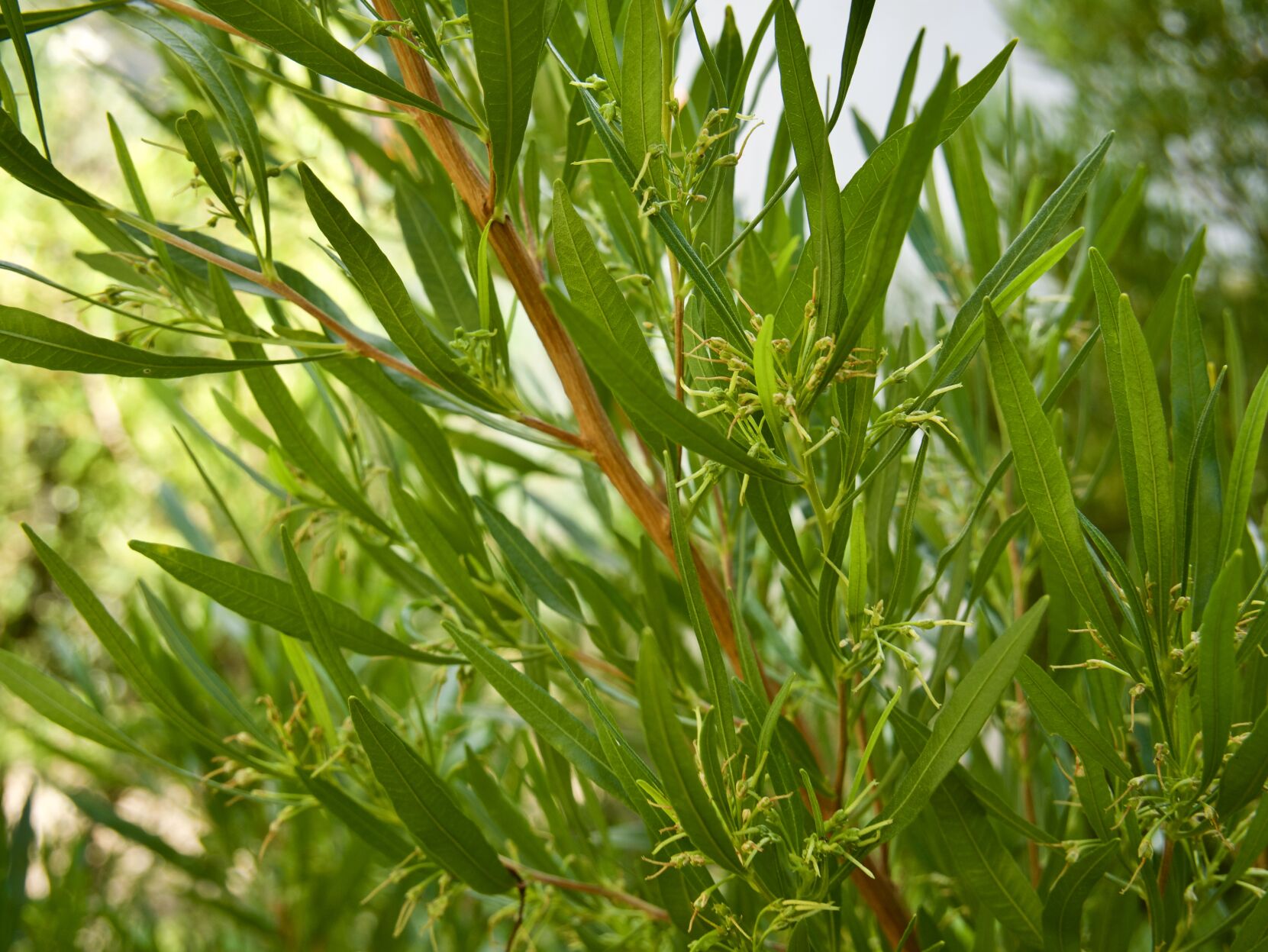
The hopseed bush is native and does very well as a lush green screening shrub.
Hopseed bush (Dodonaea viscosa): This native fast-growing bright green shrub is a great choice for an informal privacy hedge. It has a fresh green color, and female shrubs have pretty light green seed pods. Birds love these. It can handle full sun and is hardy to 15 F.

The Mexican petunia has deep violet flowers and rich green foliage. It tends to do best in partial shade.
Mexican petunia (Ruellia brittoniana; Ruellia simplex): This small shrub has dark purple flowers and medium-green leaves. It’s native to Mexico and the Southwest U.S. It’s hardy to about 28 F and will need a warm spot. It will need regular watering to look its best, particularly in summer. You can find white and pink varieties in addition to the deep purple.
Guayacan (Guaiacum coulteri): This 5-foot shrub grows very slowly, but has striking violet flowers and deep green leaves. It’s hardy to 25 F and does best in partial sun.
San Marcos hibiscus (Gossypium harknessii): Believe it or not, this is a native plant. It has light yellow flowers with red accents, and deep green leaves. It’s hardy to 25 F and doesn’t mind full sun. It can be hard to find, but Spadefoot Nursery has them from time to time, and can obtain them if requested.
Texas mountain laurel (Dermatophyllum secundiflorum): This Chihuahuan desert native is hardy to 5 F and has beautiful rounded dark green leaves. It is known for its clusters of violet, fruity-smelling flowers. It is a very slow grower, so tends to be expensive if bought in a larger size. Eventually it grows into an 8 foot shrub.
Texas olive (Cordia boissieri): This Texas and Mexico native doesn’t have the dark, lush green foliage (it’s grayish-green), but I included it because of its beautiful and plentiful white orchid-like flowers. It’s hardy to 20 F. It will require patience, as it’s a very slow grower.

Plumbago does well in shade or partial shade in Tucson and is fairly drought-tolerant. It can be supported by a trellis and provide a lovely privacy feature.
Cape Plumbago (Plumbago auriculata): This plant gets a bad rap for using too much water, but if planted in the shade and mulched it’s just as drought-tolerant as many of our natives. It has deep green foliage and attractive clusters of small tubular blue-violet flowers. There are also white varieties. I have it growing in shade on the eastern side of my house and I don’t water it any more frequently than the desert willow tree next to it. It needs a fair bit of room, as it tends to sprawl, but this can be an advantage if you want to attach it to a trellis for privacy.

Bougainvilleas come in many colors and can grow well in containers.
Bougainvillea (Bougainvillea spectabilis): Despite its large thorns, this Brazil native is a good choice for a lush garden due to its gorgeous colors and lush dark green foliage. The color actually comes from the bracts; the flowers are tiny, white and unassuming. It gives you vivid tropical colors and is safe to plant in dry, sunny exposures. There are many Bougainvillea varieties to choose from. Certain smaller varieties do well in containers. Colors run the gamut: white, yellow, apricot, hot pink, and purple. They can sprawl, but you can purchase smaller varieties. Larger varieties can be trained on a trellis and provide a backsplash of color to your garden wall. A dwarf variety called "Miss Alice" is thornless and can be grown as a groundcover of sorts. Bougainvilleas are happiest when allowed to dry out between watering, so be careful not to overwater them.

