


Twenty-four years after she whiffed on Tucson, Nora is lining up for a second crack at the Old Pueblo.
As of 10 a.m. Friday, Tropical Storm Nora was growing in the Pacific, several hundred miles west of Acapulco. Forecasters expect the storm to reach hurricane strength by Saturday night, as it spins along the west coast of mainland Mexico on its way into the Gulf of California.
The latest track from the National Hurricane Center shows Nora continuing north through the gulf toward Hermosillo, where it is expected to come ashore, once again as a tropical storm, at about 7 a.m. Wednesday.
It’s too early to say where it will go from there — or even if it will reach the capital city of Sonora, as predicted.
“There’s still quite a bit of uncertainty,” said Gary Zell, a meteorologist for the National Weather Service in Tucson. “But it is going to push a bunch of moisture up this way. We’re pretty confident about that.”

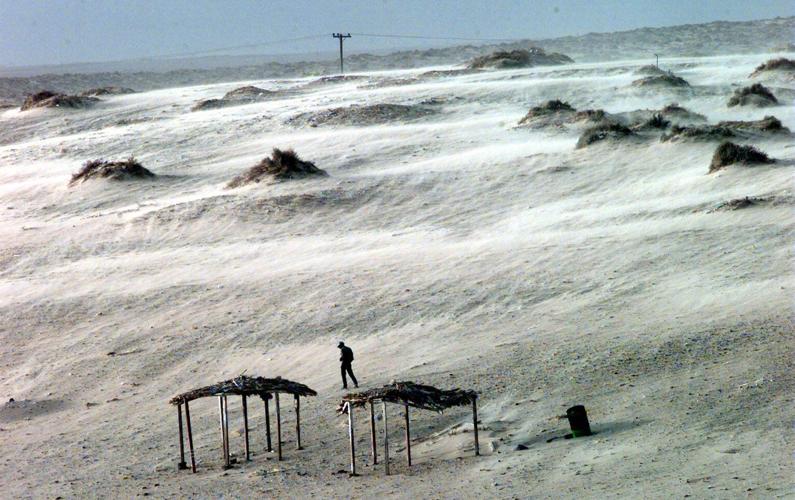
High winds blow across the desert sands of Puerto Peñasco as Hurricane Nora departed Sonora on Sept. 25, 1997. A new storm named Nora is projected to climb north up the Gulf of California early next week. Tucson is projected to see a 60% to 80% chance of showers and thunderstorms by Tuesday.
You can practically hear longtime Tucsonans rolling their eyes at that.
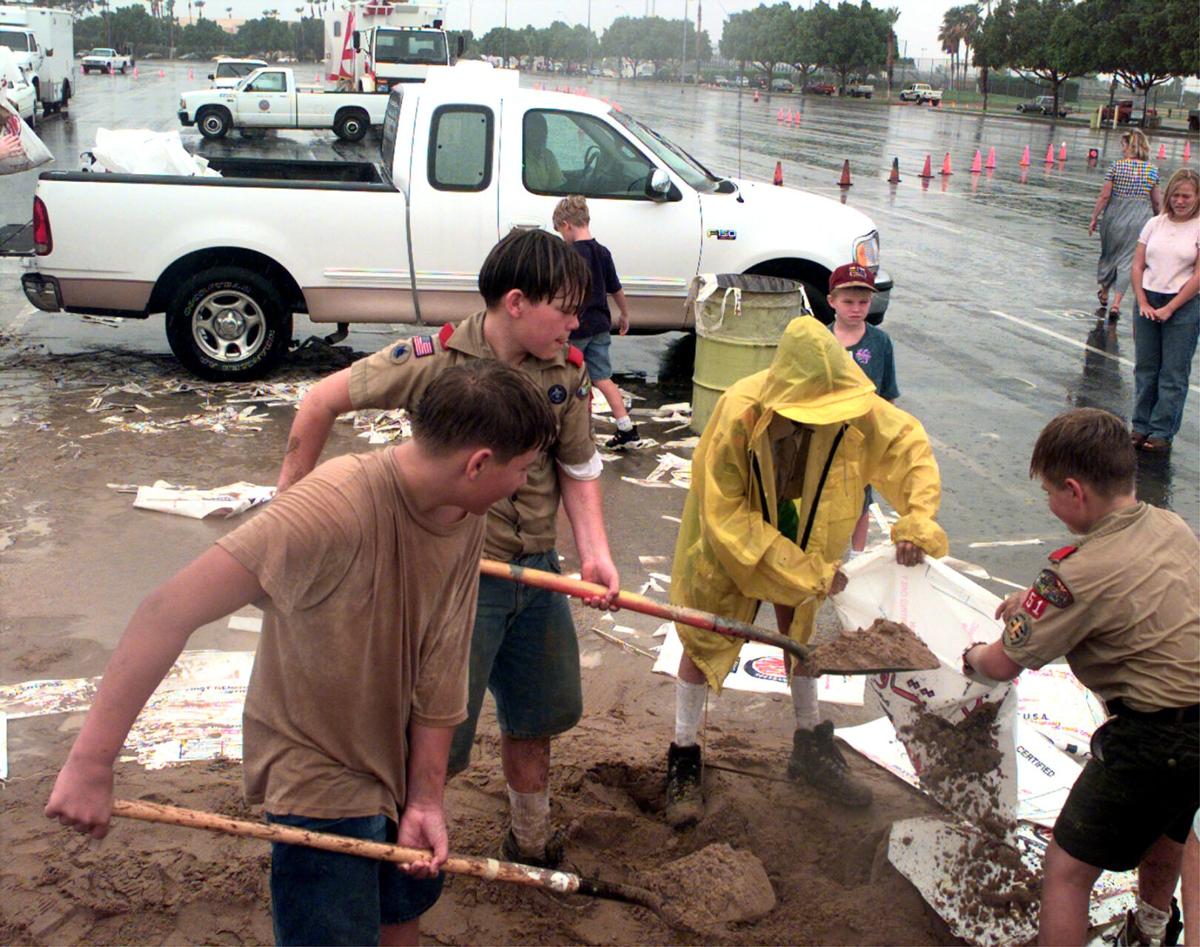
The last time a storm named Nora headed this way was in September 1997. For days in advance, local residents stacked sandbags around their homes and stocked up on emergency supplies, only to see the hurricane sputter before it ever reached southeastern Arizona.
It’s possible the same thing could happen with Nora 2.0.
Zell said tropical storms and hurricanes that enter the Gulf of California have a tendency to curl to the east into Mexico long before they reach the international border.
It’s almost impossible for Tucson to take a direct hit from a named storm, he said. This far inland, the risk from a tropical storm like Nora is flooding, not wind. “We get worse winds with our monsoons,” Zell said.

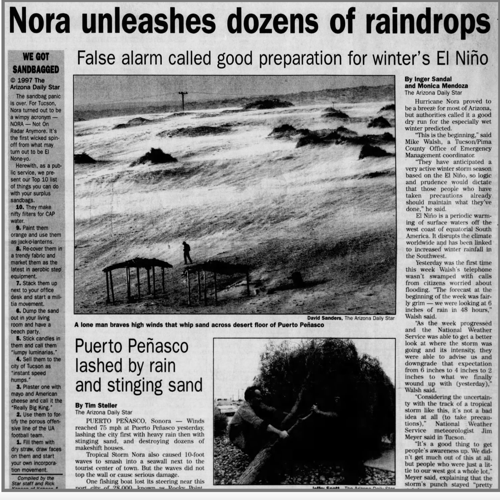
1997 headline in the Arizona Daily Star: Nora unleashes dozens of raindrops
If lots of rain is what you want, the best case scenario is for Nora to “come right up the gulf like they have it doing now,” he said.
Of course, there is also such a thing as too much moisture, which can cause the sky above Tucson to cloud over without producing much in the way of rain. Zell said heavy downpours often require a “sweet spot” of moderate moisture and sufficient sun to heat things up just enough to trigger thunderstorms to form.
Tucson will see an increased likelihood of rain starting Monday, regardless of where Nora decides to go.

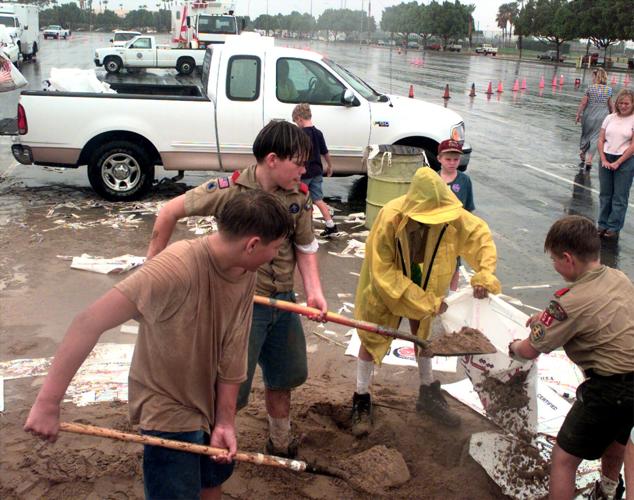
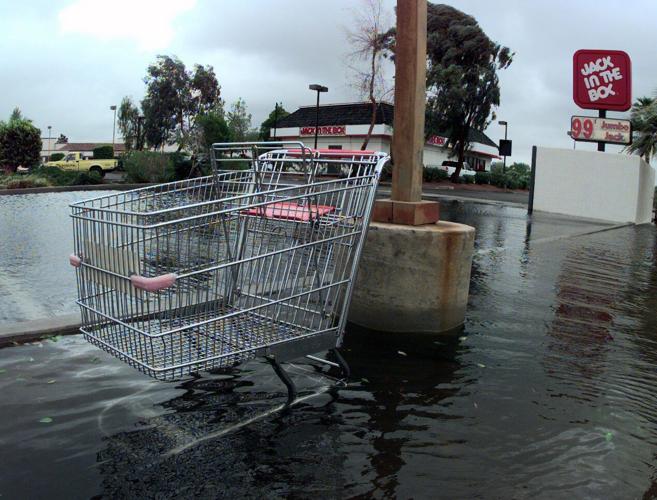
Most of the flooding that occured with Tropical Storm Nora in the Yuma area was localized to areas such as streets and parking lots.
By Tuesday, Zell said, there is a 60-80% chance of showers and thunderstorms.
Any precipitation will only add to what already ranks as Tucson’s third wettest monsoon season on record.
As of Friday, 11.86 inches of rain had fallen since June 15 at the official weather station at Tucson International Airport. Another inch and a quarter between now and Sept. 30 would vault this year’s monsoon into second place on the all-time list. Another 2 inches of rain, and 2021 would replace 1964 as the wettest monsoon ever recorded in Tucson.
Maybe Nora will help with that, or maybe it won’t. That’s the thing with trying to predict atmospheric moisture levels or the track of a hurricane more than a week out, Zell said: “I am 100% certain it will change by then.”
That’s what happened with the previous Nora. Early projections called for up to 6 inches of rain in 48 hours, but forecasters gradually reduced those numbers to 4 inches, then 2 inches and on down from there.
In the end, the non-event in ‘97 produced little more than a flood of sarcastic headlines, few drier than the one in the Star: “Nora unleashes dozens of raindrops.”
That appeared on the front page on Sept. 26, 1997, alongside a snarky list of possible uses for the community’s sudden stockpile of superfluous flood barriers. The headline on that item was, “We got sandbagged.”
Emergency management officials even got in on the act, referring to all the local preparations as “a good dry run” for some real disaster down the road.
Get it, dry run?
We’ll check back in about a week to see how many Tucsonans still think that’s funny.

