


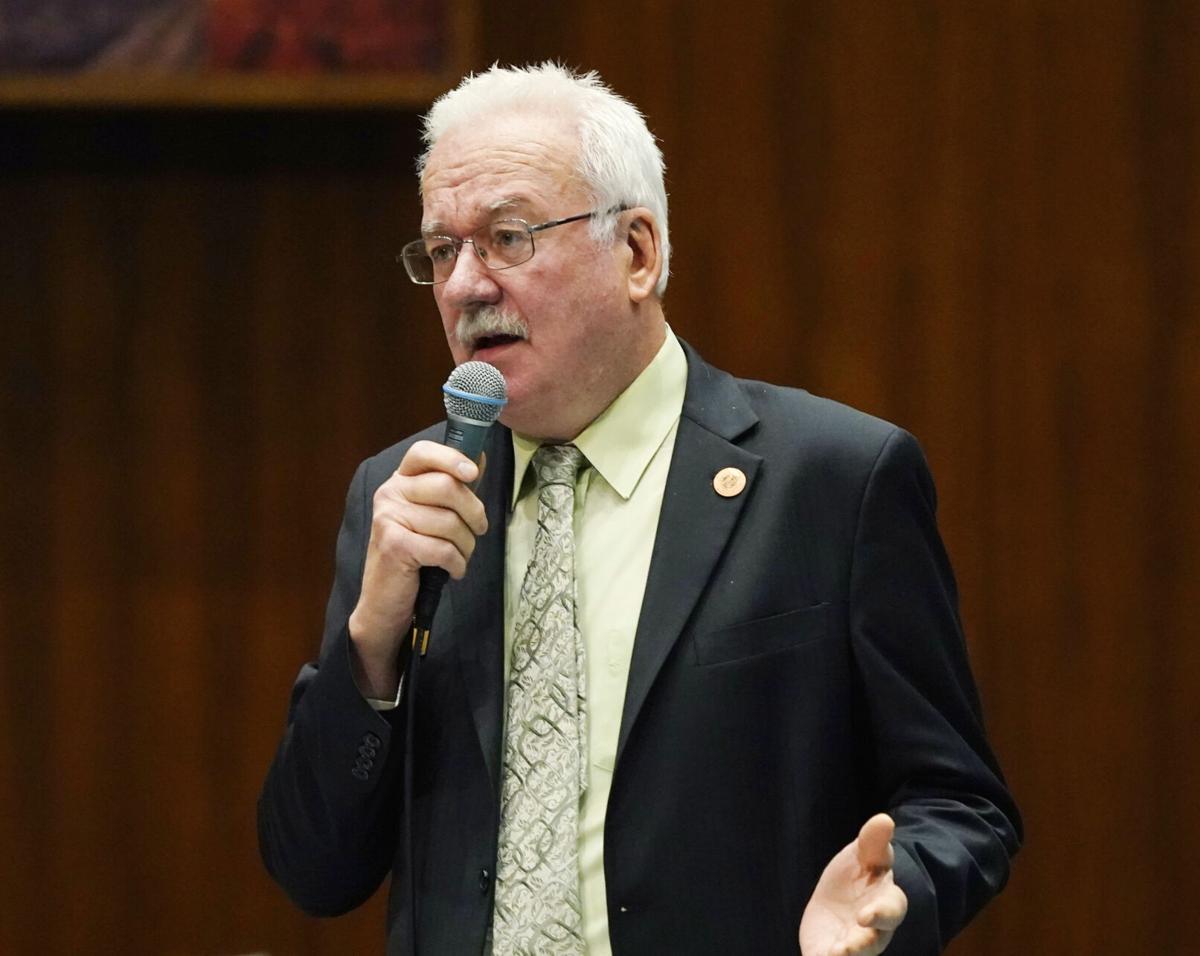
PHOENIX — A new legislative proposal would bar school employees from knowingly referring to a student by a pronoun “that differs from the pronoun that aligns with the student’s biological sex’’ regardless of the student’s preferences. Only if an employee first gets parental permission would that be permissible.
Sen. John Kavanagh, R-Fountain Hills, has introduced the proposal as Senate Bill 1001 and already plans to expand it, to close what he sees as a possible loophole in which teachers could avoid pronouns and instead address a student by the first name he, she or they prefer.
He wants state law to mandate that only a student’s given name or its variants can be used. Someone named Edward could be addressed as Eddie or Ed, but calling that student Emma or Evelyn would be breaking the law.
Kavanagh says his measure would make sure parents know if their children are identifying themselves by a gender other than the one they were assigned at birth. That would ensure the children can get the psychological treatment they may need, he said, to deal with depression and potential suicidal thoughts.
But what it’s not designed to do, he told Capitol Media Services, is make it easier for a parent, informed of a child’s gender dysphoria, to get them the medical treatment needed to match the sex assigned at birth to the gender identity.
“You’re talking to somebody who was a parent who wouldn’t let their minor child get a tattoo, much less change their gender,’’ Kavanagh said. “Those decisions need to be deferred to when an individual’s an adult and can make a mature decision.’’
His legislation comes less than a year after state lawmakers approved — and outgoing Republican Gov. Doug Ducey signed — a measure to prohibit any form of “irreversible gender reassignment surgery’’ on an individual younger than 18, even with the consent of parents.
To get the votes, proponents had to remove a provision that would have prohibited doctors from providing puberty-blocking hormones or any other hormone therapy to minors.
Ducey also signed another measure passed by the Republican-controlled Legislature spelling out that anyone assigned male gender at birth cannot participate in intramural or interscholastic sports for females, regardless of whether the student has fully transitioned.
He hasn’t heard of any such cases
Kavanagh acknowledged he has heard of no issues in Arizona schools with teachers using the “wrong’’ pronouns with students.
But he said, “It’s something that is spreading. We want to nip it in the bud.’’
The measure is a bad idea, said Jeanne Woodbury, interim executive director of Equality Arizona, a nonprofit organization that says it’s “Arizona’s power base for LGBTQ+ civic and political equity.”
“Reactionary legislators are now trying to forcibly enlist teachers into their efforts to make schools inhospitable to trans and binary students,’’ Woodbury said.
Woodbury called it “an embarrassment to good governance’’ for this to be the first measure introduced in the Senate for the 2023 session.
Kavanagh is trying to make an issue out of something that’s not problem, said Bridget Sharpe, state director of the Human Rights Campaign, a nonprofit that says it’s the nation’s largest LGBTQ advocacy organization.
“All that happens at the end of the day is that the kids feel ostracized,’’ Sharpe said. She said it also undermines the ability of trans students to believe they have “a trusted person at school’’ with whom they can speak.
“It’s really an attempt, we’ve seen it nationwide, to just kind of demonize these kids and saying that their pronouns don’t matter,’’ she said.
Kavanagh pointed out that his legislation would not preclude a teacher or other school employee from referring to a student using his, her or their preferred pronoun or a name that doesn’t match the person’s gender assigned at birth.
“It says they can’t do that unless the parent has given permission,’’ he said.
‘We are constantly being politicized’
Kavanagh said there’s also a potential benefit in requiring teachers to check in with parents when a student makes such a request.
Gender dysphoria is generally described as a sense by individuals that there is a mismatch between their sex assigned at birth and their gender identity, which can result in distress.
Kavanagh said alerting the parent could get the child necessary treatment.
“In fact, if the parents know about it and the child is receiving treatment, then calling a child a name or a pronoun that doesn’t align with their gender may, in fact, be contrary to their treatment,’’ Kavanagh said.
“These children are often depressed and suicidal,’’ he continued. “So the last thing that I want to do is keep parents, who are in a position to help the child, in the dark.’’
But he acknowledged that “treatment’’ would be for the depression, essentially getting the child to be comfortable with assigned gender, rather than any intervention, medical or otherwise, to help confirm the child’s perceived gender.
The legislation also is raising concerns among educators.
It comes as the the state is losing thousands of teachers each year, said Marisol Garcia, president of the Arizona Education Association. She said measures like this make it harder to convince more people to enter the profession, citing a conversation she had with some would-be teachers.
“It was their No. 1 priority: How do we stay in a state where we are constantly being politicized?’’ with state government adding to the bureaucracy. Garcia said. “It’s just frustrating and angering.’’
Rep. John Fillmore, R-Apache Junction, offered a similar idea last session. His proposal would have precluded school officials from requiring teachers and other staff to use a gender pronoun that differs from what is on a student’s birth certificate.
But it would not have precluded someone from voluntarily honoring a student’s request, something Kavanagh’s SB1001 would outlaw.
Fillmore’s measure did not even get a hearing in the House Education Committee to which it was assigned.

