


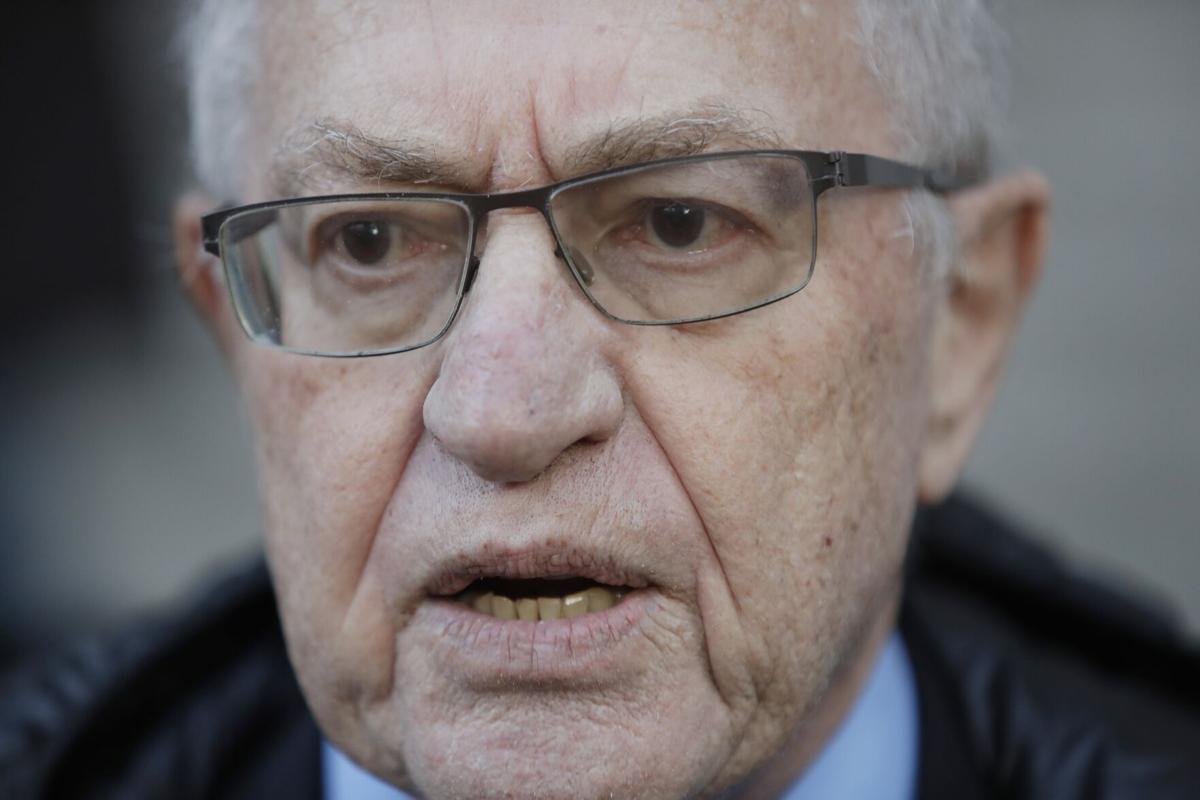
PHOENIX — Famed constitutional attorney Alan Dershowitz must pay a share of sanctions imposed on lawyers who brought a frivolous lawsuit on behalf of failed candidates Kari Lake and Mark Finchem, a judge says.
U.S. District Court Judge John Tuchi ruled Friday that the retired Harvard Law School professor’s signature on court documents in the case was tantamount to saying Lake’s and Finchem’s claims had legal merit.
Tuchi accepted Dershowitz’s claim that his role was limited, however, so he will have to pay 10% of the $122,200 in fees run up by Maricopa County in defending its use of machines to tabulate ballots.
The balance will be borne by the other two attorneys hired by Republicans Lake and Finchem, who lost the governor’s and secretary of state’s races in November, in their unsuccessful bid to require hand counting.
Dershowitz was not satisfied.
“I’m going to appeal this all the way up to the Supreme Court,’’ he told Capitol Media Services. “I will not accept any ruling that says I owe a single penny.’’
He claimed the ruling threatens to undermine the role of legal experts like himself who serve merely as consultants in lawsuits and don’t take a position in the underlying case.
Friday’s order was the one remaining issue before Tuchi after he threw out the claims by Lake and Finchem that tabulators can produce inaccurate results. The judge ruled last year that their assertions were little more than speculation backed only by “vague’’ allegations about electronic voting systems generally.
“Plaintiffs fail to produce any evidence that a full hand count would be more accurate,’’ Tuchi wrote in his original ruling. He also pointed to existing requirements for pre- and post-election audits to ensure the machines that tally the paper ballots report accurate results.
Having determined the lawsuit was frivolous, Tuchi said last year that the pair’s attorneys — but not Lake and Finchem themselves — are jointly responsible for paying the legal fees incurred by Maricopa County in defending against the lawsuit.
What was left to decide was the amount and how much of it Dershowitz should pay.
Dershowitz argued he should be entirely excused, saying he wrote only one paragraph of the legal pleading and that it dealt not with the claims by Lake and Finchem that machines are inherently unreliable, but on a narrow legal question.
“I helped to develop the following argument: When a private company is hired by the government to perform a quintessential government function such as vote counting, it cannot refuse to provide relevant information about the workings of its machines on the grounds of business secrets,’’ Dershowitz told the judge. None of that related to Lake and Finchem’s arguments that machine counting of ballots should be forbidden, he said.
“I had absolutely no duty to investigate the rest of the allegations because I had nothing to do with them,’’ he said. “I didn’t vouch for them.’’
Dershowitz specifically sought to put some distance between himself and Lake, in particular.
“I’ve never met Lake,’’ he told Capitol Media Services. “I would not have voted for her. I’m a Democrat.’’
Dershowitz, in at least his initial filings in the case, listed himself as “of counsel’’ to the plaintiffs. That’s a legal phrase that generally means someone hired by a law firm to do work, versus actually representing a client.
That distinction left the judge unimpressed.
“An attorney’s signature is tantamount to a warranty that the complaint is well grounded in fact and existing law (or proposes a good faith extension of the law) and that it is not filed for an improper purpose,’’ Tuchi said.
“Whether Mr. Dershowitz signed, or intended to sign, those filings as ‘counsel,’ or ‘attorney’ or ‘of counsel,’ he signed them,’’ Tuchi wrote. He also said the signature wasn’t necessary, as lawyers can contribute to cases without signing the pleadings.
“And he effectively conceded that he authorized his signature on these filings without investigating whether they were legally and factually sound,’’ the judge said.
Tuchi also said Dershowitz took a larger role than simply writing one paragraph.
Dershowitz participated in at least one telephonic conference with Maricopa County lawyers, he said. Also, Dershowitz, who is not licensed to practice law in Arizona, specifically applied for and obtained permission from the court to appear and participate in the case.
Still, Tuchi said Dershowitz claims “with some credibility’’ to have committed nothing more than an “honest mistake.’’
“Further, any monetary sanctions imposed should not be so significant as to dissuade other legal experts from providing advice or assistance in litigation out of fear of sanctions,’’ the judge said.
But he said it also would be wrong to let Dershowitz escape any penalty at all.
“Attorneys must be reminded that their duties are not qualified in the way he suggests and that courts are entitled to rely on their signatures as certifications their filings are well-founded,’’ Tuchi said.
Dershowitz told Capitol Media Services that forcing him, as a legal consultant, to pay financial sanctions for his consulting role would upset a personal precedent that goes back more than half a century.
“I started doing it in 1970, signing myself ‘of counsel,’” he said. “That’s what lawyers ought to do when they have a limited role.’’
Lake and Finchem are asking the 9th Circuit Court of Appeals to overturn the judge’s decision.
Get your morning recap of today's local news and read the full stories here: http://tucne.ws/morning

