



Curb appeal has long been a problem for Tucson.
Ride into town from the airport, head to the university along Speedway Boulevard, or cruise in on Interstate 10, and you can easily view Tucson’s blemishes while missing what makes it nice.
That’s been true for years, and these days, you’re also liable to see the tent camps of the unhoused or passed-out people on drugs. That’s not just a Tucson problem, but all in all, visitors’ first visual impression may well be a negative one.
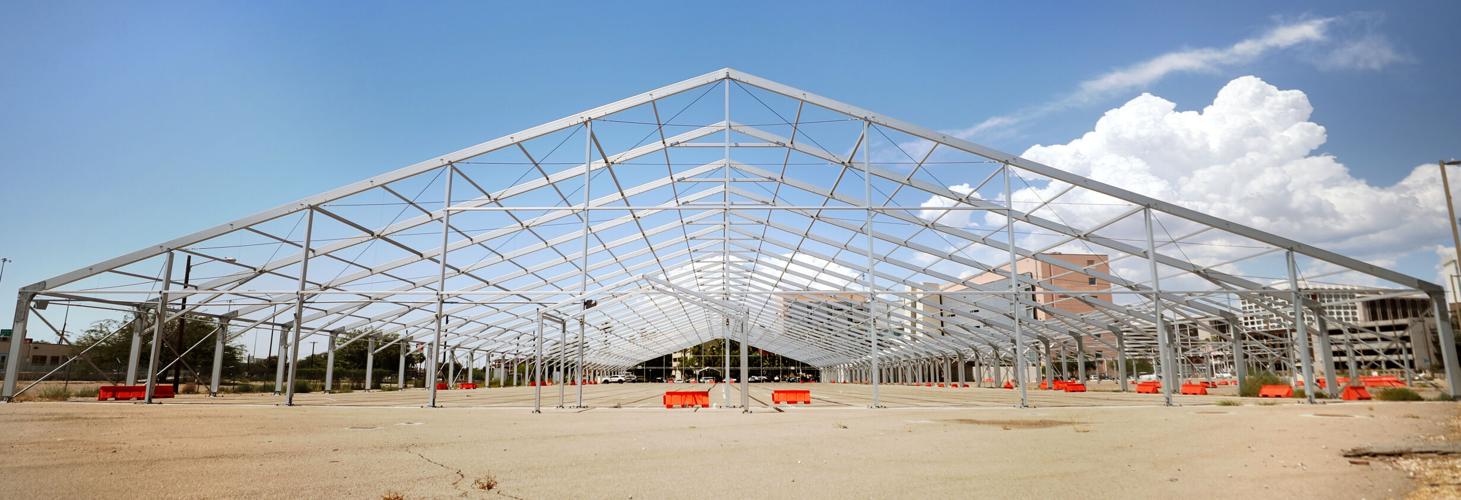
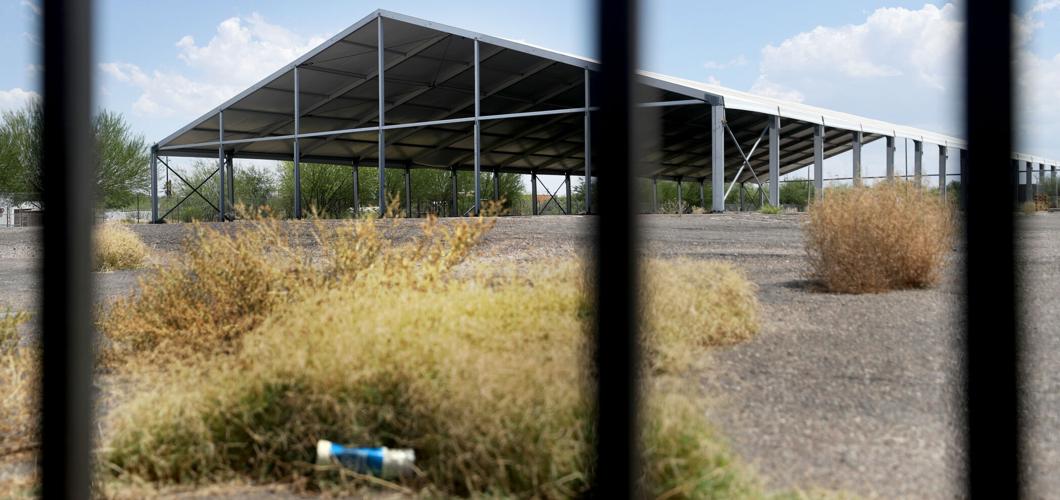
Before the tents of homeless people proliferated, there were other tents up that I’ve never gotten used to, that have been hanging around year after year. As you enter Tucson from the east along I-10, you pass a set of these tents near South Country Club Road, then the trashed old Spanish Trail Motel, then round the bend to the north, and as you approach downtown, you see not one, not two, but four huge, empty frames.
These ones near downtown are the frames of the tents that hold three of Tucson’s big gem shows: the 22nd Street, JG & M and GJX, which has two large tents. They have not always stayed up all year-round, after the gem, mineral and fossil shows end in February, but for at least five years, some have.
Some of these shows weren’t even supposed to be in tents anymore. Plans have long been in the works to build permanent structures where the 22nd Street and GJX shows take place, but those plans have been held up for years, due to problems with financing, development conflicts, the pandemic and other factors. Meanwhile, though, a gradual shift to more permanent gem-show spaces is happening in various spots around Tucson.
Not everyone cares about Tucson’s big tent frames, as I learned from posting about it on Facebook. Some find them ugly, as I do, but others don’t, and others don’t care what they look like because they belong to important money-generating businesses.
It turns out there has long been drama surrounding the inspections of tents, as Carolyn Cary, a former operations manager for gem shows in Tucson, told me. Some operators have been cited or fined, while others have sometimes lied about when they put the tents up to evade inspection requirements and others finessed the rules, she said.
“When you finally get busted, that’s when people give it up and don’t even care,” she said. “Tucson is a bit of a don’t ask, don’t tell city.”
‘It’s green to leave it up’
The way the permits for these mega-tents work, city spokesman Andrew Squire told me, they receive a 180-day permit from the Tucson Fire Department before the gem-show starts. During the pandemic years, these regulations weren’t strictly enforced — not just on gem-show tents but other outdoor structures that businesses put up. But some were left up all year anyway, including Danny Duke’s JG & M structure at West Simpson Road and South Freeway, the frontage road.
Not only does it save labor and money, he said, but it also saves on carbon emissions.
“I think it’s green to leave it up,” Duke told me.
Elsewhere in Tucson, though, there is movement beyond the big-tent era. Village Originals, perhaps known best for operating shows in large temporary tents near the Kino Sports Complex, also owns eight acres near South Palo Verde Road and East Ajo Way.
There, one 20,000-square-foot building for year-round exhibitions and retailing is under construction and should be complete by November, said owner Jim Gehring. The company is also in process to build a second 20,000-square-foot-building on the same property.
“We’ll have a permanent presence,” Gehring said. “We can be open all year long.”
In addition, he said, it saves money in the long run to build a permanent structure. The company spends a half a million dollars per year having a contractor put up and take down tents at Kino, he said.
Nearby, alongside I-10 and South Country Club Road, the Holidome shows by G & LW still have some tents up, too. Owner Candace McNamara told me they usually take them down, but they are holding a small show in September there.
“We don’t want permanent structures up because immediately it’s too small,” she said. “Therefore, we use hard-sided tents, then we tear them down and put them back up.”
Another advantage of tents, she noted, is that they don’t increase property taxes the way permanent structures do.
‘Tents are an expensive hassle’
The JGM show, near the federal court house at 198 S. Granada Ave., was expected to become part of a multi-purpose development including the strip of land along the I-10 frontage road years ago.
In 2015, Allan Norville’s Nor-Generations LLC won the right to develop the so-called Arena Site in a contested request-for-proposals process before the Rio Nuevo board. The Nor-Generations proposal featured a visual-arts center, hotel, and apartment complex.
This plan was supposed to work together with Nor-Generations developing a permanent gem-show site at the adjacent property, 198 S. Granada Ave., where the GJX tent frames are now. But there has been no visible progress, which led to a lawsuit by Rio Nuevo and a settlement last year.
Now, Nor-Generations is planning to sell the northern part of the Arena Site, at Congress and I-10, to another developer, who is proposing a 17-story residential project. Nor-Generations attorney Pat Lopez told me that other plans, including a permanent gem-show structure, depend on what happens with that project. If it wins a rezoning, then the sale of the land for that project can proceed, and so can further developments, such as a gem-show pavilion.
Further south, the 22nd Street show was also supposed to become part of the shift to permanent exhibition halls years ago. Owner Lowell Carhart won the old El Campo Tire property in a city auction but couldn’t make his initial plan work financially.
Carhart told me he’s working on getting the business on financially more solid ground this year before launching his next attempt to build a permanent hall there.
“We are contractually required with the COT (city of Tucson) to have a 50,000+ sf (square foot) edifice completed by February 2027 and I am eager for it to happen sooner,” he told me by email. “Tents are an expensive hassle. The yearly payments on a mortgage on a new building would be less than the annual cost of the same size tent.”
Moving toward permanence
Duke, who owns gem-show properties around town, told me he foresees a shift in the North Oracle corridor, where many shows occur.
“There’s a whole area that’s moving toward permanent buildings,” he said. It will be, he said, “mostly new buildings and a couple of old buildings.”
But he’s not looking to make that move along the I-10 frontage road. In fact, he’s had that property on the market and may sell it. For now, though, he’s got the tent-frame up with the fabric top on it.
Duke is one of a few gem-show operators who have received notices to do something about their tents recently. In the last 10 days or so, the Tucson Fire Department began warning those who had 180-day permits for their gem show tents that they need to take the frames down, Squire told me.
It’s an expensive hassle for them, undoubtedly, but if we’re going to be campaigning to take tents down in Tucson, we should probably think of the big ones as well as the little ones. In the long run, as permanent gem-show structures are built, maybe we won’t need many of them at all.
Get your morning recap of today's local news and read the full stories here: http://tucne.ws/morning

