


The U.S. Bureau of Reclamation will examine the possibility of drilling tunnels through Glen Canyon Dam to ensure water can pass through it at low Lake Powell elevations, two knowledgeable sources told the Arizona Daily Star.
Such a re-engineering project will be among several options the bureau will look at due to new concerns about the ability to deliver Colorado River water through the 61-year-old facility under such circumstances.
It could prevent a catastrophic occurrence if lake elevations ever fall so low that no water could get through the dam to serve farms and Lower River Basin cities, including Tucson, Phoenix, Las Vegas, Los Angeles and San Diego.
Some “non-power” options will also be considered, the sources said. Those would allow water to pass through the dam at low levels but wouldn’t necessarily allow electric power generation at them, unlike other proposals the bureau has already said it’s studying.
Drilling tunnels would amount to a major overhaul in how the dam at the Utah-Arizona border is managed. Glen Canyon Dam and Lake Powell have long been a central pivot point on the Colorado, controlling river flows that otherwise would pass unimpeded to Hoover Dam, cities and farms in the Southwest, the Lower Colorado River and Mexico.
The dam is also the largest single source of federally subsidized power generated by several Upper Colorado River Basin dams that deliver electricity to 5 million customers in Arizona and six other Western states.
The bureau hasn’t responded to the Star’s request to confirm or deny the sources’ reports. But the agency is clearly looking more closely at several possible dam fixes for operating at low elevations, which it hasn’t identified publicly.
The bureau’s reported willingness to look at tunnels follows a recent disclosure, first reported by the Arizona Daily Star, that the four steel tubes at Glen Canyon Dam through which water would pass at low elevations suffered some damage a year ago when large amounts of water were released through them.
The releases, spanning four days in April 2023, were for an experimental river flow aimed at restoring sediment in that water to long-depleted beaches in the Grand Canyon, downstream. The damages, while not crippling, were significant enough that the bureau wrote in a March 2024 memo that the tubes, known as outlet works, shouldn’t be relied on as the only means of getting river water through the dam at low elevations.
‘Alarming’
This situation is “alarming,” say the two researchers who run the state’s university water research centers, the University of Arizona’s Sharon Megdal and Arizona State University’s Sarah Porter.
While the damaged outlet tubes don’t represent an imminent threat because the reservoirs are higher today than two years ago, Megdal said she’s still concerned the river’s long-term operations are in jeopardy. Both researchers agreed the bureau needs to act reasonably soon in finding solutions, although they didn't endorse a particular solution..
Megdal added the outlet works’ problems “call into question the operations of Glen Canyon Dam.”
All options for rectifying the problem should be explored “with all due haste,” ASU’s Porter said. “We have to look at all possibilities and go from there. We don’t know enough right know to pick the best solution, but we don’t have time. The consequences of not dealing with the situation are potentially incredibly serious.”
The bureau’s ability to continue operating the dam in its traditional fashion has been called into question by the last 24 years of declining river flows that were triggered by drought and climate change.
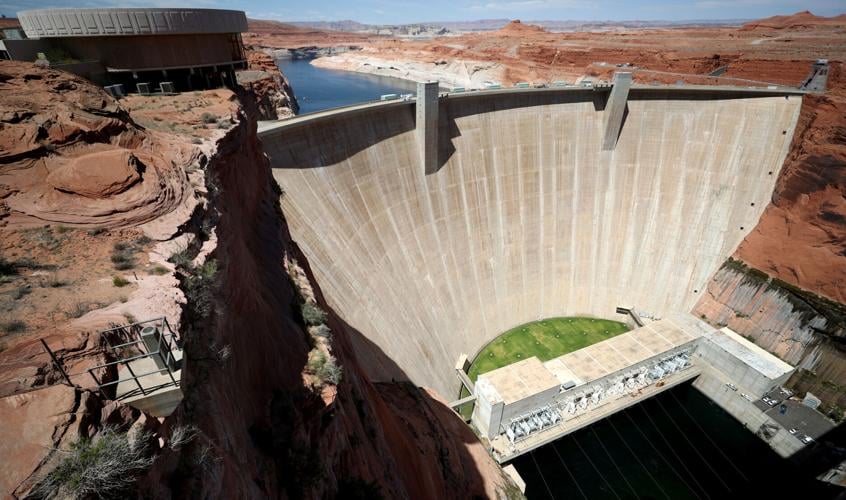
Drilling tunnels into the dam’s abutments — an idea first broached in the late 1990s — would allow water to pass through the 710-foot-tall dam whenever officials want it to.
It could also reduce the risk of major damages to the structure during big floods — such as a near-disaster in June 1983 in which a flood overtopped the dam’s spillways and major damage if not destruction of the dam was narrowly averted.
Some environmental groups have been pushing for such measures for several years now.
But drilling tunnels would also be a very expensive proposition, costing hundreds of millions or billions of dollars. It would require congressional authorization and annual appropriations of large sums of money, and take years to accomplish.
It could also run into opposition from groups or agencies who would prefer the seven Colorado River Basin states to focus more on being prepared to slash water use dramatically, to try to ensure that Lake Powell stays high enough to pass through enough water for the Lower Basin.
Costly damage
This year, federal and Arizona water officials reported that damages to the tubes included cavitation. That involves the formation of vapor bubbles in high-velocity water that can cause mechanical damage, such as erosion of metals and coatings. Sedimentation and pipe thinning also occurred due to the experiments, Arizona and federal officials have acknowledged.

The U.S. Bureau of Reclamation will examine the possibility of drilling tunnels through Glen Canyon Dam to insure water can pass through it at low Lake Powell elevations, two knowledgeable sources told the Arizona Daily Star. Such a re-engineering project will be among several options the bureau will look at due to new concerns about the ability to deliver Colorado River water through the 61-year-old facility under such circumstances.
In a late March memo, the bureau said the risks from heavy use of the tubes, commonly known as the outlet works, are serious enough to warrant limits on how much water should flow through the tubes at lower elevations. The memo didn’t specify any other ways of getting water through the dam at lake levels below 3,490 feet, and many water experts have said there are no such alternatives.
If Lake Powell were ever to fall below 3,490 feet — the lowest level at which the dam’s eight turbines generate electricity — the tubes are currently the only way that water could get through the dam.
The outlet tubes could accept water if that were necessary at the lake’s current elevation of 3,560 feet, at which Powell is 34% full and 70 feet above the level at which power generation would stop.
But if the lake were to fall as little as 20 feet from that, the amount of water that could flow through the outlet tubes would be very slightly restricted by the bureau’s new limits. If the lake were to fall below 3,490 feet, water released from the tubes would face steeper limits, as much as 17% less than the tubes’ physical capacity to deliver water.
The reports of the bureau’s willingness to look at long-term fixes for the dam came from two sources, a former bureau official and a longtime water expert who is familiar with the bureau’s operations. They asked that their names not be used, to preserve their ability to communicate candidly with other water officials and experts on sensitive topics.
On Monday, the bureau told the Star it’s narrowed possible choices for simply delivering power at below 3,490 feet from nine original options to three, as part of an ongoing study that began in 2022. The options are being further analyzed through what bureau spokeswoman Becki Bryant calls an “appraisal design” study. It should be finished by the end of 2025, she said.
“Given the early stages of this process, it would be premature to speculate on the study’s results. Reclamation is committed to decisions based on best available science, transparency, and inclusivity. We will be sharing information as these studies progress and will be coordinating with all our partners and Congress to ensure that we are prepared for any additional necessary actions in accordance with the results of these studies,” Bryant told the Star in an email.
Babbitt wants broad review
Bruce Babbitt, a former Interior secretary and Arizona governor, said there should be a comprehensive review of alternatives for managing the dam.
He was reacting in an interview to the information that the bureau, according to the Star’s sources, will be looking at drilling tunnels.
Problems with the dam’s outlet tubes and threats to its ability to generate electricity call for a comprehensive study of all relevant issues relating to dam operations and all alternatives for potential changes, Babbitt told the Star.
“It seems to me that given all the recent events and the history of making patchwork changes and now the onset of climate change, it really is time for a comprehensive study,” said Babbitt, who as Interior secretary from 1993 to 2001 oversaw Reclamation and its dams.
Babbitt noted the bureau’s study of the dam’s power generation alternatives that started last year discarded several alternatives that didn’t involve making it possible to generate power at low lake elevations. All the alternatives laid out in a February 2023 bureau slide presentation about that study “are premised on maintaining or increasing power production,” he said.
One alternative the study discarded in 2023 would have been to build “outlet works” such as steel tubes below 3,400 feet, without adding a power plant or other electrical generating facilities at those elevations, Babbitt noted.
Another option the bureau was planning to study but was clearly downplaying in its slides was to build solar or wind energy-generating facilities. The bureau said such an effort would require lots of land, adding, “this is not Reclamation’s expertise.”
In a time of climate change, the idea of installing renewable energy plants “speaks for itself,” Babbitt said.
The main purpose of a study would not primarily be to find the most cost-effective solution “but to have a comprehensive evaluation, with public input, so the Congress can make a decision in light of all the issues,” he said.
Bureau spokeswoman Bryant declined to respond to Babbitt’s suggestions, saying, “We do not respond to correspondence through the media.”
But she said the bureau has awarded a contract for what amounts to a shorter-term fix for the damaged outlet works. It will be to recoat the four tubes with an epoxy material. The work is scheduled to begin later this year, Bryant said. The recoating will protect the steel pipes from corrosion, but not cavitation, bureau officials say.
“The recoating project has been in planning for several years to replace the original coating as it has shown signs of aging,” Bryant said.
The bureau did not respond to a question from the Star about the epoxy coating’s cost. Nor did it specify which three alternatives it’s continuing to study for power generation at low lake levels.
Current projections
The bureau’s current study began at a time of near-crisis for the dam, the lake and the river in general.
In 2022 and early 2023, Powell fell to record low levels. Federal forecasts in fall 2022 showed that under “minimum probable” river flows, Powell could drop below 3,490 feet as early as October 2023 and stay that low for most of the following year. Six months earlier, low river flows caused the Interior Department to abruptly cut annual releases of river water from Powell to Lake Mead by 6%, and to deliver extra water to Powell from the Flaming Gorge reservoir at the Utah-Wyoming border.
Interior officials were concerned at the time about the threat of low water releases to the outlet works, correspondence from the time shows.
If water had to flow only through the outlet works and power generation was adversely impacted, “Glen Canyon Dam facilities face unprecedented operational reliability challenges, water users in the (Colorado River) Basin faced increased uncertainty, downstream resources could be impacted, the western electric grid would experience uncertain risk and instability and water and power supplies to the West and Southwestern United States would be subject to increased operational uncertainty,” then-Assistant Interior Secretary Tanya Trujillo wrote to the basin states’ water officials in early April 2022.
“Glen Canyon Dam was not envisioned to operate solely through the outlet works for an extended period of time, and operating at this low lake level increases risks to water delivery and potential adverse impacts to downstream resources and infrastructure,” Trujillo wrote.
“Given our lack of actual operating operating experience in such circumstances since Lake Powell filled, these issues raise profound concerns regarding prudent dam operations, facility reliability, public health and safety and the ability to conduct emergency operations,” she continued.
But extraordinarily heavy snowpack and high river runoff in 2023 sharply boosted water levels at Powell and Mead. While this year’s runoff is projected at 15% below normal, the two reservoirs remain much higher than two years ago.
in Bryant’s email to the Star Monday, she said, “Current projections show that Lake Powell is not at risk of going below 3,490 feet through 2026, and there is only a 7% risk through water year 2028. Reclamation is already taking actions to prevent Lake Powell from falling below that point including revising near-term operating guidelines for lakes Powell and Mead.”
She was referring to the ongoing negotiations among the seven river basin states and the feds to come up with new guidelines for operating the river’s reservoirs to be able to accommodate the prospects for future, sharply lower river flows. Such new guidelines most likely will require sharp cuts in water use by farms and cities if the reservoirs fall far enough.
Concerning “to rely on the unknown”
UA’s Megdal and ASU’s Porter’s comments that the situation is alarming are out of character for both researchers. As directors of university water research centers, they commonly work with people on all sides of controversies, and are generally moderate in tone and not prone to outspoken comments.
“I don’t use this word very often, (but) I find this all quite alarming,” said Megdal, of UA’s Water Resources Research Center. “People have been talking about being able to deliver water through those outlets. (The bureau) now says this needs to be avoided.”
“They said that they hadn’t had experience operating the outlets under conditions that might occur. For a situation where you don’t have much water in the reservoir, to rely on the unknown is concerning,” Megdal said.
“I do think the bureau needs to convene a meeting of people to talk about this report in public,” Megdal said. “It deserves an airing and a discussion that’s public and broad. I don’t think it can be figured out for non-engineers and the public through press releases and short reports.”
More information is needed to help the general public and the experts who aren’t engineers to understand what this all really means, she added.
While there may be an interim fix to get us through the immediate crisis, “we also need to look at immediate, long-term investment,” said Porter, of ASU’s Kyl Center for Water Policy.
“We need a really serious engineering and hydrology study that lays out the various options, that include conservation and huge infrastructure investments. We need to know what are the options. (And) it would be important for the congressional delegation members from the Colorado River Basin to be informed and involved,” Porter said.
‘Antique plumbing’
Some environmentalists say the outlet works’ problem demonstrates more than any other single factor the magnitude of the river’s water crisis.
Damages to the tubes from the 2023 high flow experiments reveals that the dam’s “archaic plumbing” is the most urgent water problem facing the 40 million people of the Colorado River Basin,” said Zach Frankel, the executive director of the Utah Rivers Council, in a recent news release.

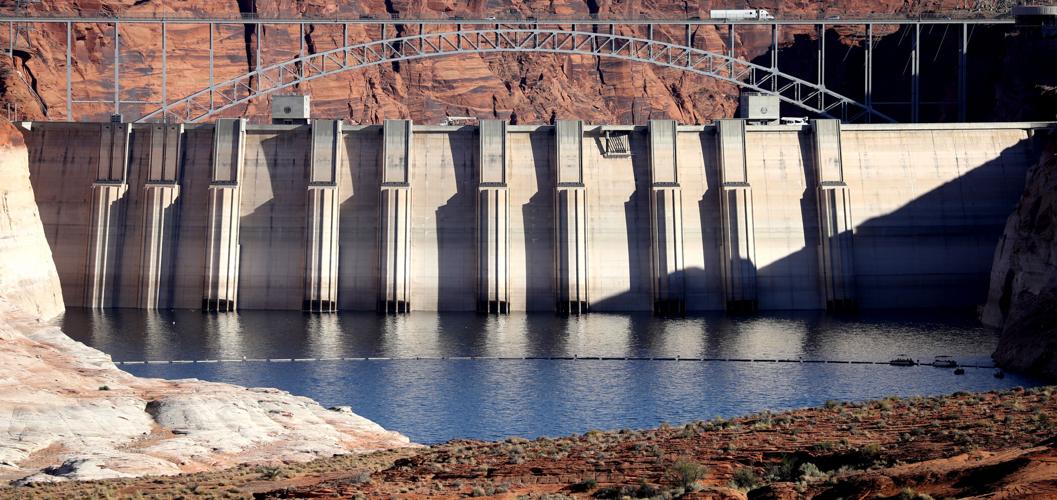
Receding water levels of Lake Powell are shown at Glen Canyon Dam in this 2022 file photo.
“Glen Canyon Dam’s antique plumbing will soon jeopardize the water supply for 30 million people downstream and the Grand Canyon,” said Eric Balken, the executive director of Glen Canyon Institute. “If we drop everything to solve it, the solution will still take 10 years to implement — so why are we procrastinating?”
The idea of drilling tunnels through the dam to let water through was broached in the late 1990s by a former Reclamation director, the late Floyd Dominy, the dam’s biggest booster and a longtime advocate of big water projects in general.
Dominy brought up the idea as a way to let more water through the dam so the natural Glen Canyon area that was flooded by dam construction in the 1960s could later be seen once again. He personally didn’t support that idea, but floated it to dam critics as a practical way of carrying out their goal of restoring Glen Canyon.
Now, 25 years later, “I think we’ve just come to a point in Colorado river where environmental interests are coming to overlap with water supply interests,” Frankel told the Star.
Longtime Arizona Daily Star reporter Tony Davis talks about the Colorado River system being "on the edge of collapse" and what it could mean for Arizona.

