


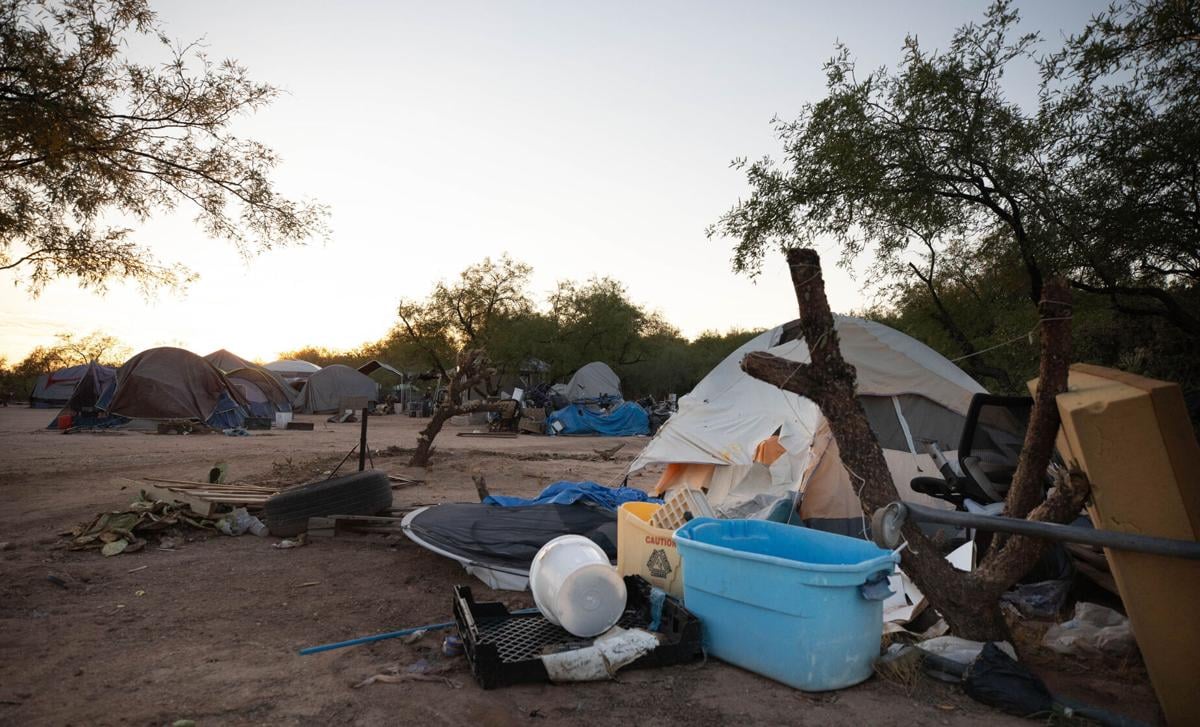
PHOENIX — Republican legislative leaders are spending $15,000 to file a legal brief meant to protect state lawmakers’ authority to enact laws to clear homeless encampments and cite people living on the street.
In the papers filed with the U.S. Supreme Court, the private attorney hired by Senate President Warren Petersen and House Speaker Ben Toma argues that unless the justices overturn a lower court ruling, states will not be able to enact laws they say not only enhance the safety of residents but also protect homeless people from the risks of unlawful encampments.
“Lawmakers must use a suite of state and local government policies, including camping ordinances, to adequately address the social and public health effects of homelessness,’’ wrote Beau Roysden, a former assistant state attorney general now in private practice.
But he said a ruling by the 9th Circuit Court of Appeals removes “a critical tool previously available to states, counties, and cities working to combat homelessness.’’ Neither Arizona nor any of its cities are involved in the case.
Petersen and Toma want the justices to overturn the lower court ruling involving Grants Pass, Oregon, which says laws against camping and sleeping in public cannot be enforced if there is not sufficient shelter space. In essence, the 9th Circuit ruled that such laws criminalize the status of being homeless for people who have no other options, a violation of the Eighth Amendment prohibition against cruel or unusual punishments.
If the justices leave that ruling intact, Roysden said, Arizona lawmakers will be hampered in enacting their own laws.
“Without this ability, lawmakers will be unable to work towards a comprehensive solution to homelessness that respects the welfare of their residents,’’ Roysden wrote.
Legislative actions
The record shows there are Arizona legislators who want such laws.
Earlier this year, lawmakers, on a party-line vote, approved a bill to require cities, towns and counties, upon notice of the existence of a homeless encampment, to notify the owner to remove the structure from the location. It also designated a violation as criminal trespass.
That didn’t become law because Democratic Gov. Katie Hobbs vetoed it, saying it “effectively criminalized homelessness.’’
Another bill to prohibit individuals from erecting tents or boxes for habitation on public rights of way did pick up the backing of two House Democrats. But this, too, met with the governor’s veto stamp when she said it was not a “comprehensive’’ solution to the problems of housing and homelessness.
“Rather than solving these issues in a meaningful way, this bill only makes them less visible,’’ Hobbs wrote.
Still, Roysden told the high court, the Arizona Legislature did take some actions, with Hobbs signing a bipartisan state budget that immediately awarded $20 million in grants “for programs that provide shelter and services to unsheltered persons who are experiencing homelessness.” More than $13 million of that went to Phoenix, with funds also doled out to Flagstaff, Mesa, Scottsdale, Tempe and Tucson.
Roysden said the Legislature is working to resolve the crisis but needs to be sure “that its legislative judgments and appropriations can be implemented efficiently without fear of legal invalidity based on an erroneous interpretation of the Eighth Amendment.’’
He also told the justices they should not bless any rule that says cities cannot apply criminal deterrents to unlawful camping if a judge mathematically determines there are more individuals without homes than the number of beds available in specific non-sectarian shelters.
“Such a conclusion — unlike democratically made policies — allows no room for nuance,’’ he wrote.
“It pays no attention to the possibility that some homeless people may stay with friends or family on a given night,’’ Roysden continued. “Nor does it consider that some individuals prefer to live outdoors and that laws may properly regulate such decisions.’’
Shelter availability debated
That leaves the question of where the homeless are supposed to go if there are not sufficient shelters and beds.
“There is no ‘if,’ ‘’ Petersen responded to Capitol Media Services. “We have empty beds right now and we can expand spots rapidly.’’
That was disputed by state Rep. Analise Ortiz who, in response to the court brief and comments by Petersen, said downtown Phoenix shelters are “overwhelmed.’’
“The experts working on our shelter network attest that there are only 2,182 shelter beds in Maricopa County,’’ the west Phoenix/Glendale Democrat representing said in a statement. She said about 5,000 adults are currently on a waiting list for housing. “There are essentially zero open beds and not enough permanent housing, so where exactly are people supposed to go?’’
Petersen, for his part, remained unconvinced there is a disconnect between need and availability. And he said there is flexibility — if local communities step up.
“We have enough schools for kids, we have enough prisons for criminals,’’ he said. “Cities and counties can have enough spots for temporary shelters.’’
Roysden has his own set of figures that differ from those cited by Ortiz. He said Phoenix and Maricopa County offer more than 12,300 beds in homeless shelters.
He did not dispute her central point about the gap between supply and demand, saying, “The city’s ballooning homeless population possibly exceeds those available beds.’’
Petersen suggested that is irrelevant. “They are saying there has to be a bed for every single conceivable person to prevent a lawsuit, which is nuts,’’ he said.
He said the spending of public funds on outside counsel is justified. “The public wants us to address the homeless crisis,’’ he said.
Goldwater Institute role
The GOP legislative leaders aren’t the only Arizonans asking the Supreme Court to revisit the 9th Circuit ruling.
In a separate legal filing, the Goldwater Institute, a conservative and libertarian public-policy think tank, said a flaw in the lower court decision is that it presumes those on the streets are not there voluntarily.
“But the idea that one is ‘involuntarily’ homeless if the government does not give that person an ‘adequate’ place to sleep, is illogical,’’ wrote attorney Timothy Sandefur. “An action is involuntary if the person literally cannot help it — not if the person could help it but fails to do so, and the government fails to give that person some benefit.’’
He said that definition of “involuntary’’ makes a political rather than a legal assumption, one in which he said “people are deemed incapable of acting responsibly, and therefore blameless, if they can ascribe their condition to the government’s failure to provide them with taxpayer-funded benefits.’’
The justices have not yet decided whether they will review the Grants Pass case.
Watch now: Tucson is responding to homeless encampments the community reports based on the level of danger they pose to the community. Video by Nicole Ludden/Arizona Daily Star.

