


Arizona’s newest jaguar was first detected in the Huachuca Mountains just weeks after the last shipping container was hauled away from Gov. Doug Ducey’s short-lived border barrier south of Sierra Vista.

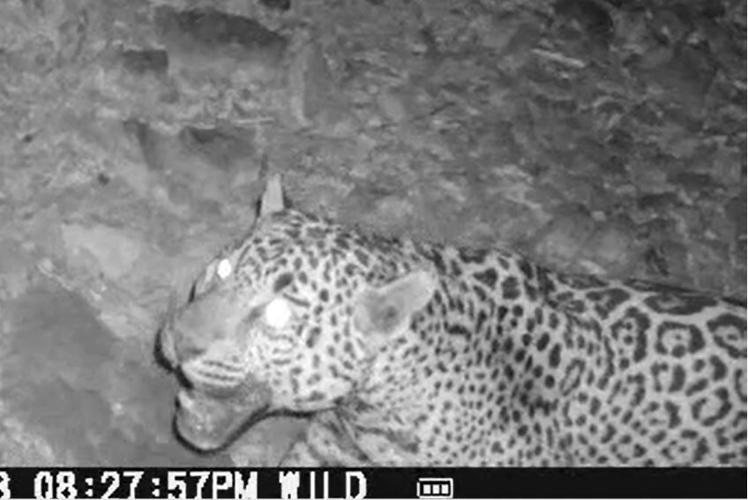
A jaguar appears in a screenshot from a trail camera video captured in the Huachuca Mountains on Dec. 20 by Vail wildlife videographer Jason Miller.
The timing was no accident, according to advocates for the endangered cats.
“I don’t think it’s a coincidence that the shipping containers were removed in January and two months later a new jaguar was documented in Arizona,” said Aletris Neils, founder and executive director of the Tucson-based nonprofit group Conservation CATalyst.
In the name of border security, jaguars have already been walled off from many of the routes they have historically used to push north into the U.S. from the closest breeding population in Sonora, Mexico, Neils said. “One of the last remaining significant corridors is the San Rafael Valley, which is right where the shipping containers went.”
The new jaguar was introduced to the world by Vail wildlife videographer Jason Miller, who caught the cat on one of his motion-activated trail cameras in the Huachucas on Dec. 20.
Miller unveiled the 20-second clip on his YouTube channel early this month.
It’s just the eighth individual jaguar documented in the U.S. in almost 30 years.
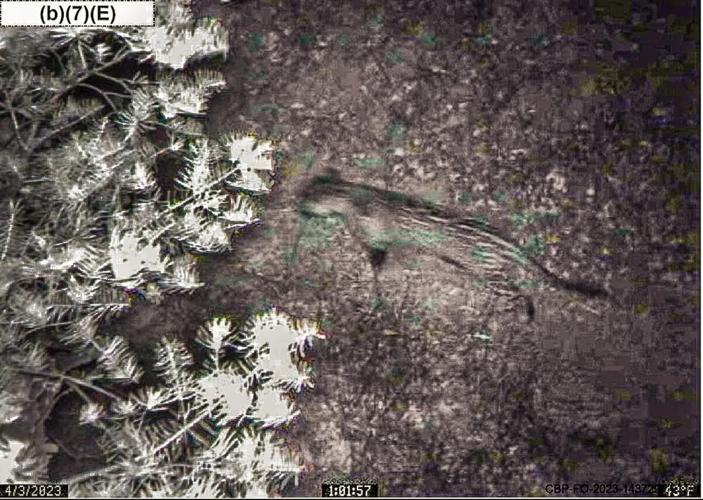
On Wednesday, Neils revealed that the jaguar Miller filmed is the same one her group has been tracking since March, when a remote camera operated by U.S. Customs and Border Protection captured a grainy image of a spotted cat in the Huachucas.
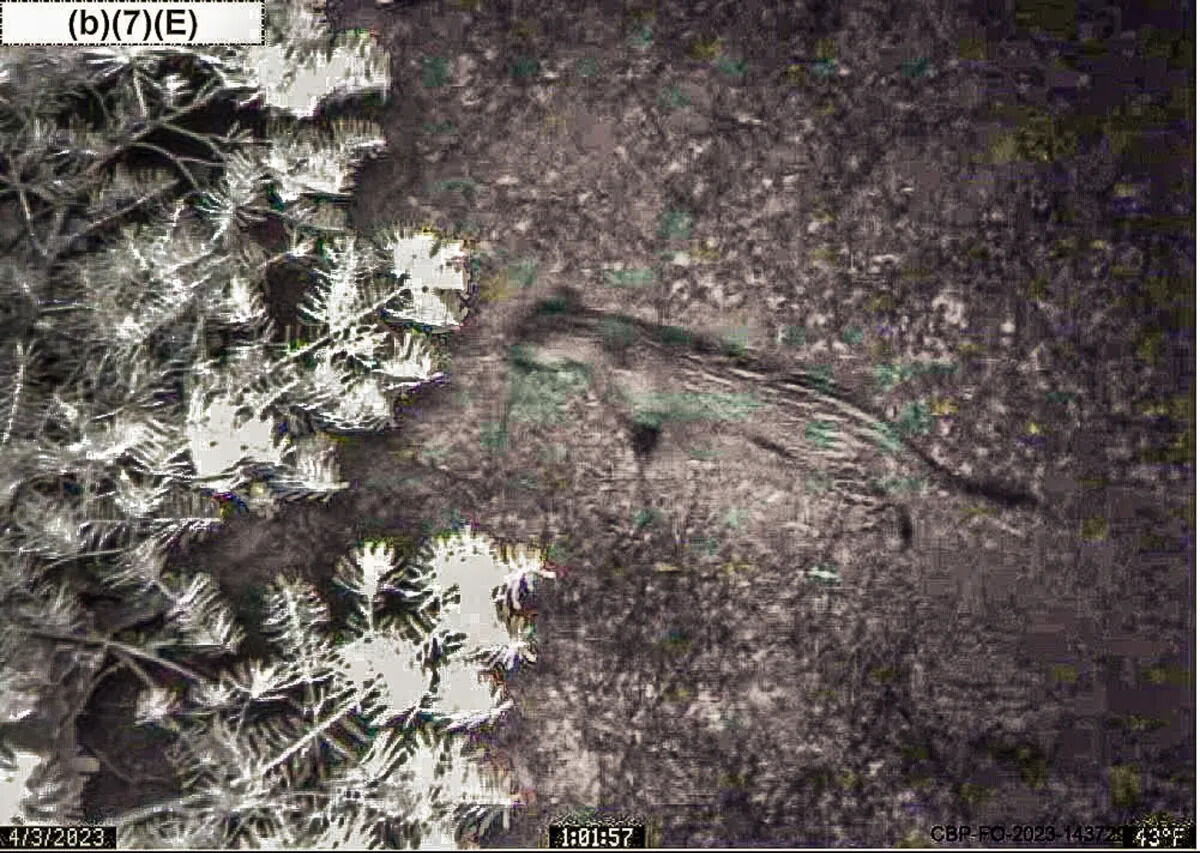
An image captured in March by a Customs and Border Patrol remote camera shows a jaguar roaming the Huachuca Mountains. The Center for Biological Diversity got the photo through a public records request, but efforts to enhance the image enough to identify the jaguar by its distinctive spots were unsuccessful.
She said the new jaguar has been “pretty consistently documented” since then, including in “multiple” trail camera pictures of the animal that have not been released to the public.
Based on those images, Neils said the jaguar appears to be a “younger adult male” in excellent condition — a testament to the quality of the habitat in Arizona’s sky island mountain ranges.
“He’s finding everything he needs here, not only to survive but to thrive,” she said. “Hopefully he’ll be able to settle down and make Arizona his home.”
So far, she said, the new jaguar has been documented in the Huachucas and one other Southern Arizona mountain range.
Conservation CATalyst suspects the cat has also wandered through a third mountain range, but the group has not been able to verify that.
Neils said the animal could be roaming in search of territory to claim, much the way the jaguar known as El Jefe did after first being photographed in the Whetstone Mountains in 2011.
That cat famously settled in the Santa Ritas south of Tucson, where it was repeatedly documented through 2015. Then El Jefe vanished only to reappear in Mexico, about 100 miles south of the border, in late 2021.
For the safety of this new jaguar, Neils declined to identify which mountain ranges in Arizona it might be using.
“The last thing we want is for an area to be flooded with activity that can affect the animal’s behavior,” she said. “This cat is already covering large areas and going (mostly) undetected while doing it, which is really exciting.”
Uncontained
The discovery of the first jaguar documented in the Huachuca Mountains since 2017 was especially gratifying to Russ McSpadden, a conservation advocate for the Center for Biological Diversity.
He was part of a group of protestors who halted work on Ducey’s unauthorized border barrier in December 2022 by standing in front of construction vehicles at the worksite in the Coronado National Forest near the Huachucas.

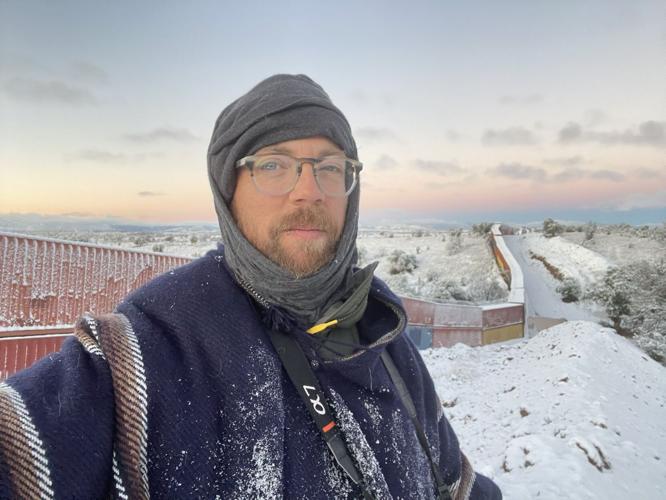
Russ McSpadden, conservation advocate for the Center for Biological Diversity, poses near Gov. Doug Ducey’s shipping container border wall during a protest at the site south of the Huachuca Mountains in December 2022.
“I personally camped out there for almost a month,” McSpadden said.
He was also there on Jan. 31, 2023, when the last shipping container was trucked out of the area.
“The jaguar was a significant reason so many people rallied to stop that barrier,” he said. “I definitely take (the new jaguar) as a sign that it was well worth the effort.”
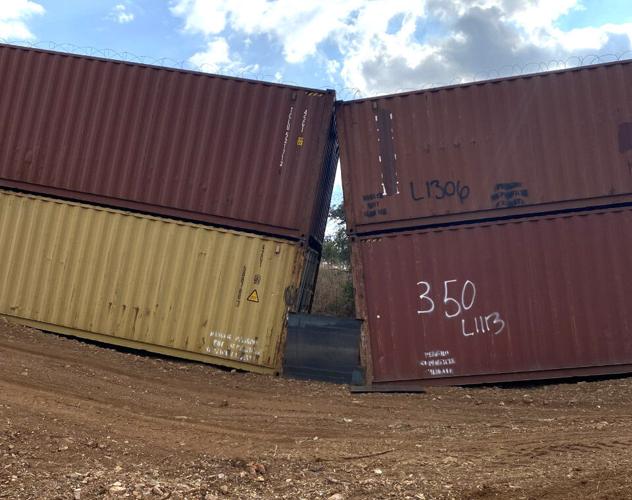
Ducey’s shipping container wall ended up costing the state about $200 million while briefly blocking about 4 miles of a 10-mile gap on the south side of the Huachucas.

Shipping containers placed by the state of Arizona along the Arizona-Mexico international border on Coronado National Forest land south of Sierra Vista in December 2022.
The federal government has placed a much bigger obstacle in the path of wandering wildlife. According to the Utah-based environmental group Wildlands Network, the international boundary in Arizona and New Mexico is now lined with almost 400 miles of wall or pedestrian fencing, 263 miles of which was built during the Trump administration.
McSpadden said those stretches of wall present an insurmountable barrier to wild animals, but don’t seem to be much of a deterrent to humans. By far the largest number of migrants he has seen crossing in recent years is in Organ Pipe Cactus National Monument, where they are making their way into the U.S. through cuts made in the bollards along some of the newest stretches of 30-foot border barrier.
By contrast, McSpadden said, he almost never sees people attempting to cross in the more remote, wild areas where there is no wall.
“If your goal is border security, the wall has shown itself to be a colossal failure,” he said. “It’s an enormous waste of money and an absolute environmental disaster.”
In a 2019 press release, Customs and Border Protection said the border wall supports the Border Patrol’s efforts to stop illegal crossings and smuggling.
Though President Biden has signaled interest in some of his predecessor’s border policies, Homeland Security Secretary Alejandro Mayorkas said last year that “this administration has made clear that a border wall is not the answer.”
Walled off
The man behind the new jaguar footage isn’t big on politics, but on this issue he does agree with McSpadden and other conservationists.
“My honest opinion about the wall is it doesn’t work,” Jason Miller said. It’s ugly and destructive and only serves as a barrier to animals, not the people it was intended to stop.
People “cut through it or go under it,” he said. “I feel the wall is punishing wildlife. It’s not there for that, but that’s who’s being punished.”
It’s unclear exactly where the jaguar Miller caught on camera entered the U.S., but Arizona Game and Fish Department officials believe the cat most likely crossed somewhere to the southwest of the Huachucas, since other nearby wildlife corridors are largely blocked by long sections of border wall.
Spokesman Mark Hart said the department has not taken an official position on the wall, nor have agency officials been asked to weigh in on it to his knowledge.
“What we do know is fences, walls and highways are barriers to wildlife,” Hart said, so game officials seek to mitigate the impacts of such infrastructure whenever possible.
But such mitigation measures along the border can be complicated, because any barrier opening or wildlife crossing large enough to accommodate an animal the size of a jaguar would also be “large enough for a man,” he said.
Ultimately, though, it’s not AZGFD’s call to make. “The border is not our jurisdiction,” Hart said.
The federal agency in charge of protecting jaguars, the U.S. Fish and Wildlife Service, declined to comment on the state’s aborted effort to block the border with stacks of shipping containers.
As for its position on the federal border wall, spokeswoman Jessica Zehr said the service “has been and continues to be in coordination with U.S. Customs and Border Protection on wildlife conservation based on site operations and national security needs.”
Jaguars have no such concerns, of course. They are just looking to live and reproduce in a landscape they have occupied for thousands of years, Neils said.
Increasingly, though, the barriers erected by and for humans are blocking their way, which makes every new sighting in Arizona all the more amazing.
“It’s very, very difficult for jaguars to naturally recolonize and recover, but they’re still doing it,” Neils said. “I hope people recognize how incredible this is.”

