



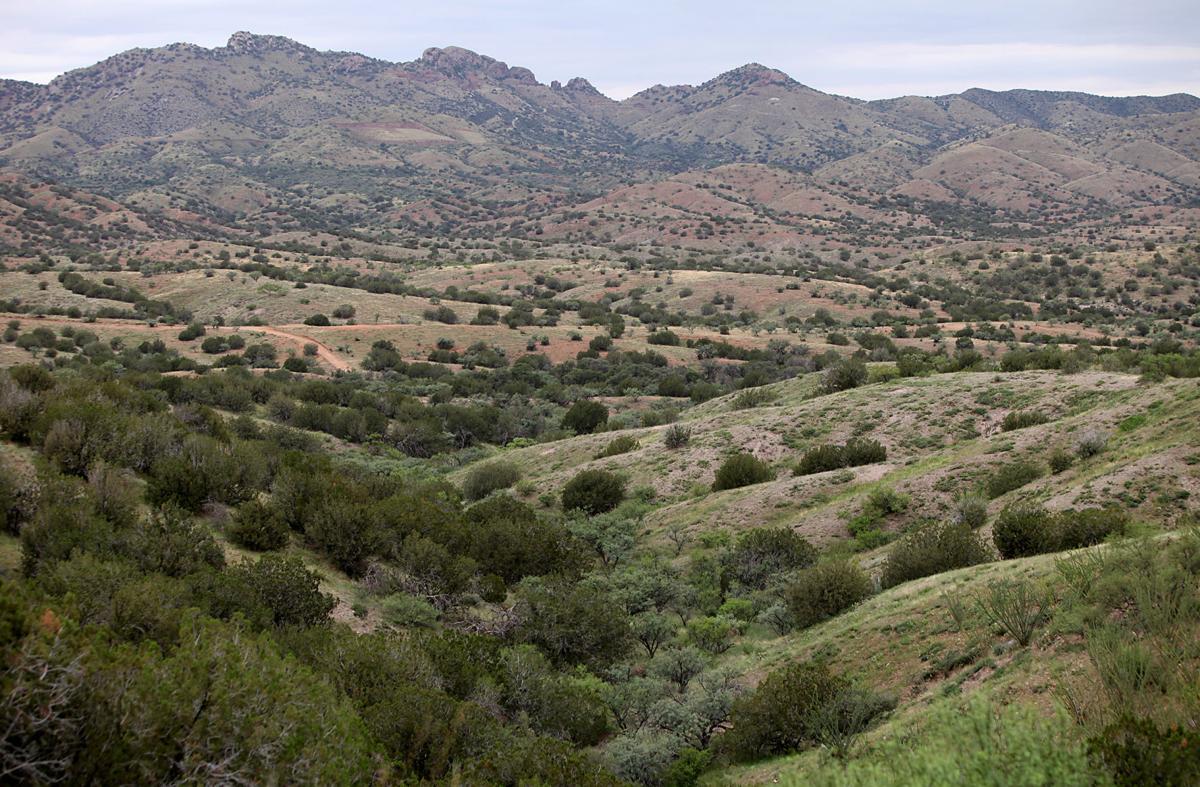
In a major policy switch, the Biden administration has reversed a past federal decision that stripped the government’s oversight over development along normally dry washes on the proposed Rosemont Mine site.
The U.S. Army Corps of Engineers’ March 2021 decision that Rosemont-area washes don’t merit Clean Water Act regulation of development along them is “not valid,” Assistant Secretary of the Army for Civil Works Michael Connor wrote to a tribal attorney, Stu Gillespie, on Friday.
The Corps had found, in two separate rulings, that the Rosemont washes don’t qualify as “Waters of the U.S.” That’s a legal term for washes considered hydrologically and biologically important enough to merit federal oversight. That decision was based on a Trump administration rule, since abandoned, that by definition excluded virtually all washes on the Rosemont site from federal control. The excluded streams are ephemeral, carrying water only after big storms.
Connor said that decision can’t stand because it was made without formal consultation with three tribes who have fought the Rosemont Mine, which Gillespie represents. They are the Tohono O’odham, the Pascua Yaqui and the Hopi, all of which had asked for the Corps to consult with them before the March 2021 decision. That decision freeing Rosemont washes from federal oversight was, in legal terms, “an approved jurisdictional determination,” typically the Corps’ final conclusion on issues involving its authority over washes on a development site.
“Given the specific circumstances … it is my policy decision that the Corps should have honored these government-to-government consultation requests,” Connor wrote.
Connor issued simultaneous decisions regarding this issue Friday for Rosemont and for a titanium mine proposed for swamplands in the Savannah, Georgia, area, in a memo to the Army Corps’ commanding general.
100 acres worth of washes
At issue with Rosemont are about 100 acres worth of washes over which the Army Corps had relinquished jurisdiction in its 2021 decision.
The Rosemont Mine would provide up to 600 jobs and extract copper from as deep as a half-mile underground in an open pit more than a mile in diameter in the Santa Rita Mountains southeast of Tucson, says Hudbay Minerals Inc, the company proposing to build the mine. If built, it would be the third largest copper mine in the U.S.
In the Twin Pines case in Georgia, the Corps had previously excluded 556 acres of wetlands near the Okefenokee Wildlife Refuge from its jurisdiction. Both these companies can now submit new requests for determination of their Clean Water Act status but the Army will request tribal consultation, Connor wrote.
Hudbay issued a statement Tuesday taking issue with Connor’s action but not saying what steps it would or might take to fight his decision or to otherwise advance the stalled Rosemont project. The company said it hadn't received a copy of Connor's letter.
“By their terms, and consistent with longstanding Army Corps policy, the AJDs (approved jurisdictional determinations) are valid for five years ‘unless new information warrants revision,’” said Hudbay.
“We do not believe that the lack of consultation with the tribes is ‘new information’ that justifies a revision. There is no legal requirement for the Corps to consult with tribes on AJDs and their policy at the time our AJDs were issued was not to consult. This is a reasonable position considering that an AJD is a purely legal decision where input from the tribes cannot affect the outcome,” Hudbay said.
The company said the 2021 Corps jurisdictional determinations are “formal agency decisions that can only be reversed by another formal agency decision, which would be subject to judicial review.”
Project already stalled
The precise impact of Connor’s decision on the Rosemont Mine’s future is unclear. That’s partly because the nearly $2 billion mine construction project has been stalled since July 2019 by unfavorable federal court rulings on other grounds.
In addition, Hudbay told the Army Corps in late April it’s relinquishing the federal permit the Corps had issued the company in 2019 to allow it to build the mine. The Corps told the Star last week it has no legal process to surrender permits but is treating Hudbay’s action as a request to revoke the permit. But a federal judge last month upheld the company’s right to relinquish the permit.
“The Army Corps of Engineers has never determined that there are jurisdictional ‘Waters of the U.S.’ in the area and Hudbay has independently concluded through its own scientific analysis that there are none,” Hudbay said in its statement. “The permitting effort for Rosemont was based on Rosemont voluntarily consenting to the Corps’ jurisdiction without an actual determination. Hudbay has now surrendered the permit, which the U.S. District Court ruled we are within our rights to do.”
Connor’s decision came as he considers a request from U.S. Rep. Raúl Grijalva, a Tucson Democrat, to similarly consult with tribes on and to possibly stop Hudbay’s ongoing clearing and grading on private land the company owns on the Santa Ritas’ west slope for its Copper World project. That work has proceeded since April 12 as an early step toward Hudbay’s plan to build up to five open pits to mine copper on the west slope area.
In his memo, Connor wrote the effects of his latest action are limited to the jurisdictional findings the Corps made for the Rosemont and Twin Pines, Georgia, projects. His memo “is not intended to establish or rescind any separate national policy guidance,” Connor wrote.
But if the Corps were now to decide on its authority over Copper World washes, it would have to rely on the definition of “Waters of the U.S.” that existed before 2015 — a definition that allows for development along ephemeral streams to be regulated in some circumstances.
Connor’s decision is a victory for tribes that have opposed the mine, because it means Rosemont Copper, Hudbay’s Arizona subsidiary, won’t be able to avoid having washes on its property regulated under the Clean Water Act because of the Corps’ 2021 decision. In general, the Environmental Protection Agency and the Army Corps have halted implementation iof the Trump-era rules nationwide and are interpreting “Waters of the U.S.” consistent with the pre-2015 rules and guidelines, until further notice, an Army spokesman said.
“It’s a step in the direction of insuring compliance with the Clean Water Act. It means Hudbay can’t rely on a negative determination,” tribal attorney Gillespie said. “Hudbay can no longer say the Corps has freed them from jurisdiction. They’ll either have to get a Clean Water Act permit or demonstrate there’s no jurisdiction in another way,” he said.
In 2020, the Trump administration had issued a regulation excluding all ephemeral streams from being classified “Waters of the U.S.” In August 2021, a federal judge in Tucson overturned that rule.
But the Corps had continued to say its earlier Rosemont determination would remain for five years, under longstanding agency policies.
In his letter to Gillespie last week, Connor cited what he called the federal government’s trust responsibility to tribal nations, which was highlighted in a January 2021 memo from President Joe Biden.
“President Biden reaffirmed the federal government’s enduring commitment to consultation as a means of strengthening the sovereign relationship between the United States and our tribal nations,” Connor wrote. “The memorandum directs all agencies to engage in regular, meaningful and robust consultation with tribal nations on federal actions that have tribal implications.”
The three tribes have long opposed Rosemont out of concern it would degrade land they considered culturally significant.
Connor also wrote Gillespie that if Hudbay “proceeds with discharges into jurisdictional waters of the United States without appropriate authorization they may be in violation of the Clean Water Act.”

