


The city of Tucson has been routinely rejecting residents who demand payment from the city for money they have spent increasing security on their properties.
A new law lets property owners in any jurisdiction request a rebate of a portion of their property taxes if the city, town or county refuses to enforce laws against public nuisances like illegal camping, public defecation and public drug use. It went into effect last year after voters passed it by a 59% to 41% margin as Prop. 312 in 2024.
The city of Tucson has been the subject of the most complaints by far of any Arizona city or county under the law, with residents demanding repayment for expenses like fences, gates, security doors and cameras. Through Oct. 15, the last date for which complaints were publicly available, Tucson was the recipient of 62.5% of the complaints under the law, 15 out of 24 total statewide.
Arizona Daily Star columnist Tim Steller
That's even though Tucson is home to only about 7% of Arizona's population. Phoenix, on the other hand is home to about 22% of the state's population and had a proportional 21% of the complaints, five of 24.
In most of the 24 cases filed through Oct. 15 with the Arizona Department of Revenue, problems with the filings meant they were incomplete and as a result had not received a response from the city, town or county they were filed against. As of Tuesday the city said it has received nine complaints under this law.
Three responses filed by the city of Tucson show that they have an apparent policy of rejecting all claims because the city disputes the constitutionality of the law.
"The City rejects the application because of its good faith belief that various provisions of A.R.S. 47-17451 (Prop. 312) violate the Arizona Constitution and are unenforceable under Arizona law," the city says toward the end of each of its rejection letters.
If you don't like it, they say, you can sue: "You have the right to appeal this denial by filing a cause of action in the Pima County Superior Court."
In a statement, City Attorney Roi Lusk said the city is disputing the constitutionality of the law to "reserve our rights in the case of litigation."
"If we were to see a legitimate and accurate application (we have not), we would and could advise our client to consider paying the rebate," Lusk said. "All that to say that we review each claim on a case-by-case basis."
'Serious safety concern'
The city's blanket rejection of these claims because it disputes the law came on top of other reasons in each case, some of which show the weakness of the law for residents. The ballot issue set up a system for reclaiming these costs if the city shows a pattern of not enforcing its laws, but the system only allows a resident to recoup the local property tax they paid in the previous year to the jurisdiction they're filing against.
Often, in the case of a city like Tucson, that's a small amount around $100-$200.
Take the person from Tucson who filed a claim Aug. 22, requesting $2,024.98 for the cost of cameras, gate repairs and other expenses. They wrote, according to documents redacted by the Department of Revenue to remove individual identities:
This matter has been a serious safety concern for my family. I live with my two daughters, and throughout 2024 and early 2025, despite repeatedly reporting homeless encampments near my property, no action was taken. During this period, our home was directly targeted:
• Several packages were stolen by individuals coming from nearby encampments.

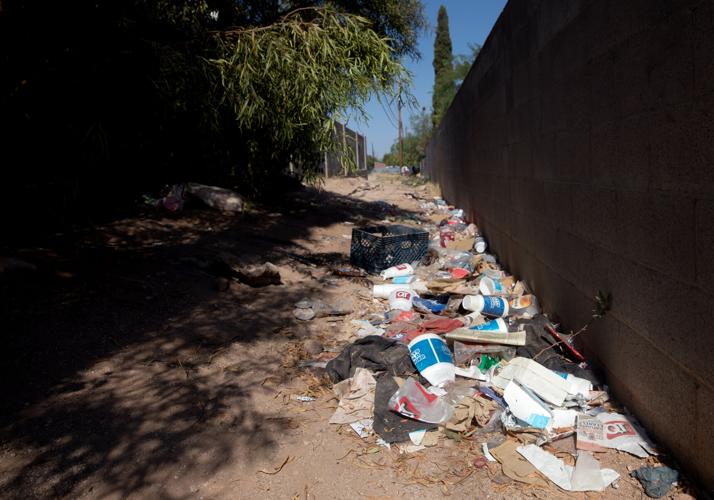
Tucson has received the most complaints of any Arizona city or county from a voter-approved law that lets property owners request a rebate of a portion of their property taxes if a city, town or county refuses to enforce laws against public nuisances, like illegal camping.
• We experienced two attempted break-ins, the second of which was captured on Ring video at 4:30 a.m. Individuals, masked and carrying backpacks and duct tape, tampered with my garage door operner and outdoor security light in an effort to gain entry. They gained access to my courtyard and were actively trying to enter my front door. Thankfully, I was able to stop the incident in progress.
This person included receipts for front gate repairs, Ring floodlights and security cameras, and a new security door. The city of Tucson's Jay Calhoun Zenzen rejected the application citing a variety of reasons.
"Proposition 312 is focused on local governments not enforcing laws related to issues like illegal camping or loitering that the locality has not addressed," one part of the response says. "Your reports demonstrate that the city addressed your concerns, and the conditions were not the result of a policy, pattern or practice of the city refusing to enforce applicable laws."
The city rejection of this complaint also noting that some of the resident's expenses happened before the law took effect. Finally the city said residents are asking for more money than allowed under the law, due to their small sales tax bills.
Rejecting even tiny claims
Property owners in the city of Tucson pay very little property tax to the city. This person who filed for $2,024.98 in expenses, for example, only paid $145.02 in property taxes to the city in 2024, although they paid $4,186.93 in total property taxes. That means they are only potentially eligible for $145.02 in reimbursement for that year.
If their complaint were approved, they could file again each year to continue getting reimbursed until they reach the amount they've been approved for. But to get back an amount like $2,024.98, it would probably take 13 or 14 years to be made whole.
Applicants may appeal these rejections by filing a special action in Superior Court, but of course that is a risky and costly proposition for a person who already has spent good money on home security.
I asked the Goldwater Institute, which was a force behind the passage of Prop. 312 about the background to the ballot issue and Tucson's response.
"The Safe Neighborhoods Act, Prop, 312 was carefully crafted and requires cities to return money to taxpayers when they fail to enforce their own laws," the institute said in a written statement. "Tucson has bizarrely claimed — without explanation — that it is unconstitutional. By not complying with Prop 312, Tucson is essentially violating the law twice."
But the city has found a way to push back. Until someone takes the challenge and sues Tucson, nobody is going to get even the small reimbursements available.

