

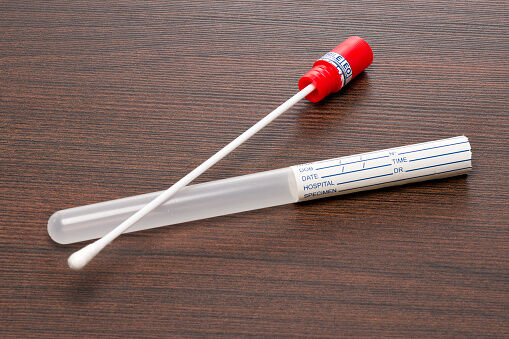
PHOENIX — A divided Senate voted Wednesday to require that anyone arrested for any felony provide a DNA sample to police, whether they are ever charged or not, much less convicted.
The 20-8 vote on House Bill 2102 came over objections of some lawmakers who questioned whether such an intrusion is justified. Sen. Kelly Townsend, R-Apache Junction, said she believes it violates constitutional provisions against warrantless searches.
But the majority of senators were swayed by arguments that 18 other states have similar laws, that the intrusion is minimal and that it could lead to Arizona being able to solve “cold cases’’ by having a larger DNA database. They noted there are procedures for those who are not charged or convicted to have the profile removed from state records.
That didn’t sway Sen. Michelle Ugenti-Rita, R-Scottsdale.
“If you want to pass things because the ends justify the means, then that’s exactly what you’re going to do in this case,’’ she said. “You want their DNA? Get a warrant and use the process.’’
Current law requires DNA collection following conviction of crimes. It also spells out that police can collect evidence after arresting people in connection with certain specified crimes, including homicide, sex offenses, prostitution and burglary of a residential structure.
HB 2102 would extend that to any felony offense.
Sen. Warren Petersen, R-Gilbert, said it’s no big deal because people leave their DNA everywhere. He told lawmakers that someone who wants theirs could simply take it from their papers on their Senate desks or even “follow us to the yogurt shop and grab the hundred spoons that we just dropped into the garbage can.’’
All this measure does, Petersen said, is expand the use of an existing tool for law enforcement.
He said he doesn’t believe there is anything special about DNA. “It’s like an ID,’’ he said. “It’s like knowing your name or your address.’’
Sen. Sonny Borrelli, R-Lake Havasu City, said it’s no different than when police take someone’s “mug shot’’ and fingerprints after arresting them.
The legislation has been a crusade by Jayann Sepich, who has testified in multiple states about the 2003 rape and murder of her 22-year-old daughter, Katie, who was a graduate student at New Mexico State University.
Speaking to Arizona lawmakers earlier this year, Sepich said the only evidence in the case was the DNA left under her daughter’s fingernails after she fought for her life. That evidence led years later to the arrest and conviction of a man whose DNA was on file for prior felonies, Sepich said.
During Tuesday’s debate, Sen. Victoria Steele, D-Tucson, said she understands how DNA can be “misused.’’ But she told colleagues this proposal makes sense.
“The fact is, every day innocent people are needlessly violated, raped, murdered, shot, knifed by repeat offenders,’’ Steele said.
“We have the technology now to help prevent some of that,’’ she said. “We have the technology now that will help us catch repeat offenders sooner, that will help us prevent violent crimes.’’
Steele said DNA can also be used to exonerate the innocent.
Townsend, however, said all that has to be measured against the U.S. Constitution.
“The right of the people to be secure in their persons, houses, papers and effects against unreasonable searches and seizures, shall not be violated,’’ she quoted the document. The amendment says the only way to get a warrant must be “upon probable cause.’’
But Petersen said the constitutionality of DNA collection is clear, citing a 5-4 ruling by the U.S. Supreme Court in 2013 that taking samples from a cheek swab as part of the arrest procedure is legal because it serves a legitimate state interest and is “minimally invasive.’’
Townsend countered that lawmakers need to recognize people are sometimes wrongfully arrested, possibly because of “political motivation, a political hit.’’
“Is any one of us at risk of being targeted politically and arrested for a felony that we are later able to prove that we are innocent of?’’ she asked. “But, meanwhile, they have forcefully taken our DNA against our will simply because we’ve been arrested.’’
Townsend wasn’t impressed by Petersen’s argument that people leave DNA around all the time.
“Just because you can take it off my desk doesn’t mean you have a right to take it during an arrest,’’ she said.
Existing law requires courts to order the removal of DNA records in cases of people who are not charged, not convicted or whose convictions are overturned.
HB 2102 would add language to specifically require any agency that collects DNA to provide both oral and written notice explaining the process, including instruction on how to ask the court to remove the evidence.
Sen. Lupe Contreras, D-Avondale, in voting for the measure, said he has to err on the side of providing a tool for law enforcement.
“I’m hopeful that my family never has to go through anything to where this is the way they find the perpetrator or anything like that,’’ he said. “But if this is going to help any one of my family members, or just anyone at all in our great state ... I want to do the right thing.’’
HB 2102 now goes to the House, which has not considered the measure.

