


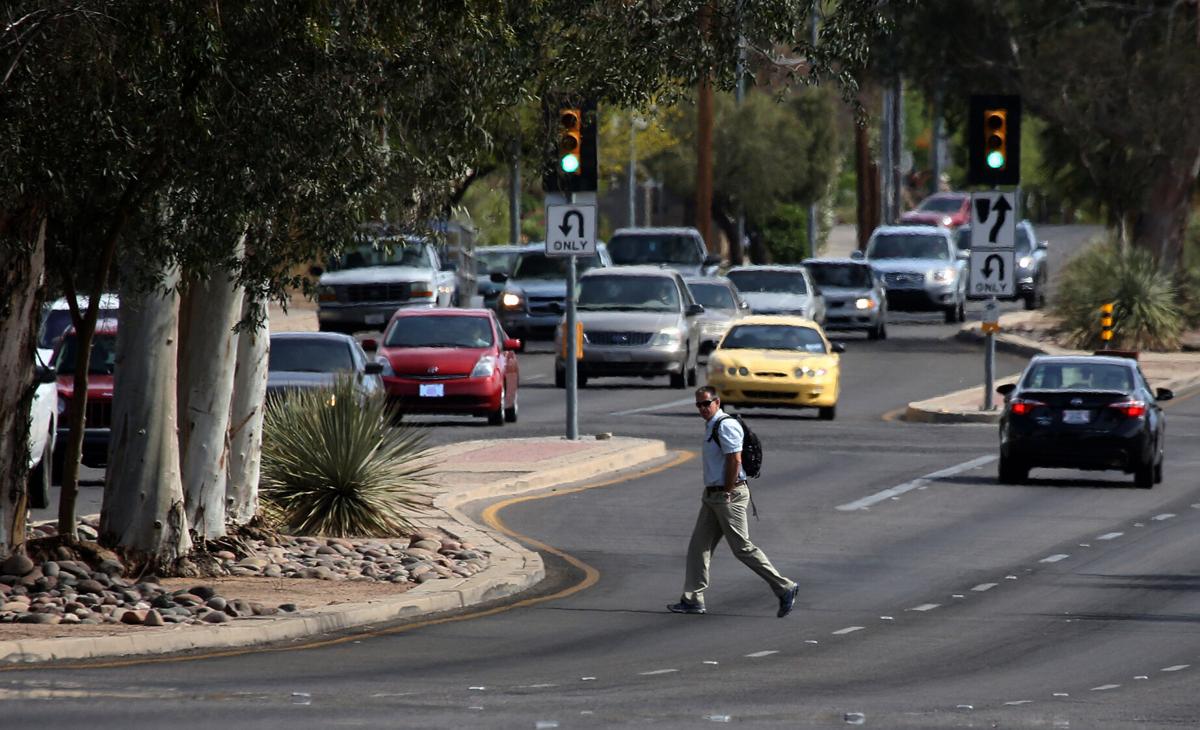
PHOENIX — Riding a bicycle and run into the side of a moving vehicle?
It turns out state law doesn’t require you to tell police who you are.
Ditto scooter operators and jaywalkers who violate state traffic laws.
And now Tucson police officers want state lawmakers to close that loophole to allow them to demand identification of those people, a move that would allow officers to start issuing citations.
But the request comes despite concerns by several lawmakers about not just about protecting the Fifth Amendment rights people have against self-incrimination but the possibility that more interactions between police and citizens at traffic stops will lead to situations escalating — especially when they involve racial minorities.
Jobe Dickinson representing the Tucson Police Officers Association told members of the House Judiciary Committee on Wednesday that in 2022 there were 99 fatal collisions in Tucson. Of that, 49 were pedestrians and six were bicyclists.
State traffic laws do apply not only to those driving motor vehicles but also anyone operating anything else on a street, as well as to pedestrians. Only thing is, the ability of police to cite errant “non-operators” — anyone other than the driver of a vehicle — is hampered by the fact that courts have overturned statutes that allow police to demand their names.
“What Tucson is experiencing is we run into someone who’s committed a violation, say jaywalking or riding on a sidewalk doing something differently,” Dickinson explained.
“If that person just remains silent, we cannot ask them their identity,” he continued. “There’s no way to write them a citation, anything, to enforce the current (traffic) laws.”
Joe Clure of the Arizona Police Association echoed the concern.
“Right now, we’re hamstrung,” he said.
“All they got to do is sit there and look at us and we can do nothing,” Clure said. “And the pedestrian accident fatalities will continue to rise in the city.”
SB 1088 would spell out that police have the power to demand the person’s name, address and date of birth if they have “reasonable cause” to believe a traffic law was violated.
“Maybe it’s a 12-year-old riding a bike,” he said. “Maybe ... it’s their first time in Arizona.”
And Dickinson said he’s not saying they have to produce identification.
“But we do believe they need to give their true identity,” he said.
Jobe Dickinson, a representative of the Tucson Police Officers Association, spoke to the House Judiciary Committee on Wednesday about a bill that would change identification requirements during traffic stops. Video courtesy of Arizona Capitol Television.
Dickinson sought to assure lawmakers that the measure isn’t designed to allow police to start questioning the occupants of vehicles.
“If the car is speeding and I stop the car for speeding, I am contacting the driver,” he said.
“They are the ones I have reasonable suspicion,” Dickinson continued. “The passenger had nothing to do with that traffic violation.”
But it’s not that simple.
“If they were not wearing their seat belt they are committing a traffic violation because you are required to wear your seat belt in the front seat,” he said. “So, yes, I would be able to ask them.”
All that drew alarm from Rep. Analise Ortiz, D-Phoenix.
“Our state has a sordid history of racial profiling that we didn’t even talk about,” she said.
“And where does that happen? At these traffic stops,” Ortiz continued. “And it disproportionately impacts my community and Black and brown Arizonans.”
All that, she said, could cause “escalations in traffic stops” to where what was a simple incident spins out of control when people are told they have to talk to an officer when they currently do not.
“And that only opens up the potential for dangerous interactions and for my community to potentially be harmed as they so often are in these traffic stops,” Ortiz said in voting against the measure.
Rep. Alexander Kolodin, R-Scottsdale, said he was concerned people police would approach under this law might not understand there is a limit to what they have to say.
Kolodin, who is an attorney, said he knows he needs to provide only his name, address and date of birth.
But he said he fears that those without legal training might believe they need to say more. And in doing so, Kolodin said, they would effectively be waiving their Fifth Amendment rights against self-incrimination.
What he wants included in the legislation when it now goes to the full House is some requirement that police affirmatively inform the person that the name, DOB and address is all they are required to provide — and that they need not say anything more. And Kolodin, who voted for the bill in committee, said he won’t support it on the House floor without such language.
The whole fact that there had to be a public discussion — one that is preserved on the legislative website in video form — about what is, and isn’t, required now concerned McClure.
“Some smart YouTuber’s going to pull this video and educate even more people — which is OK — that currently the law is you don’t have to talk to police,” he said.
Even if the measure gains approval of the full House, it still needs to go to the Senate, which has never seen this version of the measure.

