


A national environmental group is taking aim at two federally subsidized farm programs it says are failing to help farmers across the Colorado River Basin adapt to the forces of drought and climate change reducing river flows.
In a new report, the Environmental Working Group criticized federal programs that insure farmers against drought-related crop losses and that pay farmers to adopt more conservation-friendly practices on their cropland. These programs encourage farmers to continue practices the group considers outmoded at a time when the Colorado River’s flows have shrunk by 20% since 2000, the report said.
Together, the two programs pumped $6.1 billion toward river basin farmers from 2017 through 2023, the group reported.
The crop insurance program in particular has a major presence in Arizona, the river basin in general and in Pinal County, lying just north of the Tucson area. Pinal County got more crop insurance payments than any other county in the river basin — about $153 million — from 2017 through 2023, the report said.
A longtime Pinal County farmer, Dan Thelander, said these programs have helped keep farmers like him in business during tough times such as the prolonged drought in this region since 2000. The crops he and other farmers grow are what the market wants, he told the Arizona Daily Star, saying it’s not feasible to rapidly shift on a wholesale basis to more drought-tolerant crops.
The Environmental Working Group, however, says these programs need serious modifications and reforms, in part to encourage farmers to grow less water-thirsty crops compared to the cotton and alfalfa crops now heavily grown in this region.
“Increased drought and higher temperatures in the region are inevitable, thanks to the climate emergency. In the not-too-distant future, Colorado River state farmers will not be able to farm what and how they farm today,” the report said.
The report said the insurance program funneled $830 million into the state, out of $5.6 billion paid in crop insurance to farmers across the seven-state river basin, from 2017 through 2023.
Arizona got the third-largest crop insurance payment of the seven river basin states, after California and Colorado.
Three other Arizona counties finished right behind Pinal as the highest-paid counties under this program in those years. They were Coconino, Navajo and Apache counties.
Overall, farmers in 108 of 119 counties that get water from the Colorado River received a crop insurance payment, the report said.
“In the Colorado River Basin states, farmers are on a collision course with the climate crisis,” the group wrote. “Agriculture’s ravenous water use can’t coexist with the area’s worsening drought.”

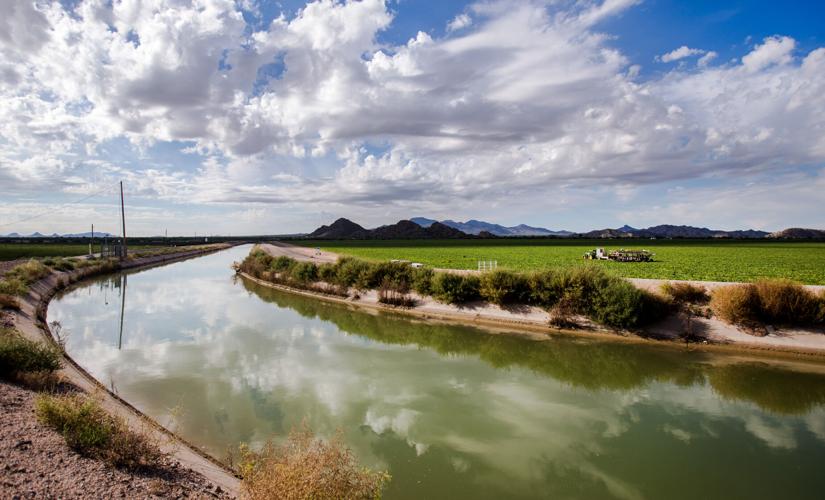
A canal ferrying Central Arizona Project water makes a bend around an agricultural field in Pinal County in this 2018 photo. A near-elimination of CAP deliveries to Pinal County farmers started in 2022 under a drought contingency plan. Federal crop insurance has “kept us going, and viable, when we had water shortages,” says Pinal County farmer Dan Thelander. But environmentalists say the federal subsidies discourage water conservation.
Pinal farmer Thelander said, however, “like a lot of other farms across the the U.S. we have used federal crop insurance. It’s been very helpful during tough years, when we have had water shortages and we weren’t able to farm all of our acreages. It kept us going, and viable, when we had water shortages.”
The shortages included a near-elimination of Central Arizona Project water deliveries to Pinal County farmers starting in 2022 under a drought contingency plan approved by Arizona and the other river basin states three years earlier. The plan was aimed at reducing river water use across the Lower Colorado River Basin, but it focused most heavily on cutting CAP water use.
The Maricopa-Stanfield Irrigation District, where Thelander farms, was getting 100,000 acre-feet a year of CAP water a few years ago, he said. Now, “we get 2,500 acre-feet of surface water through a water banking program with a water company. It’s a very small amount of surface water.
“We’re really struggling to try to get more irrigation wells operating, and a better pipeline structure, where we can deliver water around our irrigation district,” said Thelander, who farms on 7,500 acres near the city of Maricopa.
“We’re hopeful we get more CAP water in the future, but we’re planning for the worst and hoping for the best,” he said.
The government payments “help keep efficient producers in business during times of water shortages,” Thelander said. “They help producers of all sizes. They help us stay in business for things beyond our control.
“To abandon those types of efforts and only focus on farmers growing drought-tolerant crops, it’s just not going to work for the reality of farmers’ economics,” he said.
But with drought and heat worsening in the Colorado River Basin due to climate change, these farm support programs could better help farmers adapt to extreme weather, said Anne Schechinger, the Environmental Working Group’s Midwest regional director and the new report’s author.
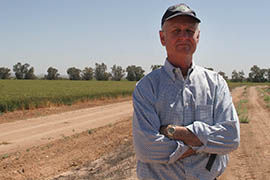
Pinal County farmer Dan Thelander says federally subsidized programs have helped keep farmers in business during tough times such as the prolonged drought in this region since 2000.
With roughly 74% of the river’s water that goes to human uses being put onto cropland, “it will be very difficult for farmers to farm as they do today. They need help to evaluate what crops to grow and what agriculture practices to adopt to help them adapt to extreme weather in the near future and the distant future as well,” Schenginger told the Star.
The report warned, “As the climate crisis deepens, drought and heat in the Colorado River region are also worsening, wreaking havoc on farms.
“The (U.S.) Department of Agriculture has a significant role to play in helping farmers in those and other states adapt and become more resilient to climate change — but two major USDA programs do neither,” a reference to the crop insurance and conservation programs the report criticized.
Livestock feed crops like alfalfa and other types of hay alone account for almost half — 46% — of all river water consumption, the report said. That was an apparent reference to a key finding of a recent, peer-reviewed study headed up by Brian Richter, president of another national conservation group known as Sustainable Water.
“In other words, millions of acres of thirsty crops that will feed livestock are being grown in an area running out of water,” the working group’s new report said.
If you subsidize risk, it makes farmers more likely to take risk, more likely to farm on marginal land and more vulnerable to extreme weather, report author Schechinger said.
“The crop insurance program causes farmers to think more about the next growing season. It doesn’t make them think about five or 10 years ahead.”
Thelander, however, said that while alfalfa does use a lot of water, “to produce pork and chicken and lamb and beef, you need to feed them a lot of alfalfa. You can’t have reasonably priced products in grocery stores without alfalfa.”
Currently, Thelander’s farms are growing guayule, a drought-resistant crop used in production of natural rubber. However, guayule occupies only about 80 acres of his farm’s total acreage.
“We hope it will be a viable crop in central Arizona. But we can’t grow only guayule in our farm. If West-wide, we (farmers) start only growing drought-tolerant crops, there is going to be a big hole in our food production,” he said.
But he noted that his farm is taking a state grant to switch 500 acres now receiving traditional flood irrigation to less thirsty drip irrigation.
“That will be considerably more efficient than flood; that is helping my farm to adapt to less water availability,” Thelander said.
Generally, agricultural scientists are working on drought-tolerant alfalfas and drought-tolerant grains “and on everything,” he said.
“Whenever new seed varieties come out, they will be more drought tolerant, and we will go for them,” he said. “We have to pay for the water. The bottom line is we’re going to grow crops that make the most profitable returns.”
The federal crop insurance program pays private insurance companies to sell and service policies for farmers and other crop producers.
The federal agriculture agency subsidizes parts of the insurance premiums that farmers pay, the insurance companies’ administrative costs and government costs for losses related to the policies.
Premium subsidies took in by far the largest share of the federal payouts. The subsidies averaged about 62% of the policyholders’ premiums in 2022, the most recent year for which such statistics are available, said a report from the federal watchdog agency the Government Accountability Office.
The crop insurance program is aimed at protecting crop producers against financial losses from price declines and from poor harvests due to natural causes, the GAO report said.
Of $5.61 billion paid to river basin farmers for crop insurance from 2017 to 2023, about 80%, or about $4.5 billion of that went to various programs regarding crops directly affected by hot and/or dry weather, the Environmental Working Group’s report said.
The balance covers costs for replacing crop irrigation water supply equipment damaged during hot, dry spells.
In the Colorado River states, the USDA crop category “pasture, rangeland, forage” collected the most drought-related crop insurance payments, more than $2 billion, the working group’s report said. Those crops include heavy-water-using crops such as alfalfa and hay.
Rice, corn and wheat made up the next largest group of crops for which farmers got drought-related indemnities.
Farmers of these three commodities received over $1.15 billion in crop insurance payments due to drought, heat and failure of irrigation supply or equipment, said the report.
Drought-related payments accounted for a larger share of total crop insurance payments in the Colorado River Basin states than nationally.
Across the U.S., half of total crop insurance payments went to drought-related payments. But in the Colorado River Basin states, such payments accounted for 61% of total indemnities of farm crop losses, the report said.
The Colorado River region also had a disproportionate increase in drought-related payments over the 2017-23 period analyzed — 297% in the river basin compared to a 253% increase nationally.
“Farmers in the region must change what and how they farm. With help from agronomic experts and USDA farm programs, farmers in the region urgently need to evaluate the crops they grow and the agricultural practices they use, to adjust to hotter and drier conditions,” the report said.
Get your morning recap of today's local news and read the full stories here: tucne.ws/morning

