


Rep. Raul Grijalva’s widow would receive an additional year of congressional salary under a legislative-branch appropriations bill being considered in Congress.
Grijalva is one of three members of the U.S. House who died while serving this year — the other two were Reps. Sylvester Turner of Texas and Gerry Connolly of Virginia — and the survivors of each would receive a $174,000 payment. In Grijalva’s case, the survivor named in the bill is his wife, Ramona.
It is tradition in Congress that the survivors of members who die in office receive a year’s pay in what is known as a “death gratuity payment,” said Demian Brady, vice president of research at the National Taxpayers Union Foundation, based in Washington, D.C.
“For every member who has passed away in office since 2000, every single one of them got this payment,” Brady said in an interview.
In fact, the tradition goes back much further than that. In 2021 research, Brady was able to find similar payments being made as early as 1880. But he has argued that it is an outdated tradition.
“It dates back to the earlier times in history when they didn’t have the large retirement programs that we have today,” Brady said. Today, he added, “it’s a completely different situation because members of Congress tend to be wealthy and there are statutory benefits.”
Members become eligible for a pension after five years, and the amount of that pension increases with time served in office, he said. Turner had served less than one year when he died. Connolly had served about 16 years. Grijalva had served more than 22 years.

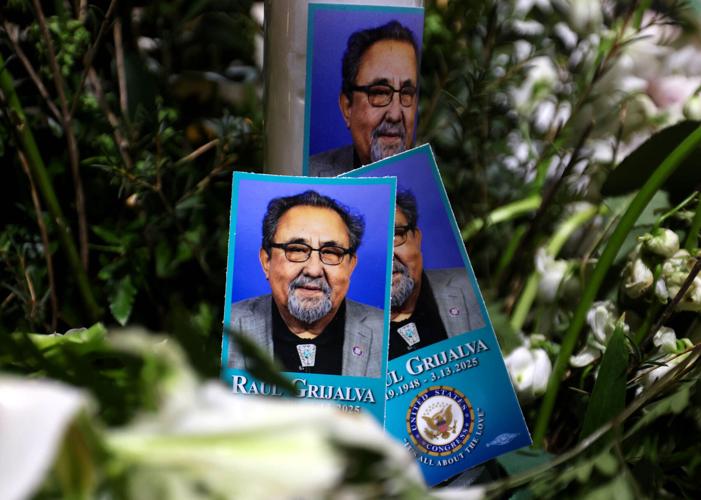
Memoriam stickers and candles available during the celebration of life for Congressman Raúl M. Grijalva at El Casino Ballroom, 437 East 26th Street, Tucson, March 26, 2025.
Brady argues that the tradition creates an incentive for elected members to die in office rather than resign when they can no longer serve. Of course, members may also hold out for other reasons, notably that they enjoy the role or are expecting their health to improve.
The latter apparently was the case with Grijalva. His longtime aide, Ruben Reyes, issued the same statement repeatedly during the congressman’s last months: “Congressman Grijalva is following the advice from his medical team with the goal of returning to Washington D.C.”
And before he was re-elected, he said that the 2024 election would be his last.
Ultimately, though, his health never improved enough. Grijalva held the job but only showed up briefly to cast votes twice in the period between March 2024 and March 13, 2025, when he died of cancer. He announced his diagnosis in April last year and won re-election in November.
"This is a standard benefit afforded to all House employees, members, and millions of workers in the public and private sector," Grijalva's daughter, congressional candidate Adelita Grijalva, said in a texted statement. "To suggest that my dad stayed in office for financial benefit is grotesque, it's a lie, and it is an insult to his memory, which my family and I are still in the process of grieving."
Rep. Bill Posey, a former member of Congress from Florida, introduced legislation to end the practice of gratuity payments while serving in the House, but his bill didn’t pass.
“I believe members of Congress should do what other Americans do, purchase their own life insurance,” Posey said in 2011.
There are no current bills that would end the death gratuity tradition, Brady said.
Most Foxx donors from out of state
The upstart campaign of Deja Foxx for the Democratic nomination for Congress is getting the vast majority of its financial support from out of state.
An Arizona Daily Star analysis of a portion of Foxx’s contributions shows that just 16% came from donors in Arizona, while 27.5% came from California and 15.5% from New York.
Only the itemized donations can be analyzed using Federal Election Commission filings, and those make up about 24% of Foxx’s $591,791.54 in reported individual donations. The Foxx campaign said that if all donations are taken into account, not just the itemized ones, the percentage rises to 18% of total donations being from Arizona.
Those proportions are in significant contrast to the other candidates for the Congressional District 7 nomination who have filed with the FEC.
Of Daniel Hernandez Jr.’s itemized donations, about 52% came from donors in Arizona, while 20.5% came from California and 7.5% came from New York. Itemized donations made up 85% of Hernandez’s $862,821.51 in individual donations.
Of Adelita Grijalva’s itemized donations, 63.5% came from donors in Arizona, 11% came from Washington D.C., and 6% from Maryland. Itemized donations made up about 55% of Grijalva’s $682,927.22 in individual donations.
Foxx has also benefited from a late infusion of independent spending. David Hogg’s Leaders We Deserve PAC has spent $150,000 on digital advertising and media production supporting Foxx. Hogg, who is leading a campaign against some Democratic incumbents, will appear with Foxx Friday evening at a Hotel Congress event.
The Tucson Families Fed Up PAC also reporting spending $23,502.04 supporting Foxx. This may account for a recent mailer many voters received supporting Foxx and opposing Grijalva.
More outside money has also come in supporting Grijalva. Progressive Promise, a group that had already spent $101,250 supporting her, has put another $120,000 toward digital ads for her. The Americas Future Project super PAC, based in Mesa, also spent $23,850 on get-out-the-vote mailers supporting Grijalva.
‘Crime-free’ activist source of Ward 6 mailer
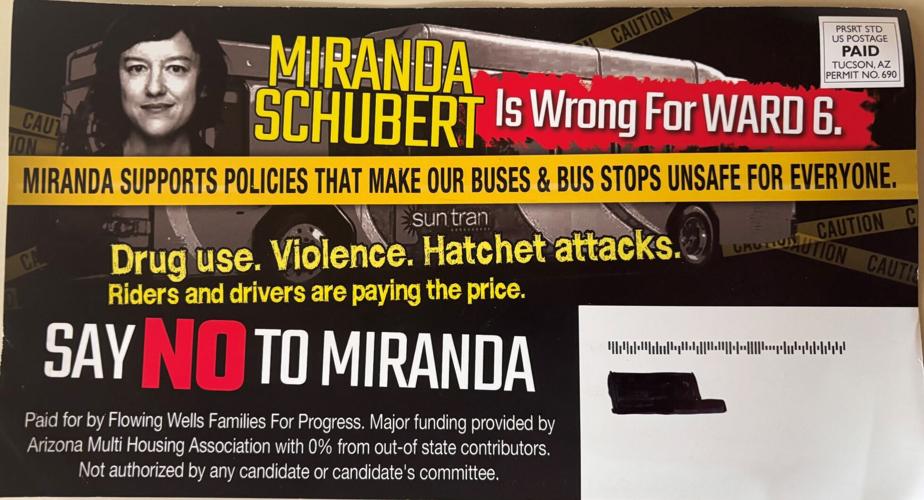
A mailer appeared in mailboxes across Midtown Tucson this week, slamming Ward 6 City Council candidate Miranda Schubert’s support for fare-free transit.
The mailer mentions “Drug use. Violence. Hatchet attacks.” And it says, “Miranda supports policies that make our buses & bus stops unsafe for everyone.”
It is the handiwork of Kevin Daily, who founded the political action committee Flowing Wells Families for Progress on July 3 with his wife, Marie. Major funding for the mailer is provided by the Arizona Multi Housing Association.

A political action committee formed by Kevin Daily sent out this mailer slaming Ward 6 Democratic candidate Miranda Schubert. Daily, a co-founder of the Tucson Crime Free Coalition, opposes Tucson’s fare-free transit policy.
Daily, who lives in Ward 3, also co-founded the politically active Tucson Crime Free Coalition and is president of the Flowing Wells school board and the Flowing Wells Neighborhood Association board. Daily and the coalition ardently oppose the city’s fare-free transit policy, which has been in effect since 2020.
Daily supports Leighton Rockafellow in the Democratic primary, in which James Sinex is also running. Rockafellow supports returning to charging fares, with free transit only for those who can’t afford it. Schubert wants to continue with the city’s fare-free policy.
Although Daily supports Rockafellow, Rockafellow condemned the mailer, noting he disagrees with Schubert on the transit policy, but said “the language used in this mailer crosses a line. It politicizes a tragedy and exploits the pain of victims for political gain.”
In a text, Schubert said “It’s disappointing to see fear mongering tactics being used in an attempt to manipulate our democratic process. I am proud of the campaign we have run and believe in Ward 6 voters’ ability to see through these baseless attacks as just that.”

