


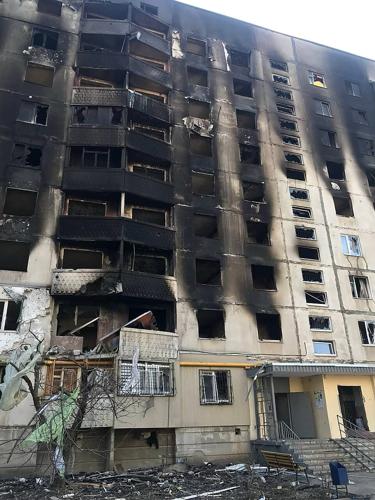



Two-thirds of their hometown’s residents have fled, their own apartment had its windows blasted out, and an artillery battle is raging nearby.
Still, Viktor and Liudmyla Lytvyn are ready to go home to Kharkiv.
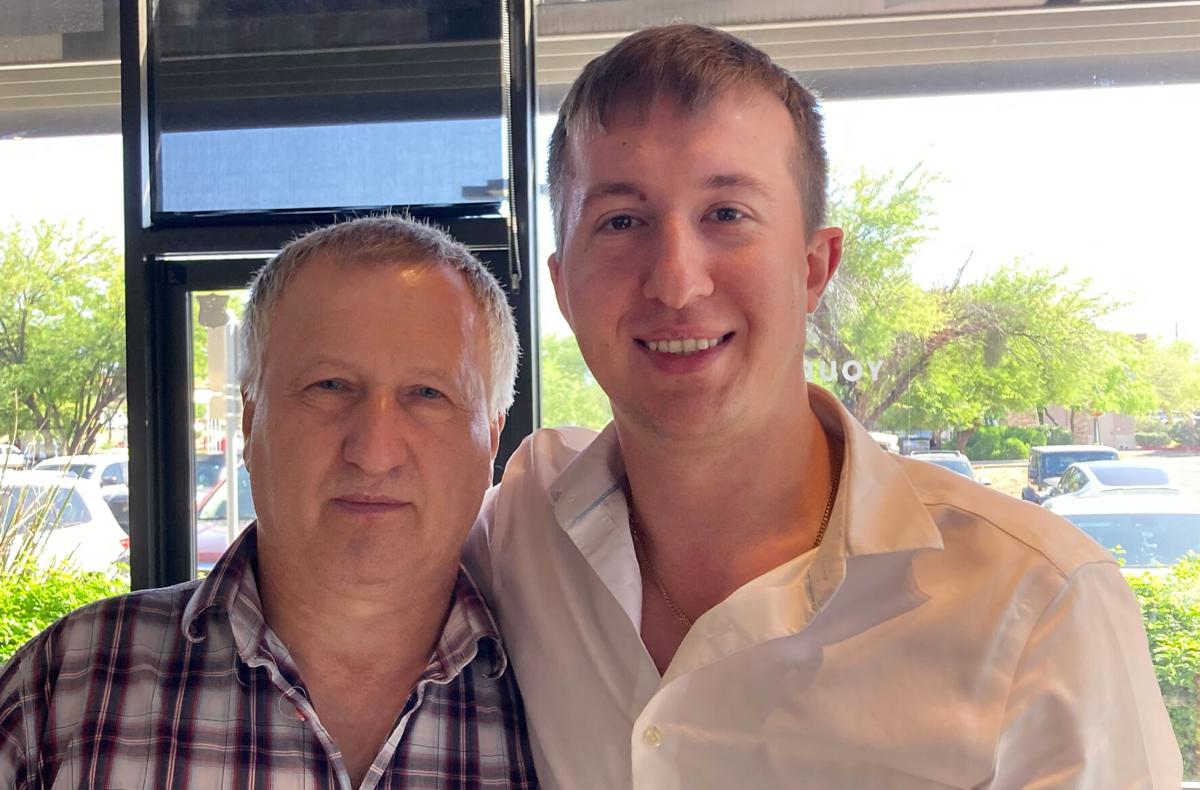
The Ukrainian couple has been in the Tucson area for months now, after war broke out during a visit to their son’s family in Oro Valley. Their son Oleksii Lytvyn, 33, and his wife Carly Booth, own the Monarch Ballroom dance studio on West Ina Road.
Liudmyla came from Kharkiv in December to help care for the couple’s 2-year-old child, her grandchild. Then Viktor followed Feb. 4. War had already been going on in far eastern Ukraine since 2014, when Russia first attacked, but none of the family really believed a new all-out war would happen — until Russia invaded Feb. 24. The Lytvyns were in Oro Valley.
“I was shocked,” Viktor Lytvyn said through his son, who translated for me when the three of us met at an Oro Valley coffee shop. “For a week we didn’t sleep. We watched the news all the time.”
In the first weeks of war, Russian troops nearly took Kharkiv, a northeastern city close to Russia’s border that is Ukraine’s second-biggest. But instead, what happened is wave after wave of shelling and bombing, destroying or damaging many apartment buildings and other structures.
Now, thanks in part to foreign military aid, Ukrainian troops are slowly pushing Russian forces back from the city and out of shelling range, in what the New York Times described from the front line Friday as a “grinding artillery war.”
Oleksii’s 38-year-old brother Pavel has stuck it out there in Kharkiv, along with about a third of the city’s 1.5 million residents. But the rest of Pavel’s family has also left the city, Oleksii said. Still, Viktor and Liudmyla are ready to return to their half-ruined hometown.
Putin twists Ukrainian history
When Russian president Vladimir Putin began threatening Ukraine again this year, he said it was to “denazify” the country.
The absurd claim made no sense to most people and had little impact outside of Russia, where the Great Patriotic War— World War II — is one of the country’s key unifiers. On Monday, May 9, Russia celebrates Victory Day, an important holiday that commemorates the Soviet Union’s victory over Nazi Germany.
Ukraine’s role in that war has been treated different ways by Soviet and Russian authorities over the years, Yale University historian Timothy Snyder has said in interviews and writings. During the war, Soviet Premier Josef Stalin celebrated Ukrainian resistance to German invaders, but afterward he cast suspicion on those countries occupied by the Nazis, where some people had collaborated.
Any resistance to Stalin in Ukraine would have been understandable, though. His policies caused the starvation of millions of Ukrainians in the early 1930s. Still, Ukrainians proudly fought for the USSR.
Viktor Lytvyn’s grandfather was a highly decorated commander in the Soviet Army during World War II, he said. He was a machine gunner who survived the war, even while two siblings died and a third was put into forced labor for Germany. Lytvyn said he heard the stories often as a child.

Kharkiv apartment buildings, like this one in the complex where the Lytvyns live, have been damaged or destroyed by Russian shelling and bombing.
“We’re the ones who fought the Nazis — now we’re the ‘Nazis,’” Oleksii Lytvyn said.
Putin has twisted the Soviet World War II heritage to fit his own designs, as historian Snyder told interviewer Chris Hayes in an April podcast. Because the Soviet Union won the war, a heritage now assumed by Russia, they’ve retained the right to label any enemies Nazis, Snyder said — even when they themselves are taking genocidal action against a sovereign people.
The idea, Snyder said, is “because we were on the right side of the war, we get to say who the Nazis are, even when we are the Nazis.”
“What ‘denazification’ means in practice is, ‘I (Putin) get to destroy your state, because a Nazi is just someone who resists me.”
‘Nobody believes us’
Kharkiv may be unknown to most Americans but is a historic and significant city in that region. From a strategic position, occupying Kharkiv could have allowed Russia to slice off a much larger, more important portion of eastern Ukraine than it already occupies.
“Kharkiv is one of the most beautiful cities in Ukraine for sure,” Viktor Lytvyn told me through his son. “For 10 years, this city has grown so much. New parks. Everything clean, everything beautiful.”
The family is not originally from there, though. They are from a city called Okhtyrka, farther west, which put up strong resistance to the Russian invasion. President Volodymyr Zelenskyy designated Okhtyrka a “hero city” for its resistance.

People stand in the hallway of their apartment building as Russian attacks continue in Kharkiv, Ukraine.
This designation serves as another reference point to World War II. Soviet authorities labeled as “hero cities” such places as Stalingrad (now Volgograd) that resisted the Nazi invasion. Now Ukraine is doing the same for its cities resisting Russia.
The Lytvyns are native Russian speakers, even though they are of ethnic Ukrainian heritage. People living farther west and in villages tend to speak Ukrainian, while people living in the east and the bigger eastern cities tend to speak Russian.
They know people across the border in Russia, too. Speaking with them has proved dismaying, Oleksii and Viktor Lytvyn said.
“We have relatives in Russia. We have friends in Russia,” Viktor Lytvyn said. “When we call our relatives in Russia, we say ‘What’s going on? Come out! Say no to war.’ Nobody believes us. They didn’t believe us.”

Firefighters work to extinguish a fire at a warehouse amid Russian bombardments in Kharkiv, Ukraine.
“They’re saying, ‘It’s fake. It’s not true. We’re not bombing the cities. We’re doing super accurate (attacks) with new technologies,” he said.
Understandable fears
Ukraine’s fertile soil has been coveted by foreigners for centuries. Lithuanians, Poles and Russians are among the colonial powers who have taken control.
Now Russia is attempting to deny the independent existence of the Ukrainian country and culture again, by force. It’s another colonial war, Snyder argues.
Citing’s Putin’s writings, Snyder wrote in a recent New Yorker essay: “His vision is of a broken world that must be restored through violence. Russia becomes itself only by annihilating Ukraine.”
Given that existential threat, and the slaughter and destruction in places like Bucha, Mariupol and Kharkiv, the only option Ukrainians have seen is to fight for their national life.
“They call themselves Slavic brothers, but Ukrainians don’t want anything to do with them anymore,” Viktor Lytvyn said. “It’s going to take a hundred years to wash the blood off their hands.”
We in the United States, of course, have given essential military help to the Ukrainians, something the Lytvyns gave profound thanks for. So have European countries. Understandably, though, getting involved worries some Americans.
I hear from readers concerned we are waltzing toward nuclear war with Russia. It’s an understandable fear, but it appears to me we are in a good position, by helping Ukraine push back their invaders without involving American troops directly. So far, the strategy is working.
And if you think we are taking a risk, imagine the Ukrainians themselves, fighting for their country’s independent existence. And imagine the millions of Ukrainian refugees, as well as stranded people like the Lytvyns, desperate to re-establish themselves in their Ukrainian homes and simply live their lives.
“Every time he thinks about Ukraine and the people, he feels bad he’s here,” Oleksii Lytvyn said of his father. “There is still his family, his home, and friends, so he wants to be close to them.”

