


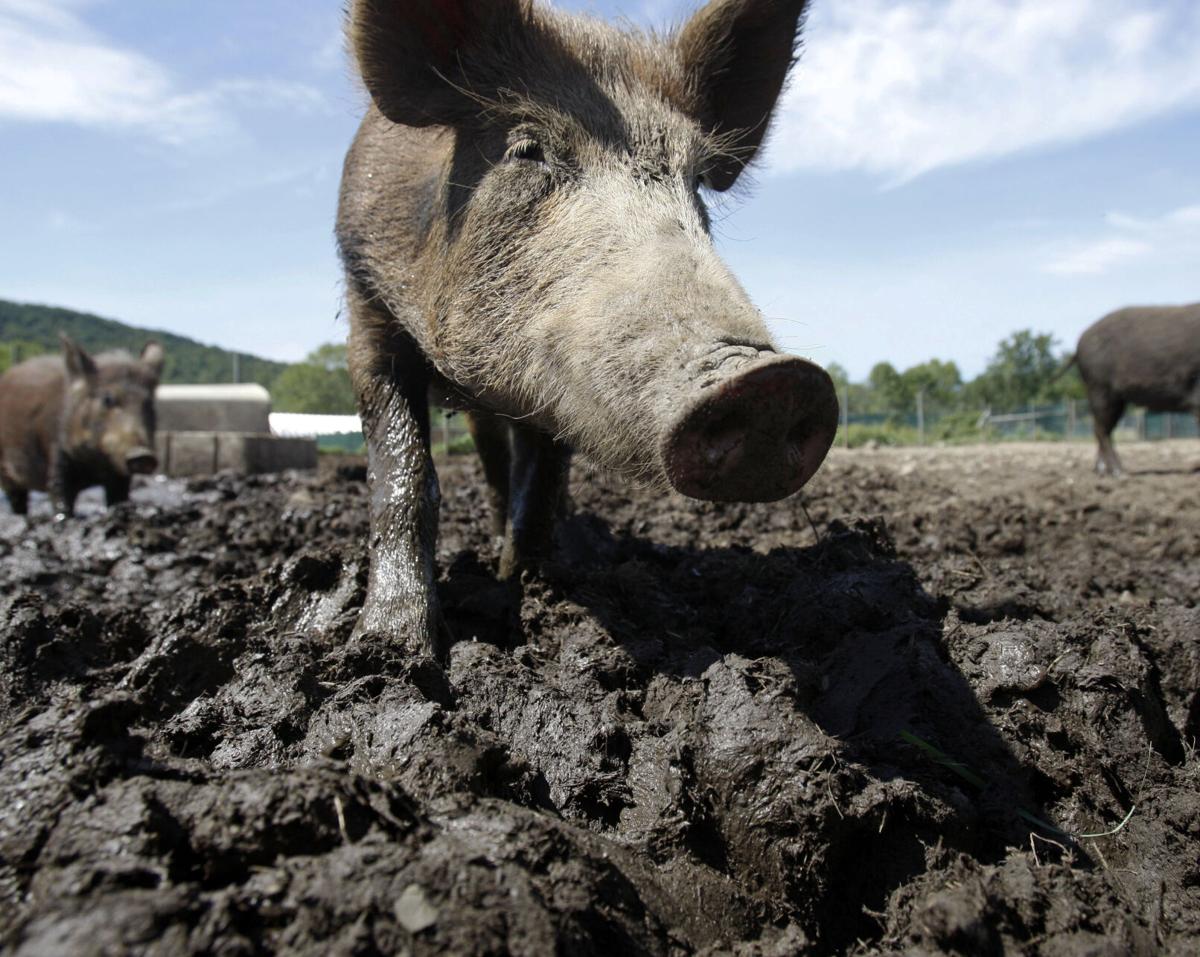
One is smaller and flat-edged and native to the Sonoran Desert. The other is larger, rounder and invasive, with the potential to wreck Arizonan agriculture and wildlife.
The former is a javelina (Pecari tajacu) and the latter is the invasive feral hog. Although sometimes confused for one another, they are two entirely separate animals. Javelinas are technically not pigs, as they are classified as peccary.
Feral hogs were brought to North America centuries ago by Spanish missionaries as a source of food. Some escaped. In some cases, Spanish explorers placed hogs on islands with the idea of finding them later.
They have since become invasive, threatening wildlife and livestock alike. They choose areas near water sources due to their lack of sweat glands.
In Arizona, they can be found in locations including the San Pedro River, Willcox and the Arizona Strip. The most concerning population is in Navajo County and is getting larger. The population on the Colorado River in Havasu National Wildlife Refuge is close to being eradicated. David Bergman, Arizona state director of USDA APHIS Wildlife Services, estimates there are fewer than 10 hogs left at Havasu.
“As for Arizona, our goal is eradication,” Bergman says. “And we’re doing this in partnership with the U.S. Fish and Wildlife Service, Arizona Game and Fish Department and the Arizona Department of Agriculture as well as a number of other land management entities.”
The invasion has been costly, yet difficult to quantify. A 2007 study by David Pimentel of the College of Agriculture and Life Sciences at Cornell University in Ithaca, New York, put estimated total damages at roughly $1.5 billion.
Sophie McKee, a research economist at the National Wildlife Research Center and Colorado State University, emphasizes how rough this number is. Much research still needs to be done, she said.
Disease spreaders
One danger of invasive feral hogs is the spread of diseases.
“If you look at it as a health issue, feral swine carry around 30 viral and bacterial diseases, around 40 different parasites,” says Bergman, state director of USDA Wildlife Services.
Some of these diseases have the potential to be zoonotic, meaning they can infect both animals and people.
One disease called Aujeszkys, or “pseudo-rabies,” can cause respiratory and reproductive issues in pigs. It has been eradicated from commercial herds but persists among the feral hogs. Although not a threat to humans, it is a cause of concern if pets or livestock contract it through contact with a hog carcass.
It can be deadly for horses, cattle and pets, dogs especially, says Dr. Alex Ramirez, senior associate dean for academic programs and faculty affairs at the University of Arizona College of Veterinary Medicine.
The threat of these diseases necessitates the added expense of vaccinating animals, McKee says.
Rooting up plants
Another danger presented by feral hogs is a habit of theirs known as rooting. This can damage both properties and ecosystems. According to Bergman, feral hogs will root around on a golf course or dig up native plants, hurting a habitat that isn’t evolved to handle their presence.
What makes this phenomenon even more difficult is that it’s a team activity.
“The challenge with that is where you find one, you find many,” Ramirez says. “So it’s not like just one pig that rooted things up in your backyard or the area, it’s a whole group of them together will do that, and can be very devastating to that environment.”
Rooting can cause habitat destruction for some wildlife species by changing the water quality in riparian areas. Feral hogs have also been known to eat snakes in these areas. Riparian damage is a concern for endangered frogs, native fish and a number of bird species, Bergman says.
Unexpected costs
Invasive feral hogs create many predictable expenses such as replacing hay that’s been eaten, fixing damaged fences and enacting surveillance measures — either detection systems or hired dog handlers. And, in their quest for water, hogs can destroy irrigation systems.
But hog-induced expenses can pop up in some more unexpected ways as well.
“We’re discovering every day new items that they can damage,” McKee says.
In a situation known as opportunity cost, farmers are forced to restructure their business models to avoid the hogs’ wrath. They select their agricultural commodities based on what the hogs do or don’t like to eat, rather than on profit.
The feral hogs also wallow in fields, causing farming equipment to get damaged by running on soil that isn’t flat, according to McKee.
Yet another way that these pigs drain the human bank is by causing car crashes.
Hog heaven
There is hope for Arizona to be relieved of its feral hog invasion, as it is a category one state. In comparison, Texas is a category five state, meaning feral hogs will most likely never be fully wiped out there. South Dakota is one of close to 16 “zero states,” which have no feral hogs at all, Bergman says.
Methods for removing feral hogs include shooting and trapping. Aerial hunting is one of the best options currently available. For the future of hog eradication, experts have their eye on toxicants such as Hoggone. Additionally, sodium nitrate is used in Australia, and experts hope to add it to the mix here at some point. Immuno-contraceptives are another item on the wish list for future eradication tools.
“We want to ensure that we’re protecting the natural resources here as well as economic viability for the agriculture industry,” Bergman says. “And, in addition, protect human health and safety.”
In 2014, Congress allocated $20 million for the creation of the National Feral Swine Damage Management program. But since the goal is to not only control the current invasion, but also prevent its spread to zero states, McKee says more funding is needed.
“When you have a fire, you’re like ‘Oh, yeah, we need a lot of money to put the fire down,’” McKee says. “But maybe it would be good also to put money to prevent the fire from spreading.”

