



The coronavirus turned loved ones into statistics and kept families from gathering in hospital rooms and funeral homes to say goodbye.
A new public art project on Tucson’s south side will give that community a place to remember the names of those who were lost.
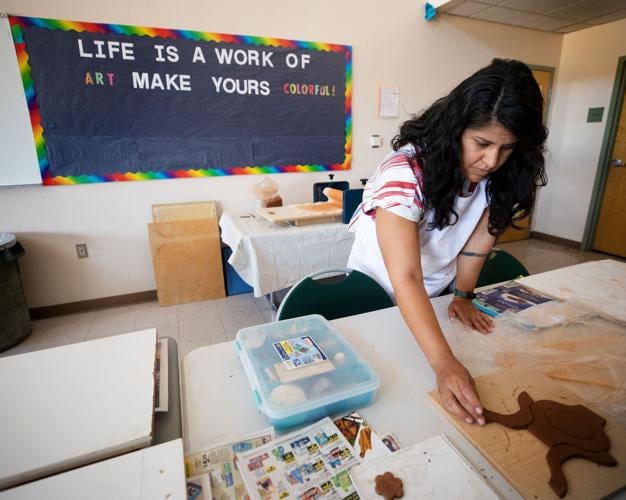
Tucson artists Alexandra “Alex!” Jimenez and Paloma Jaqueline plan to build a large altar dedicated to southside residents who died from COVID-19, and they are seeking help from the community to decorate the ceramic tiles that will cover the memorial.
Jimenez is hoping the site will become a sort of permanent ofrenda, where families can mourn and remember their loved ones.
“A lot of families weren’t able to grieve or have the ceremony they would have wanted if there hadn’t been a pandemic going on,” the southside native said.
Almost 1,000 southside residents have died from COVID-19 since March of 2020, according to figures from the state that loosely cover metro Tucson south of 22nd Street and west of Kino Parkway. That’s nearly one quarter of all coronavirus deaths recorded in Pima County.
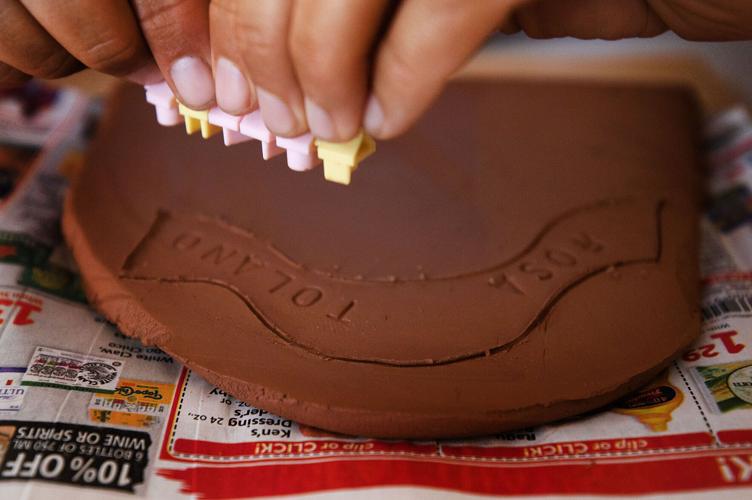
Many of those names will be stamped on the tiles that will decorate the “In Memory Of” project.
With approval from the city of Tucson, Jimenez and Jaqueline hope to install the altar by the end of June at Mission Manor Park on 12th Avenue south of Drexel Road, in the Sunnyside Neighborhood.
“The memorial is for the southside community, and it will live in the southside community,” Jimenez said.
There are several ways for southside residents to participate in the project: People can submit the name of a relative to be added to the memorial; they can come in and physically stamp their loved one’s name into the clay; or they can attend one of several upcoming workshops to create a special tile for the person they lost.
The next workshop will be held from 2:30 p.m. to 5 p.m. Saturday, April 15, in the arts and crafts room at Quincy Douglas Recreation Center, 1575 E. 36th St.
Jimenez said the personalized tiles have enough room on them to be imprinted with small objects of importance to the departed — a ring, a comb, a watch or a string of rosary beads.
Creating such a tribute can be an emotional experience, she said, so private studio time is available for anyone who isn’t comfortable being around other people in a workshop setting.
Each tile is roughly 6 inches wide, 6 inches tall and rounded into the shape of an eye. “I’m not a fan of squares,” Jimenez said with a laugh.
The finished memorial will include about 300 tiles, arranged in an interlocking pattern that is meant to evoke waves on water. They will be glazed in different shades of blue to fit a sky-and-water motif, with water on the bottom and the night sky on top.
“There is something healing about water,” Jimenez said.
She should know. She recently served as Tucson Water’s first-ever artist-in-residence. That grant-funded position led her to collect audio recordings of summer storms and recruit local musicians to build original songs around them, resulting in last year’s release of a uniquely Tucson “Monsoon Mixtape.”
The COVID-19 memorial is being funded with a $77,000 grant administered by the city and paid for by the American Rescue Plan, a federal pandemic-relief bill.
This is her first time working with clay, but Jimenez said the experience has felt familiar from the start. There is something almost instinctual about molding it in your hands.
“It’s healing and grounding, because you’re working with the earth,” she said. “It just feels right, like we’ve been doing it our whole lives.”
She has also learned a lot about ceramics from her project partner, Jaqueline, an expert potter and “phenomenal teacher,” Jimenez said.
The idea for the memorial grew from her own experience with unexpected loss and grief. Seven years ago, Jimenez’s mother died from cancer at age 52.
“I started realizing the extent of early death in the southside community,” she said. “My story just wasn’t unique, which is really sad.”
The All Souls Procession returns for its 33rd year Nov. 6, with the two-mile route winding through Tucson's Barrio Hollywood and Menlo Park neighborhoods. Here's a recap of the past 10 years of the annual event.

