



The Trump administration's Interior Department is moving to overturn a Biden administration legal opinion — stemming from two federal court rulings — that blocks mining companies from disposing of wastes on much of the land owned by the Bureau of Land Management.
Interior's planned change would reverse a 2023 department policy established to mesh with court rulings limiting mine waste disposal on U.S. Forest Service land. The first of those rulings stopped the Rosemont Mine from being built in national forest in the Santa Rita Mountains southeast of Tucson.
Mining companies and their political allies have blasted the court rulings and the Interior solicitor's 2023 opinion as an overturning of 150 years of precedent for how and where waste rock and mine tailings were dumped. But environmentalists have said traditional waste disposal practices were clear violations of the 1872 federal law that was passed to encourage mining on public lands.
U.S. District Court judge James Soto in Tucson ruled against Rosemont in 2019 and that opinion was upheld in 2022 by the 9th Circuit Court of Appeals. The courts in both cases ruled the Forest Service had erred in approving the placement of 1.95 billion tons of waste rock and tailings on nearly 2,500 acres containing federal mining claims.
Tony Davis graduated from Northwestern University and started at the Arizona Daily Star in 1997. He has mostly covered environmental stories since 2005, focusing on water supplies, climate change, the Rosemont Mine and the endangered jaguar. Tony and David talk about the award winning journalism Tony has worked on, his journey into journalism, Arizona environmental issues and how covering the beat comes with both rewards and struggles. Video by Pascal Albright/Arizona Daily Star
Now, in an executive order, new Interior Secretary Doug Burgum has directed his assistant secretaries to quickly come up with a series of "action plans" that would "suspend, revise or rescind" the May 2023 Interior solicitor's opinion and a host of other department regulations, secretary's orders, solicitor's opinions and departmental manuals.
Three pending mine proposals on BLM land in Arizona could at least theoretically be affected by Burgum's plan to loosen mine waste disposal rules, depending on how they choose to dispose of their wastes. Arizona has 12.1 million acres of BLM land in total.
Closest to Tucson is a large copper mine project planned for the Galiuro Mountains near Mammoth on private and BLM lands. The Copper Creek mine is proposed by Faraday Copper, based in Vancouver, B.C. It would include at least 28 square miles of private land and 32,000 acres of BLM land. BLM will hold a virtual public meeting on March 6 to provide public information about that project.

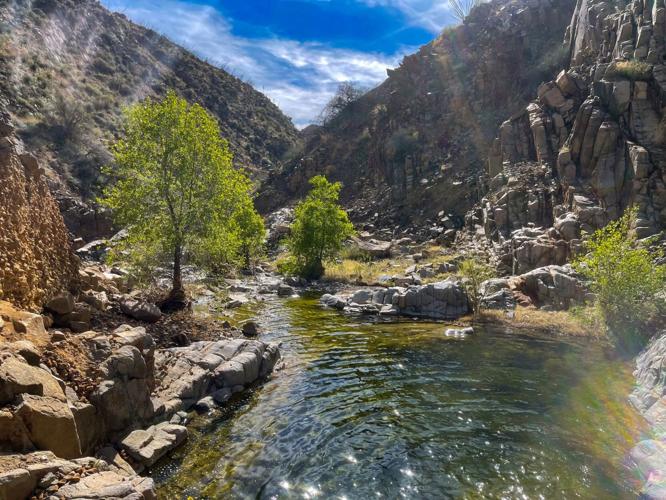
Water flows down Copper Creek, not far from the site in the Galiuro Mountains where Canadian company Faraday Copper is proposing to build an open-pit and underground mine.
A proposed lithium mine project in the Willcox Playa south of Willcox also contains some BLM land. Max Power Mining Corp., also of Vancouver, B.C., has been conducting exploratory drilling on state land and has filed mining claims on neighboring BLM land.
And last June, BLM announced its approval of the Big Sandy Valley Lithium Exploration Project near Wikieup, nearly 140 miles northwest of Phoenix. The approval allowed Big Sandy Inc. to drill and test up to 131 exploration holes on about 21 acres of BLM-managed land to determine if full-scale lithium mining would be viable. That drilling has been put on hold by a federal court injunction in a lawsuit filed by the Hualapai tribe, which says the drilling would endanger sacred cultural properties.
Burgum's order is aimed at carrying out provisions of President Donald Trump's Jan. 20 executive order titled "Unleashing American Energy." It directs the removal of "impediments imposed on the development and use of our nation's abundant energy and natural resources by the Biden administration's burdensome regulations," Burgum wrote in his new order.
"By removing such regulations, America's natural resources can be unleashed to restore American prosperity. Our focus must be on advancing innovation to improve energy and critical minerals identification, permitting, leasing, development, production, transportation, refining, distribution, exporting, and generation capacity of the United States to provide a reliable, diversified, growing, and affordable supply of energy for our nation," Burgum wrote.

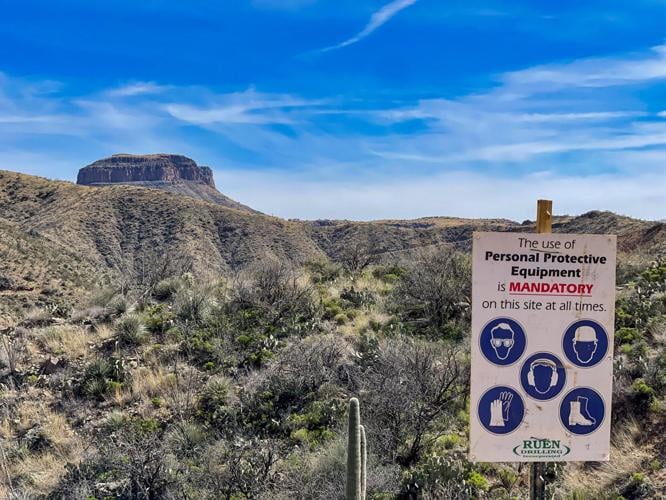
A sign in the Galiuro Mountains marks a location of drilling activity for the proposed Copper Creek open-pit and underground mine. The mining proposal is one of three pending on BLM land in Arizona that could at least theoretically be affected by the new Interior secretary's plan to loosen mine waste disposal rules, depending on how they choose to dispose of their wastes.
Environmentalists say Burgum is ignoring the federal courts.
"It looks like Burgum s laying the groundwork for going back to the days where mining companies can go dump trash on public lands," said Aaron Weiss, deputy director of the environmentalist Center for Western Priorities. "It's not the way the 1872 Mining Act is written. The courts have ruled on that.
"It's a dangerous trend we're starting to see across the Trump administration — ignoring the courts. He's withdrawing a (BLM) guidance that says 'follow the court order'. The only reason you're withdrawing that order is if you're preparing to disobey the courts," Weiss said.
The Interior Department didn't respond to a request from the Star for comment on that allegation.
The 2023 solicitor's opinion tells the agency not to approve mining plans that call for dumping mine wastes on lands not known to contain valuable minerals. The solicitor's opinion is binding on the BLM staff but is not a formal regulation.
A National Mining Association spokesman, Conor Bernstein, said the group is pleased to see the Interior secretary recognize the need for certainty for mining companies to be able to use land for essential support activities such as buildings, roads and processing facilities.
"The May 2023 Solicitor’s Opinion was a flawed response to flawed court decisions that upended more than 150 years of precedent related to how mining is conducted," Bernstein said.
While that opinion was carefully crafted to remove legal ambiguities around a specific project, "it did nothing to address the larger issue for mines across the country," he said.
"Mining companies often invest hundreds of millions of dollars into a project before earning a single dollar in return; they must have the certainty that the responsible projects they invest in will eventually move into production," said Bernstein.
But "as a matter of law, the Interior secretary cannot ignore the binding and controlling Rosemont decision regarding mining operations proposed on lands that have not been verified to contain rights under the mining law," said Roger Flynn, a Colorado attorney who successfully argued the case against the Rosemont Mine's use of federal land for waste disposal.
Such lands include waste and tailings dumps and "other infrastructure (on) mining claims that have not been shown to be valid," said Flynn, director of the Western Mining Action Project in Lyons, Colorado.
Asked about the court rulings that have legally blocked the disposal of mine waste on forest and in one case on BLM land, the mining association's Bernstein said, "You’re underscoring the need for durable clarity.
"That’s precisely why we strongly support the Mining Regulatory Clarity Act which was just reintroduced with bipartisan, bicameral support," Bernstein said of a pending congressional bill that would legally overturn the two Rosemont rulings.
The bill would lift the court rulings' requirement that mining operations prove the land where they wish to dispose of wastes contains valuable minerals.
Bernstein called that bill "a durable path forward to ensure the fundamental ability to conduct responsible mining activities on federal lands."
Blaine Miller-McFeeley, a lobbyist for the Washington-based Earthjustice environmental law firm, called the bill “a wholesale giveaway to mining companies.”
“Now that the judicial system has finally begun to interpret the antiquated 1872 mining law in a way that calls into question the irresponsibility of the mining industry ... we see the industry rushing to do damage control,” said Sarah Wochele, the mining justice organizer of the Progressive Leadership Alliance of Nevada.

