

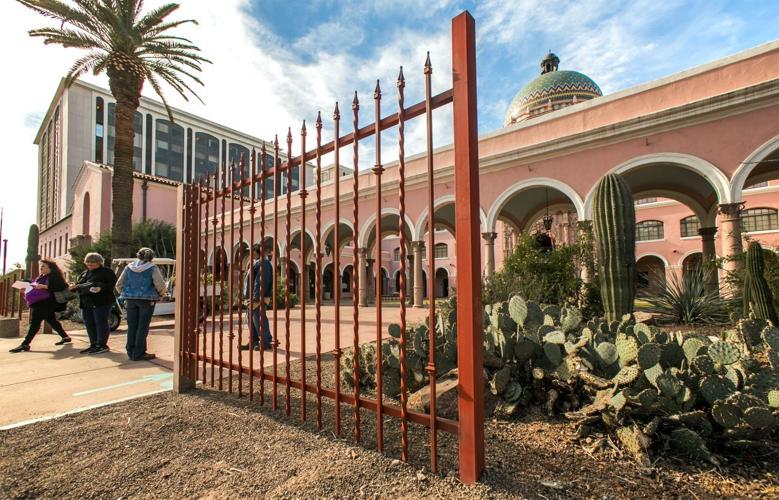
Months after building fences around the terraces at the Pima County government complex, workers have begun to install similar barricades at the historic county courthouse building.
“We have now moved all of the uses that were in the historic courthouse to a new facility,” Pima County Administrator Chuck Huckelberry said. “And in doing so we need to increase the security for the facility.”
One gate will be installed along the east side of the courthouse and another will close off the west entrance through the arched walkway. A covered walkway on the building’s south side also will be closed off with gates after hours.
Huckelberry ordered the installation of the fences in the spring after months of cleanup efforts around the county’s downtown buildings.
“Unfortunately, some of the homeless were using it as a
restroom, and that’s not what it’s purpose is,” Huckelberry said.
There also were incidents of vandalism, which Huckelberry said added to the need to secure the courthouse, known to most Tucsonans for its iconic tiled dome.
The problems of daily waste and garbage accumulation reached an apex early this year when dozens of people living in wooden boxes, tents and other structures filled downtown sidewalks at the height of the so-called Safe Park movement.
Safe Park stemmed from a pair of lawsuits filed by homeless activists against the city of Tucson, which had denied extended overnight usage of a city park.
City officials, concerned that a federal judge’s earlier ruling prevented them from stopping people from sleeping on sidewalks, allowed the population of homeless downtown to swell.
In March, the judge told city officials nothing in his ruling prevented police from enforcing existing ordinances, and the tents and boxes were ordered removed.
The number of people sleeping on sidewalks downtown has decreased since then, but a small contingent stays on the Church Avenue sidewalk near Congress Street.
Huckelberry said fences and gates at the old courthouse would be locked nightly to prevent after-hours access to the building.
The building had been slated for millions of dollars in county bond funding from the recent bond proposal, but voters rejected all seven questions in the $815 million plan.
The funding was to have paid for a museum and the redesign of El Presidio Plaza west of the courthouse.
Huckelberry said the county now would look at repurposing the building for other uses.
“We’re now looking at various adaptive-reuse plans for this facility that vary from as much as a museum to more professional offices to a visitor center,” Huckelberry said.
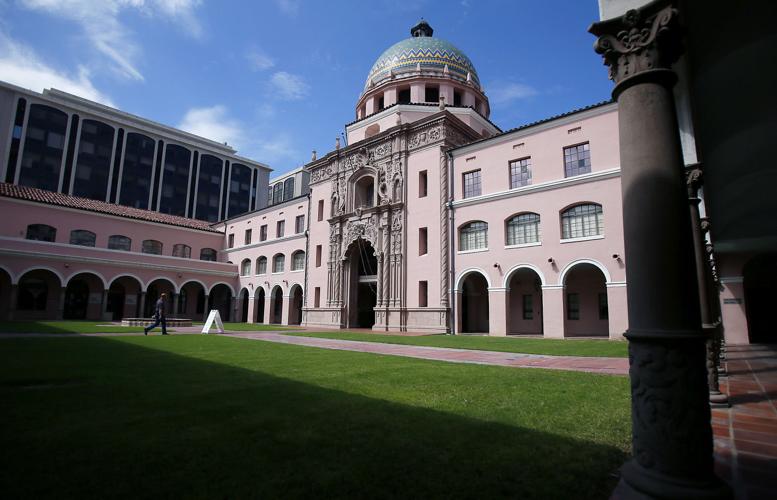
The 1920s-era courthouse was the design of Tucson architect Roy Place.
Place incorporated elements of Spanish and Moorish architecture in the courthouse, as well as in the open courtyard and mezzanine walkways, in an example of the Spanish Colonial Revival movement from the early 20th century.
The building is a popular backdrop for weddings and other special-occasion photos.
It also happens to be the building most identified with Tucson and appears on Pima County letterhead.
“It’s probably the second-most-beautiful building in all of Pima County, with the first being San Xavier,” said Pima County Supervisor Richard Elías.
Elías said the courthouse is an iconic structure for the region with a history that represents European and Latino influences as well as the long presence of Native Americans in the region.
“It’s important that we preserve this building and take care of it in the best manner possible,” he said.
Huckelberry said the materials used in the new fences would mimic the look of wrought iron that was incorporated in railings and other features of the building’s original design.
The work will likely be completed within 60 days. The cost for the new fencing is about $40,000.
“That’s, I think, a fairly reasonable amount to secure an historic building and the iconic structure of Pima County,” Huckelberry said.

