

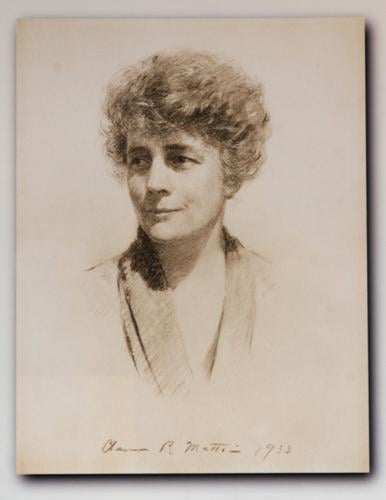
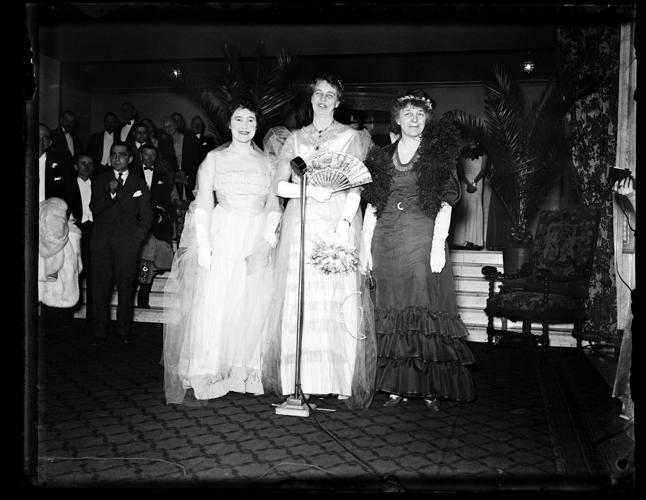
Isabella Dinsmore Selmes was born in Kentucky on March 22, 1886. After her father’s death, she and her mother moved to New York City where she became a lifelong friend of one of her schoolmates, Eleanor Roosevelt, probably sparking an interest in politics that lasted the rest of her life.
Isabella would attain one of the highest pinnacles in politics open to women at the time, a seat in the U.S. House of Representatives as Arizona’s first woman in Congress.
When Eleanor married her cousin Franklin Delano in 1905, Isabella served as one of her bridesmaids. That same year, Isabella married former Rough Rider Robert (Bob) Ferguson. Martha Ferguson was born in 1906 and Robert Ferguson Jr. in 1908.
The family moved to New Mexico after Bob developed tuberculosis. At the beginning of World War I, Isabella worked for the Red Cross, organized the New Mexico Women’s Auxiliary of the Council for Defense, and chaired the Women’s Land Army for New Mexico encouraging women to harvest sorely needed produce.
At the end of the war, she headed the state’s Land Service Committee overseeing increased food production and served as the women’s representative on the Sate Labor and Reconstruction Board.
After her husband died in 1922, Isabella turned to old friend John Campbell Greenway, another Rough Rider, for solace.
John and Isabella married a year after Bob’s death and settled in Ajo, where John oversaw operations at the New Cornelia Copper Co. John (Jack) Selmes Greenway was born in 1924.
Less than two years later, John Greenway died. Distraught over the loss of her husband of only three years, Isabella miscarried their second child four days after her husband’s death.
She moved to Tucson and eventually bought a cattle ranch in northern Arizona near Williams. As the widow of two war veterans, she frequented a Tucson hospital to comfort veterans suffering from tuberculosis as had Bob Ferguson.
The men spent their days creating wooden items to earn a few dollars, crafts Isabella realized were skillfully built.
Purchasing woodworking tools, she established Arizona Hut, a place where veterans could produce high-quality furniture and artifacts that were sold to stores across the country.
Campaigning for Presidential candidate Alfred E. Smith in 1928, Isabella served as Arizona’s Democratic Committeewoman, helping to reorganize the local party.
Her reputation as a hardworking devotee of the Democratic Party led to speculation she might consider a run for Arizona governor. But Isabella quickly dispelled the rumors, declaring she had her hands full chasing after 4-year-old Jack.
On December 18, 1930, Isabella opened the doors of an upscale hotel in the heart of Tucson, the Arizona Inn, filling the four pink stucco cottages and main building with furniture from Arizona Hut. The hotel is now listed on the National Register of Historic Places.
Isabella attended the 1932 Democratic National Convention in Chicago as an Arizona delegate. Selected to second the nomination of Franklin Roosevelt as president , her name was even mentioned as a possible vice-presidential candidate.
Fulfilling a promise to Roosevelt to bring a unified Arizona delegation to the convention, Isabella addressed the crowd. “I speak for the youngest state of the union, Arizona, a land possessed by the spirit of youth, which is the essence of life, the source of hope, and inspiration of courage. And because Arizona ... is filled with life and hope and courage and demands a leader of her own undefeated quality she wishes Franklin D. Roosevelt for the next president of the United States.”
She took to the air to support Roosevelt on a month-long tour across the state and hosted over 100 people when Franklin and Eleanor visited her ranch during their 17-state campaign tour. She attended the Roosevelt inauguration as the official Arizona representative.
Isabella was again touted as a possible candidate for governor but when she learned that Roosevelt planned to appoint Arizona’s only congressman, House of Representative member Lewis Douglas, as director of budget, she decided to run for his congressional seat. “It was no easy task for me to make up my mind to toss my sombrero (or shall I say bonnet?) into the coming congressional race,” she said.
Ironically, two other women considered running for the position — Yuma representative Nellie Bush and Grace Sparkes from Prescott. Both withdrew their names when Isabella announced her candidacy.
With the endorsement of almost every newspaper in the state, she won the primary with 70 percent of the vote and the general election by an even wider margin. “I didn’t congratulate her,” Eleanor Roosevelt told the press, “I congratulated ourselves. I am very glad to have her coming here.”
In Congress, Isabella argued for endorsement of the Nogales Flood Control Project that would bring employment to Santa Cruz County residents. Within 10 days of her arrival, the Public Works Administration approved the initiative. She fought to restore veterans’ pensions and hospital benefits, and lobbied to improve existing irrigation canals that would bring 9,000 jobs into the state.
She often worked late into the night with young Jack keeping her company. After a quick dinner at her desk, the two took to the legislative hallways on roller skates before settling down to finish her congressional duties and Jack’s schoolwork.
With little opposition when she ran for her second term, Isabella introduced a bill to provide electricity from Coolidge Dam to farmers in the Casa Grande Valley. She helped bring the Civilian Conservation Corps into Arizona, lobbied for better prices for U.S. copper, and was instrumental in having every mile of Route 66 paved across the state.
Fifty-year-old Isabella chose not to run when her term expired in 1936, and in 1938, she married for the third time, Harry Orland King, once deputy administrator for the National Recovery Administration.
When Roosevelt decided to run for an unprecedented third term, Isabella believed he was wrong to do so and refused to campaign for him. Writing to Eleanor, she fervently hoped their friendship could weather this political split. The friendship remained intact.
At the beginning of World War II, Isabella moved to Washington, D.C., to chair the American Women’s Voluntary Services recruiting women for national defense work. She often returned to Arizona where her children resided.
She died in Tucson on Dec. 18, 1953. In 1981, Isabella was inducted into the Arizona Women’s Hall of Fame.

