

The mountains are moving in Southern Arizona as rain falls on slopes where the vegetation burned and soil baked to an impermeable crust in this summer's fires.
U.S. Forest Service teams assessing damage from the Murphy, Monument and Horseshoe 2 fires say 31,736 acres of soil was severely burned, with much of the soil in the "hydrophobic" category, meaning any water that falls on it will run off without being absorbed.
Results of that are already evident in the Miller Canyon watershed in the Huachuca Mountains, where boulders the size of cars tumbled down slopes and rushing black streams of silt and ash flowed through yards and into a half dozen homes during a storm Sunday. More damage is expected in the aftermath of the 32,074-acre Monument Fire.
Hardest hit by fire this year were the Chiricahua Mountains, where 12 percent of the soil on the 222,954-acre Horseshoe 2 Fire - 27,730 acres - is classified as "high severity."
Debris flows this week blocked Forest Road 42 - the transmountain road traversing the Chiricahuas from Pinery Canyon on the west side to Cave Creek Canyon on the east.
Research geologist Ann Youberg said the Chiricahuas and Huachucas "have a pretty good history of post-fire erosion" and both had severe burns on steep, upper slopes.
Youberg, of the Arizona Geological Survey, was on the Horseshoe 2 Burned Area Emergency Response (BAER) team - a group of soil scientists, hydrologists, geologists and other specialists assembled to assess the danger of post-fire floods and devise plans to deal with them. Ultimately, nothing will keep a monsoon downpour from eroding soil and flooding drainages, said Paul Guarnaccia, a BAER team leader on the Murphy Fire west of Tubac.
"You put enough water in the system and it's going to flow," he said.
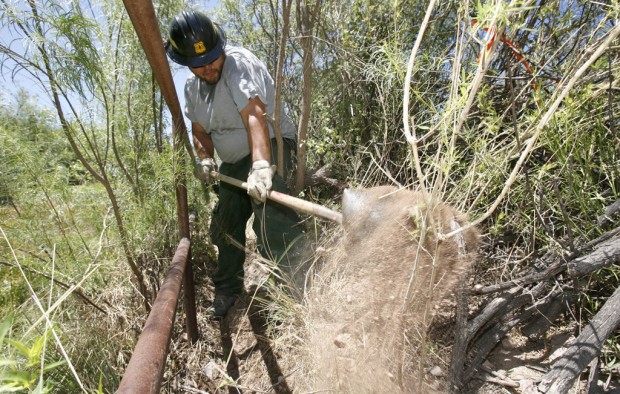
Members of his team identified resources at risk from flooding and is working to mitigate the damage those flows can cause, he said.
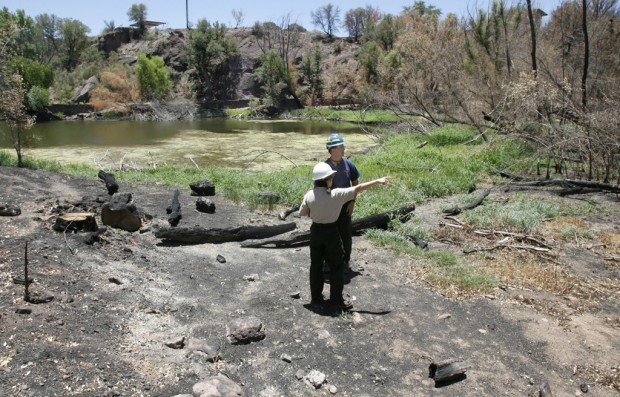
They were wrapping up work Wednesday on protective measures around Ronquillo Pond and Peña Blanca Lake, where they hope to lessen the degrading effects of silt washing into those habitats. The threatened Chiricahua leopard frog is among the species in need of protection.
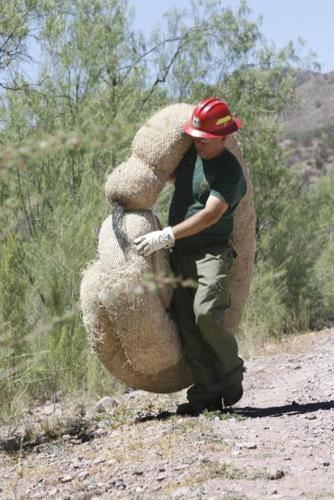
The teams were placing "wattles" - tubes of mesh filled with sterile straw - around the pond and along the banks of the lake where water flows in.
Lush green grass grew on blackened soil at the lake's edge. Some oaks along the lake still held green leaves, but many were blackened by fire. The wattles will filter sediment from runoff approaching the lake, said Guarnaccia.
Sediment buildup was one reason Peña Blanca Lake was drained and dredged in 2008. "They spent a lot of money cleaning this up, Guarnaccia said. "We don't want to fill it up (with sediment) again."
The lake was also drained to remove traces of mercury that had washed into the lake from an abandoned mine upstream.
The mine was cleaned up and capped with soil. The BAER team will seed that area to prevent the cap from washing out, he said.
The 68,078-acre Murphy Fire was contained on June 15, giving the BAER team time to complete its assessment and devise emergency treatments before any significant rain fell on the area.
It is the easiest of the three major fires in the Coronado National Forest to deal with, as only 1,688 acres are in the "severe" soil burn category, much of that in the vicinity of the historic Atascosa Lookout, which burned in the fire. Crews placed wattles around the lookout site to keep any toxins in the fire debris from moving and also "improved and weatherized the trail," Guarnaccia said.
The Murphy Fire BAER report also warns of potential flooding on private land at several ranches on the east side of the fire and at the Calabasas School. It notes that fire could lead to an increase in invasive plants such as buffelgrass, Lehmann's lovegrass and tamarisk.
BAER reports have been completed for the Horseshoe 2 and Monument fires, and protective work is starting this week.
Contact reporter Tom Beal at tbeal@azstarnet.com or 573-4158.

