



PORT-AU-PRINCE, Haiti — A gang rampaged through the Cite Soleil slum, killing and raping and setting fire to hundreds of wood-and-tin homes. Forced out of the neighborhood, one family of four lived on the streets of Port-au-Prince until they were struck by a truck as they slept.
Two brothers, 2 and 9, died in the November accident. Jean-Kere Almicar opened his home to their distraught parents, then another family, then another, until there were nearly 200 people camped out in his front yard and nearby.
They are among more than 165,000 Haitians who have fled their homes amid a surge in gang violence, with nowhere to turn in this capital of nearly 3 million people.

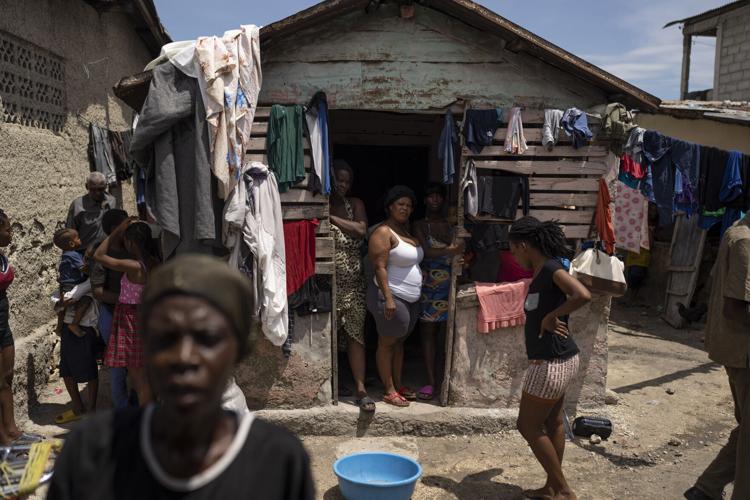
People displaced by gang violence stand in Jean-Kere Almicar's front yard, where they have sought refuge, in Port-au-Prince, Haiti.
Almicar, who once lived in Scranton, Pennsylvania, but moved back to Haiti in 2007, uses his own money.
“There was nothing I could do except tell them to come in,” Almicar said. “Their home doesn’t exist anymore. If they go back, they’re going to be killed.”
Some 79,000 people are temporarily staying with friends or family, but another 48,000 have crowded into dozens of makeshift shelters like Almicar’s or sought refuge in parks, churches, schools and abandoned buildings in Port-au-Prince and beyond. The situation is overwhelming nonprofits and non-governmental organizations.
“The government is not relocating anyone,” said Joseph Wilfred, one of several volunteers in charge of an abandoned government building in Port-au-Prince that houses nearly 1,000 people, including him and his family.
Tens of thousands of Haitians have languished in these makeshift shelters for almost a year.

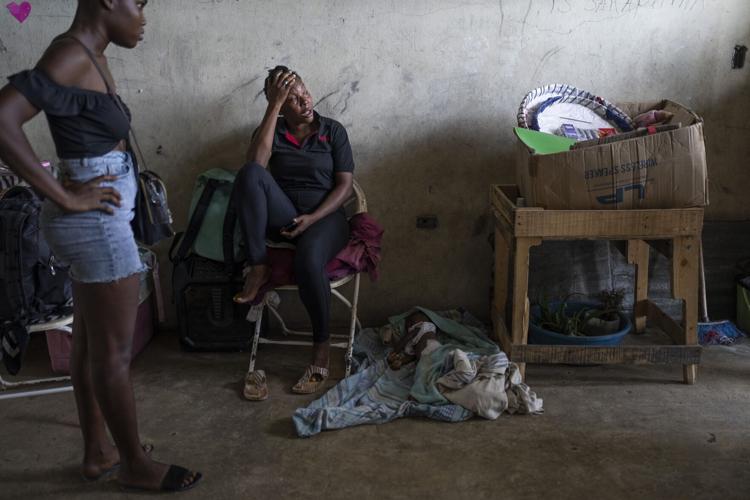
Elise Mesadieu cries as she sits next to the body of her 1-year-old goddaughter, who is believed to have died of dehydration due to cholera, at a shelter for people displaced by gang violence, in Port-au-Prince, Haiti, on May 30.
They sleep on the hard floor or on flattened cardboard boxes. Belongings are stuffed into big rice bags pushed up against the walls of packed rooms. The gangs that chased them out of their homes and control up to 80% of the capital, by most estimates, are now recruiting children as young as 8 at shelters.
One woman staying at Almicar’s place, Lenlen Désir Fondala, said someone snatched her 5-year-old son while they were living in an outdoors park in November. Her face crinkled and she began to cry, whispering that she still dreams of him.
Rapes also are common at the shelters and in the neighborhoods that gangs are razing.
Lovely Benjamin, 26, has scars on her torso and arm after being shot by gangs and attacked with a machete. Her 4-year-old son bears a machete scar on his head. They are homeless, and Benjamin struggles to find work. The gangs torched the items that she used to sell, including rice and oil, and she doesn’t have the money to buy more. She and her little boy survived the attack but gang members killed her partner and set his body on fire.
“Everybody was running,” she recalled. “The gangs burst into everyone's home.”
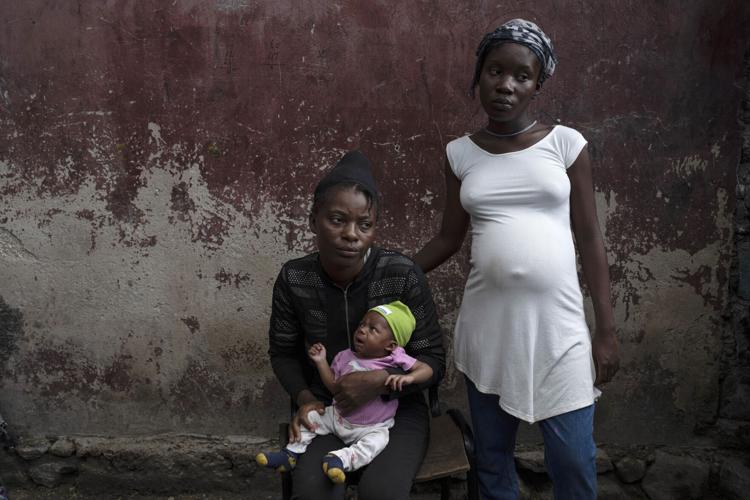
Those living alongside Benjamin include Januèlle Dafka and her 15-year-old daughter, Titi Paul, who were both raped and impregnated by gang members. Another neighbor, Rose Dupont, confided that she was nine months pregnant when four gang members shot her in the shoulder then beat and raped her, causing her to miscarry. The Associated Press does not identify people who say they are the victims of sexual assault unless they agree to be named, as Dafka, Paul and Dupont did.

Januelle Datka, her baby girl Princess and her 15-year-old daughter Titti take refuge at a makeshift shelter June 4 in Jean-Kere Almicar's front yard in Port-au-Prince, Haiti. Both mother and daughter said they were raped by gang members and that both became pregnant.
The women carry envelopes with detailed medical records of the horrors they endured and hope that someone will help them find a safe place to live.
For now, they take refuge in the yard of Almicar, who is known as “Big Papa."
“He has been investing his time, his money, not to mention his strength to keep us safe,” said Dovenald Cetoute, 33, who lives there.
But few are benevolent like Almicar. Police have been evicting people from makeshift shelters, and neighbors have threatened to kick out people left homeless because of fears that gang members might be hiding among them.
The United Nations' International Organization for Migration has helped more than 3,400 people find homes in safer areas and gives families some $350 to cover one year of rent. But a growing number of those families are returning to shelters as gangs continue to invade communities once considered safe. Even makeshift shelters are closing and moving elsewhere because of the ongoing violence, said Philippe Branchat, head of the IOM in Haiti.

People displaced by gang violence take shelter in Jean-Kere Almicar's front yard in Port-au-Prince, Haiti, on June 4.
“We are hearing these terrible stories very often,” Branchat said, adding that the agency doesn’t have access to about half of the makeshift shelters because of gang violence. “The situation is really, really bad.”
People at the shelters sometimes can only afford to eat one mango a day. Many young children are malnourished.
On a recent morning at the abandoned government building that Wilfred helps manage as a makeshift shelter, a woman wailed against the wall as the tiny body of her 1-year-old goddaughter lay on the floor, wrapped in a towel. She had died just hours ago of suspected cholera.
The night before, a 6-year-old boy died under similar circumstances, with health workers who visited the next morning suspecting cholera.
Hours later, an ambulance came by to pick up two other children fighting cholera. The bacteria, which sickens people who swallow contaminated food or water, has been spreading at the shelter that has no power or running water, and just two makeshift holes in the ground that serve as a bathroom for nearly 1,000 people.

Dieu Frisdeline, who has sought refuge in Jean-Kere Almicar's front yard, cries June 4 in Port-au-Prince, Haiti as she tells how she was raped by gang members.
The worsening situation is a regular topic at the biweekly meetings that leaders of the shelter hold for those living there.
Sony Pierre, a spokesman for the committee that runs the shelter where he lives, said he is greatly concerned about the living conditions.
“Look at this catastrophe,” Pierre said as he waved his arms at the scene behind him, where flies buzzed around aggressively in the oppressive heat. “This is an emergency. … We are looking for help to live with dignity.”
Popular videos from the past week you may have missed
Watch the moment multiple tornadoes touched down in Florida, how the loss of the Titan sub could set back deep sea research, and more popular videos from the past week you may have missed.

These tornadoes were recorded touching down in Florida all as Tropical Storm Bret edged upon many areas of the southern state. This all occurr…

Those who research the deep ocean think the loss of the Titan will likely be a setback as people reassess what is considered safe for deep sea…

Juno, a rescued sea otter at the Oregon Zoo, has become a basketball star who can dunk with the likes of LeBron James.

US investigators have been looking into a number of abuse cases in recent months. A report by the attorney general in the state of Maryland, f…

Dramatic video shows deputy sheriff sucked under water for several seconds while saving drowning man in Escambia County, Florida. Veuer’s Mari…

As a doctor, Linda Prine was used to provide abortions for 30 years. But in 2019, restrictions to the procedure in some US states started to i…

NASA’s new chilling animation is opening our eyes to the climate change crisis. The video shows how far sea levels have risen in the past thre…

Al Jazeera look at the arguments over regulating the crypto world.

This video was captured just off the coast of California where surfers were greeted by a local who wanted to be part of the action. Buzz60’s T…

What if we could see all of the CO2 emissions being created? What if each source of those emissions was color-coded? Enter NASA’s Scientific V…

It is a legal verdict with no former precedent that could pave the way for future cases: in a first for France, the Paris Administrative Cour…

