


From the Andes to the Himalayas, a new wave of protests is unfolding around the world, driven by generational discontent against governments and anger among young people.
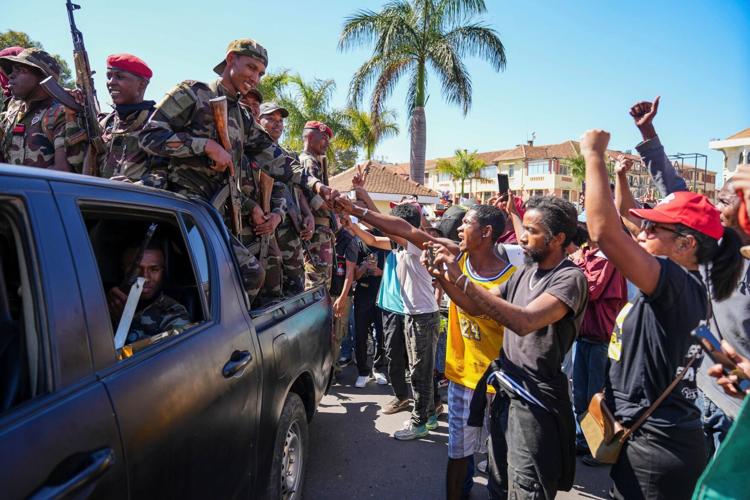
Earlier this month, Madagascar's President Andry Rajoelina was forced out of power and out of the country after a military mutiny, the culmination of weeks of demonstrations led by young protesters referring to themselves as “Gen Z Madagascar.”

Soldiers are greeted Oct. 12 by people gathering for a ceremony in tribute to demonstrators killed during recent anti-government protests in Antananarivo, Madagascar.
The rage against the political establishment in the Indian Ocean island country mirrors other recent protests in countries like Nepal, the Philippines, Indonesia, Kenya, Peru and Morocco. These protests have been sparked by specific grievances but are driven by long-simmering issues like widening inequality, economic uncertainty, corruption and nepotism of leaders.
But they have one thing in common: Mostly leaderless, they are made up primarily of young people who brand themselves as “Gen Z,” defined as those born roughly between 1996 and 2010 — the first generation to grow up entirely in the internet age.
“What connects these youth-led protests is a shared sense that traditional political systems aren’t responsive to their generation’s concerns, whether that’s corruption, climate change, or economic inequality. Protest then becomes the logical outlet when institutional channels feel blocked,” said Sam Nadel, director of Social Change Lab, a U.K.-based nonprofit that researches protests and social movements.
Protesters take cues from each other

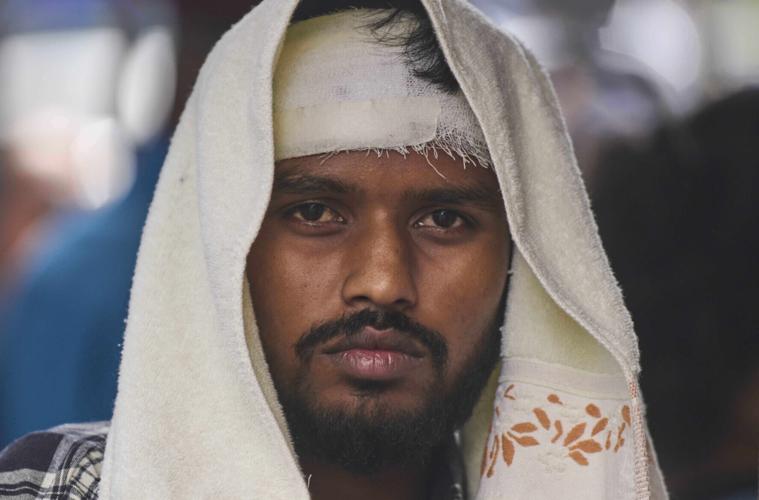
A man injured in the Sept. 8 anti-corruption protest gathers with others Sept. 21 in Kathmandu, Nepal, outside the Central Administration office.
Though their specific demands differ, most of these protests have been sparked by government overreach or neglect. Some have also confronted harsh treatment by security forces and brutal repression.
In Morocco, a leaderless collective called Gen Z 212 — named after Morocco’s dialing code — took to the streets to demand better public services and increased spending on health and education. In Peru, protests over a pension law exploded into broader demands, including action to tackle rising insecurity and widespread corruption in the government. In Indonesia, deadly protests erupted over lawmakers’ perks and the cost of living, forcing the president to replace key economic and security ministers.
The most widely recognized movement to be dubbed a “Gen Z” protest was a deadly uprising in Nepal that culminated with the resignation of the prime minister in September. Protesters drew inspiration from successful anti-government movements elsewhere in South Asia — Sri Lanka in 2022 and Bangladesh in 2024 — that led to the ouster of incumbent regimes.
In Madagascar, protesters said they were inspired by the movements in Nepal and Sri Lanka.
The protests began against regular water and electricity cuts but quickly morphed into wider discontent, as demonstrators called for the president and other ministers to step down. On Oct. 15, Madagascar’s military coup leader said he is “taking the position of president.”

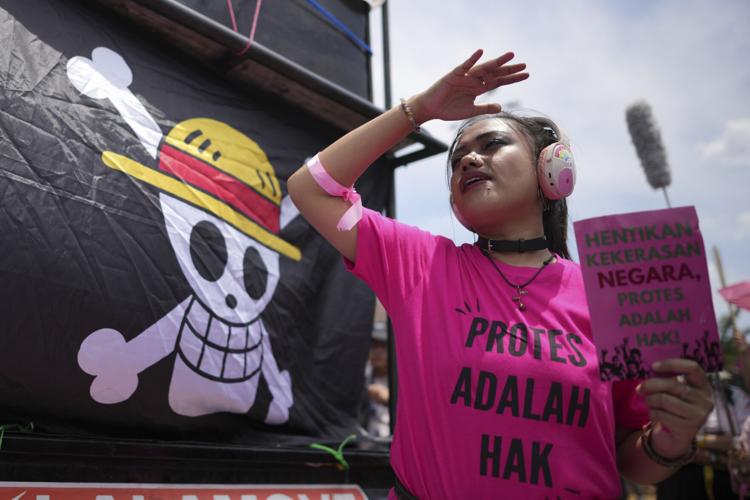
A woman stands next to a flag bearing an image of a skull and crossbones wearing a straw hat, from the popular Japanese anime One Piece, during a Sept. 3 rally in Jakarta, Indonesia.
Uniting behind a manga pirate flag
Across multiple countries, a singular pop culture symbol has emerged: a black flag showing a grinning skull and crossbones wearing a straw hat. The flag comes from a cult Japanese manga and anime series called “One Piece,” which follows a crew of pirates as they take on corrupt governments.
In Nepal, protesters hung the same flag on the gates of the Singha Durbar, the seat of the Nepalese government, and on ministries, many of which were torched in protests. It was also hoisted by crowds in Indonesia, the Philippines, Morocco and Madagascar.
In Lima, the Peruvian capital, 27-year-old electrician David Tafur recently stood with the same flag in San Martín Square, now the stage for weekly protests.

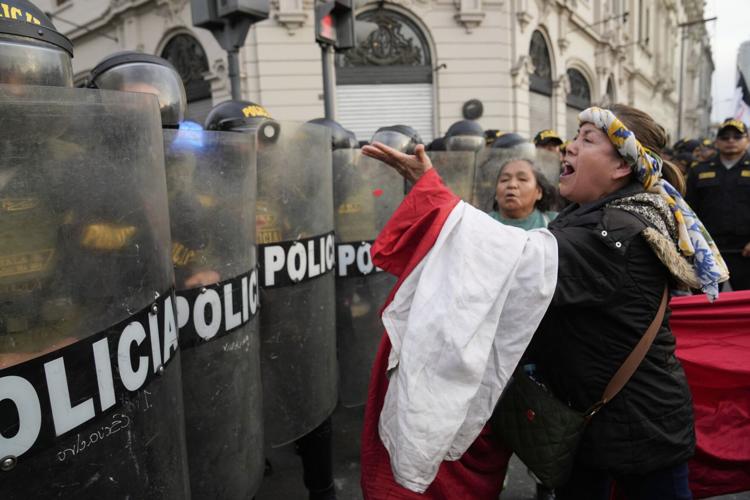
An anti-government protester pleads with riot police blocking the path at San Martin plaza Sept. 20 during a rally against President Dina Boluarte's economic and social policies.
“We’re fighting the same battle — against corrupt officials who, in our case, are also killers,” he said, recalling that President Dina Boluarte’s government held on to power since December 2022 despite more than 500 protests and the deaths of 50 civilians.
“In my case, it’s outrage over abuse of power, corruption, the deaths,” Tafur said, referring to the sharp rise in murders and extortion plaguing the South American country since 2017, amid new laws that have weakened efforts to fight crime.
Boluarte was under investigation for months over various allegations including bribery and involvement in a deadly crackdown on protesters in 2022. She was replaced this month by interim President José Jerí.
Tafur said that wasn’t enough.
“The president is an ally of Congress and has to go,” he said.

People take part in a youth-led protest against corruption and calling for education and healthcare reforms Oct. 9 in Rabat, Morocco.
Harnessing social media for mobilization, awareness
Many significant protests in the past, like Occupy Wall Street in 2011, the Arab Spring between 2010 and 2012, and the 2014 Umbrella Revolution in Hong Kong, have been led by young people. While they also used the internet and social media for mass mobilization, the “Gen Z” protesters are taking it to another level.
“Digital platforms are powerful tools for information sharing and building connections, but the most effective movements often combine digital mobilization with traditional in-person organizing, as we’ve seen in these recent protests,” said Nadel from Social Change Lab.
'No Kings' protesters take to the streets

Crowds gather Saturday, Oct. 18, 2025, to listen to Sen. Bernie Sanders, I-Vt., during a No Kings protest in Washington.

Crowds gather Saturday, Oct. 18, 2025, to listen to Sen. Bernie Sanders, I-Vt., during a No Kings protest in Washington.

Attendees sign a banner representing the U.S. Constitution on Saturday, Oct. 18, 2025, during a No Kings protest in Washington.

Demonstrators carry a signed banner representing the U.S. Constitution as they rally Saturday, Oct. 18, 2025, before marching to the National Mall during a No Kings protest in Washington.

Sen. Bernie Sanders, I-Vt., speaks Saturday, Oct. 18, 2025, during a No Kings protest in Washington.

Demonstrators carry signs Saturday, Oct. 18, 2025, as they march to the National Mall during a No Kings protest in Washington.

Demonstrators carry signs during a No Kings protest Saturday, Oct. 18, 2025, in Washington.

Demonstrators carry signs during a No Kings protest Saturday, Oct. 18, 2025, in Washington.

Demonstrators carry signs during a No Kings protest Saturday, Oct. 18, 2025, in Washington.

Demonstrators carry signs during a No Kings protest Saturday, Oct. 18, 2025, in Washington.

People participate in a "No Kings" rally Saturday, Oct. 18, 2025, in Birmingham, Ala.

Matt Ezell participates in a "No Kings" rally Saturday, Oct. 18, 2025, in Birmingham, Ala.

A demonstrator participates in a "No Kings" rally Saturday, Oct. 18, 2025, in Birmingham, Ala.

A demonstrator holds a sign Saturday, Oct. 18, 2025, during an anti-Trump protest in Madrid, Spain.

People take part in a pro-democracy 'No Kings' protest Saturday, Oct. 18, 2025, in Malmö, Sweden.

A woman shows a poster as she participates in a pro-democracy, anti-Trump protest Saturday, Oct. 18, 2025, outside the U.S. Embassy at the Pariser Platz square in Berlin.

People display U.S. flag and a "No Kings" sign as they participate in a pro-democracy, anti-Trump protest Saturday, Oct. 18, 2025, outside the U.S. Embassy at the Pariser Platz square in Berlin.

Illinois Gov. JB Pritzker arrives Saturday, Oct. 18, 2025, during a "No Kings" protest in Chicago.

A demonstrators carries a sign stating "RULE of LAW" on Saturday, Oct. 18, 2025, during a No Kings protest in Washington.

People walk along the street Saturday, Oct. 18, 2025, during the "No Kings" protest in Houston.

A rallygoer plays guitar Saturday, Oct. 18, 2025, during a rally and march through the streets in Denver.

A U.S. Park Police officer oversees a No Kings protest Saturday, Oct. 18, 2025, in Washington.

A protester wears a blow-up mushroom costume Saturday, Oct. 18, 2025, during a "No Kings" protest in New York.

Protesters holding an upside-down U.S. flag shout slogans from scaffolding Saturday, Oct. 18, 2025, during a "No Kings" protest in New York.

People gather Saturday, Oct. 18, 2025, during a "No Kings" protest in Chicago.

A demonstrator carries a sign saying "DEMocracy not TRUMPocracy" on Saturday, Oct. 18, 2025, a No Kings protest in Washington.

People march Saturday, Oct. 18, 2025, during a "No Kings" protest in Portland, Ore.

Protesters march Saturday, Oct. 18, 2025, in the streets near City Hall during a "No Kings" protest in Los Angeles.

People take part in a "No Kings" protest Saturday, Oct. 18, 2025, in Seattle.

A protester carrying an effigy of Donald Trump during a "No Kings" protest Saturday, Oct. 18, 2025, in Los Angeles.

Demonstrators wearing inflatable bald eagle costumes gather Saturday, Oct. 18, 2025, in Kiener Plaza during the "No Kings" protest in St. Louis, with the Gateway Arch in the background.

Demonstrators in costumes hold placards Saturday, Oct. 18, 2025, during a protest outside the U.S. Embassy in London.

