


Rose Hammond pushed authorities for years to lower the 55 mph speed limit on a two-lane road that passes her assisted living community, a church, two schools and a busy park that hosts youth sports leagues.
"What are you waiting for, somebody to get killed?" the 85-year-old chided officials in northwest Ohio.
Amid growing public pressure, Sylvania Township asked county engineers in March to analyze whether Mitchaw Road's posted speed limit is too high.
The surprising answer: Technically, it's 5 mph too low.
The reason dates back to studies on rural roads from the 1930s and 1940s that still play an outsized role in the way speed limits are set across the U.S. — even in urban areas.
Born from that research was a widely accepted concept known as the 85% rule, which suggests a road's posted speed should be tied to the 15th-fastest vehicle out of every 100 traveling it in free-flowing traffic, rounded to the nearest 5 mph increment.
Now, some states — with a nudge from the federal government — seek to modify if not replace that rule when setting guidelines for how local engineers should decide what speed limit to post.

Rose Hammond poses Aug. 7 in her home in Sylvania Township, Ohio.
Drivers set the speed
The concept assumes that a road's safest speed is the one most vehicles travel — neither too high nor too low. If drivers think the speed limit should be raised, they can simply step on the gas and "vote with their feet," as an old brochure from the Institute of Transportation Engineers once put it.
"The problem with this approach is it creates this feedback loop," said Jenny O'Connell, director of member programs for the National Association of City Transportation Officials. "People speed, and then the speed limits will be ratcheted up to match that speed."
The association developed an alternative to the 85% rule known as "City Limits," which aims to minimize the risk of injuries for all road users by setting the speed limit based on a formula that factors in a street's activity level and the likelihood of conflicts, such as collisions.
The report points out the 85% rule is based on dated research and "these historic roads are a far cry from the vibrant streets and arterials that typify city streets today."
Amid a recent spike in road deaths across the country, the Federal Highway Administration sent a message to states that the 85% rule isn't an official rule and carries too much weight in determining speed limits.
In its first update since 2009 to a manual that establishes national guidelines for traffic signs, the agency clarified that communities also should consider such things as how the road is used, the risk to pedestrians and the frequency of crashes.

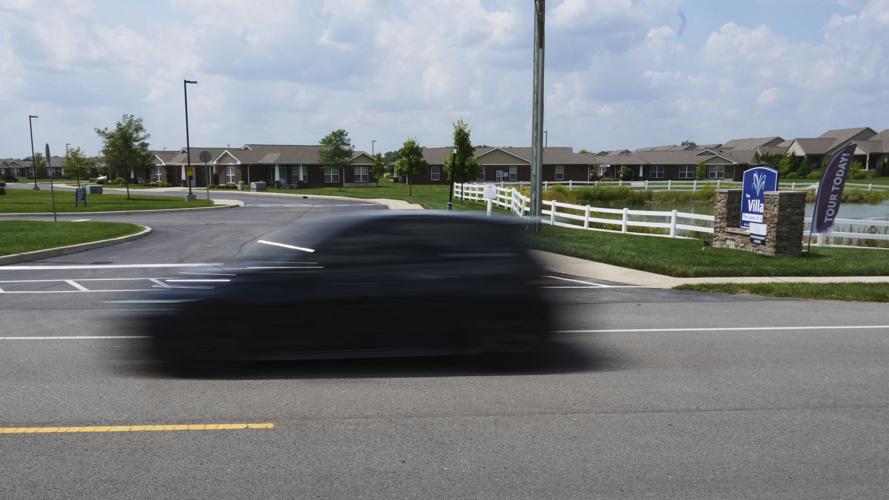
A vehicle passes The Lakes of Sylvania senior living community Aug. 7 in Sylvania Township, Ohio.
Rethinking the need for speed
Under its "20 is Plenty" campaign, the Wisconsin capital, Madison, changed signs across the city this summer, lowering the speed limit from 25 mph to 20 mph on residential streets.
When Seattle took a similar step in a pilot program seven years ago, not only did it see a noticeable decline in serious injury crashes but also a 7% drop in the 85th percentile speed, according to the Vision Zero Network, a nonprofit advocating for street safety.
California embraces the 85% rule even more than most states as its basis for setting speed limits. Legislators allowed local governments in recent years to depart from the guidelines if they can cite a proven safety need. Advocates for pedestrians and bicyclists say the change helps, but is not enough.
"We still have a long way to go in California in terms of putting value on all road users," said Kendra Ramsey, executive director of the California Bicycle Coalition. "There's still a very heavy mindset that automobiles are the primary method of travel and they should be given priority and reverence."

Jay Beeber, executive director for policy at the National Motorists Association, an advocacy organization for drivers, said following the 85% rule is usually the safest way to minimize the variation in speed between drivers who abide by the posted limit and those who far exceed it.
"It doesn't really matter what number you put on a sign," Beeber said. "The average driver drives the nature of the roadway. It would be patently unfair for a government to build a road to encourage people to drive 45 mph, put a 30 mph speed limit on it, and then ticket everyone for doing what they built the road to do."

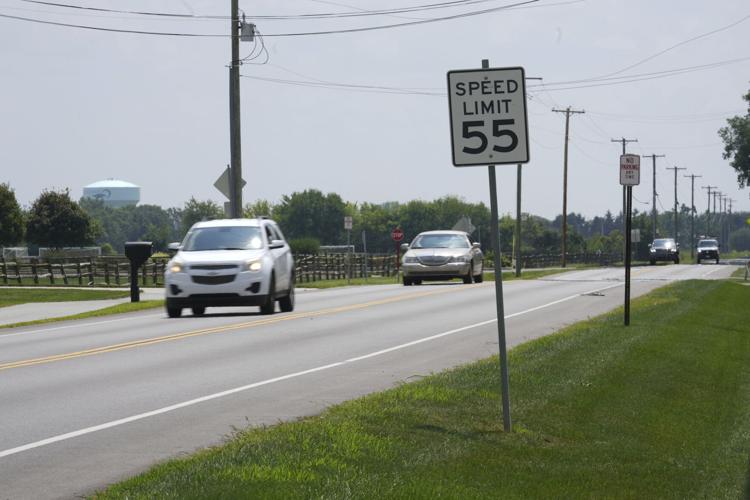
Vehicles drive Aug. 7 along Mitchaw Road past Pacesetter Park in Sylvania Township, Ohio.
80 is the new 55
Fears about oil prices prompted Congress in the 1970s to set a 55 mph national maximum speed limit, which it later relaxed to 65 mph before repealing the law in 1995 and handing the authority to states. Since then, speed limits climbed, with North Dakota this summer becoming the ninth state to allow drivers to go 80 mph on some stretches of highway. There's a 40-mile segment in Texas between Austin and San Antonio where 85 mph is allowed.
A 2019 study from the Insurance Institute for Highway Safety — a research arm funded by auto insurers — illustrates the risks. Every 5 mph increase to a state's maximum speed limit increases the chance of fatalities by 8.5% on interstate highways and 2.8% on other roads, the study found.
Ohio now gives more consideration to roadway context and allows cities to reduce speed limits based on the lower standard of the 50th percentile speed when there's a large presence of pedestrians and bicyclists. Authorities recently hired a consultant to consider additional modifications based on what other states do.
"States have very slowly started to move away from the 85th percentile as being kind of the gold standard for decision-making," said Michelle May, who manages Ohio's highway safety program.
The most dangerous cities for pedestrians
The most dangerous cities for pedestrians
Updated
Despite the health benefits of walking, only 2.2% of Americans walk to work.
As the federal government tries to promote walking and walkable cities, one major obstacle they have identified is road safety. Unfortunately, this is a valid concern as pedestrian fatalities have almost doubled since 2009.
To see where pedestrians are most at risk, researchers at TruckInfo.net analyzed data from the National Highway Traffic Safety Administration and found the following trends.

#1: Pedestrian fatalities have increased by 80% since 2009
Updated
While there was a steady decline in pedestrian fatalities from 1995 to 2009, the trend has reversed and pedestrian fatalities are now at an all-time high.
#2: Cities that walk to work have fewer pedestrian fatalities per capita
Updated
It may seem surprising that cities with more individuals walking to work have fewer pedestrian fatalities. However, the most likely explanation is that these cities promote walking to work by providing safe roads for pedestrians.
#4: Memphis, Tennessee is the most dangerous large city for pedestrians
Updated
Among large cities with a population over 350k, Memphis, Tennessee, is the most dangerous city for pedestrians with 65 pedestrian fatalities per 100k.
#5: New Mexico is the most dangerous state for pedestrians
Updated
Florida, Louisiana, South Carolina, and Delaware round out the top 5.
Methodology
Fatal accident statistics were sourced from the National Highway Traffic Safety Administration (NHTSA) and population data from the U.S. Census Bureau. Large cities were defined as cities with a population of over 350,000; mid-size cities with populations from 150,000-350,000; and small cities with populations under 150,000.
This story was produced by TruckInfo.net and reviewed and distributed by Stacker.
#3: The most dangerous roads are not in big cities or counties
Updated
Even when looking at total pedestrian fatalities (and not per capita), only three of the top 10 most populated counties appear on the top 10 list of most dangerous roads. In fact, four of the most dangerous roads in the country are in counties with populations under 1 million residents.

