

WASHINGTON — President Donald Trump signed a proclamation Friday that will require a $100,000 annual visa fee for highly-skilled foreign workers and rolled out a $1 million “gold card” visa as a pathway to U.S. citizenship for wealthy individuals, moves that face near-certain legal challenges amid widespread criticism he is sidestepping Congress.
If the moves survive legal muster, they will deliver staggering price increases. The visa fee for skilled workers would jump from $215. The fee for investor visas, which are common in many European countries, would climb from $10,000-$20,000 a year.
H-1B visas, which require at least a bachelor's degree, are meant for high-skilled jobs that tech companies find difficult to fill. Critics say the program is a pipeline for overseas workers who are often willing to work for as little as $60,000 annually, well below the $100,000-plus salaries typically paid to U.S. technology workers.
Trump on Friday insisted that the tech industry would not oppose the move. Commerce Secretary Howard Lutnick said “all big companies” are on board.
Representatives for the biggest tech companies, including Amazon, Apple, Google and Meta, did not immediately respond to messages for comment on Friday. Microsoft declined to comment.
Lutnick said the change will likely result in far fewer H-1B visas than the 85,000 annual cap allows because “it’s just not economic anymore.”
“If you’re going to train people, you’re going to train Americans.” Lutnick said on a conference call with reporters. "If you have a very sophisticated engineer and you want to bring them in ... then you can pay $100,000 a year for your H-1B visa.”

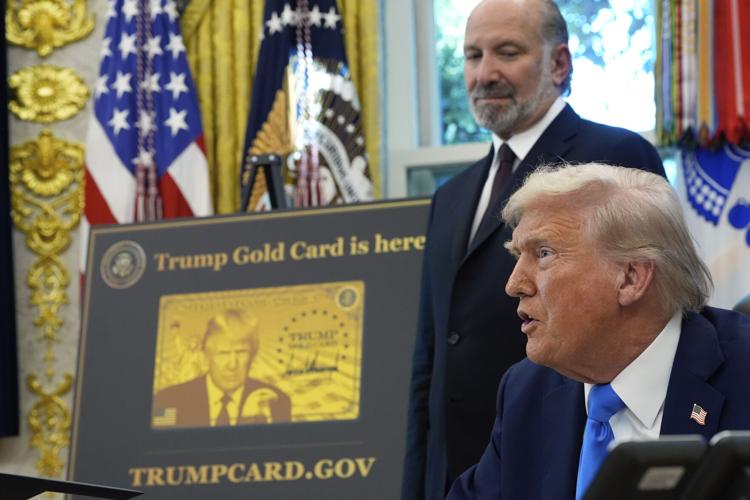
President Donald Trump speaks as Commerce Secretary Howard Lutnick listens Friday, Sept. 19, 2025, in the Oval Office of the White House in Washington.
Trump also announced he will start selling a “gold card” visa with a path to U.S. citizenship for $1 million after vetting. For companies, it will cost $2 million to sponsor an employee.
The “Trump Platinum Card” will be available for a $5 million and allow foreigners to spend up to 270 days in the U.S. without being subject to U.S. taxes on non-U.S. income. Trump announced a $5 million gold card in February to replace an existing investor visa — this is now the platinum card.
Lutnick said the gold and platinum cards would replace employment-based visas that offer paths to citizenship, including for professors, scientists, artists and athletes.
Critics of H-1Bs visas who say they are used to replace American workers applauded the move. U.S. Tech Workers, an advocacy group, called it “the next best thing” to abolishing the visas.
Doug Rand, a senior official at U.S. Citizenship and Immigration Services during the Biden administration, said the proposed fee increase was “ludicrously lawless.”
“This isn’t real policy — it’s fan service for immigration restrictionists,” Rand said. “Trump gets his headlines, and inflicts a jolt of panic, and doesn’t care whether this survives first contact with the courts.”
Lutnick said the H-1B fees and gold card could be introduced by the president but the platinum card needs congressional approval.

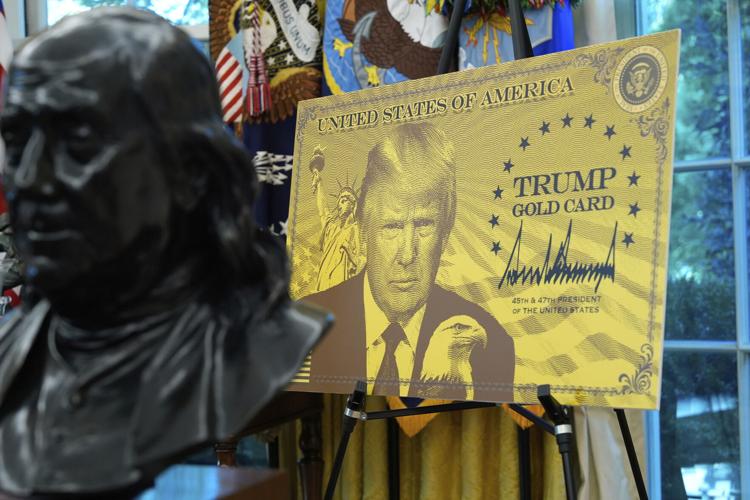
A poster showing the Trump Gold Card is displayed Friday, Sept. 19, 2025, as President Donald Trump speaks in the Oval Office of the White House in Washington.
Historically, H-1B visas were doled out through lottery.
This year, Amazon was by far the top recipient of H-1B visas with more than 10,000 awarded, followed by Tata Consultancy, Microsoft, Apple and Google. Geographically, California has the highest number of H-1B workers.
Critics say H-1B spots often go to entry-level jobs, rather than senior positions with unique skill requirements. While the program isn’t supposed to undercut U.S. wages or displace U.S. workers, critics say companies can pay less by classifying jobs at the lowest skill levels, even if the specific workers hired have more experience.
As a result, many U.S. companies find it cheaper to contract out help desks, programming and other basic tasks to consulting companies such as Wipro, Infosys, HCL Technologies and Tata in India and IBM and Cognizant in the U.S. These consulting companies hire foreign workers, often from India, and contract them out to U.S. employers looking to save money.

First lady Melania Trump, the former Melania Knauss, was granted an H-1B work visa in October 1996 to work as a model. She was born in Slovenia.
In 2024, lottery bids for the visas plunged nearly 40%, which authorities said was due to success against people who were “gaming the system” by submitting multiple, sometimes dubious, applications to unfairly increase chances of being selected.
Major technology companies that use H-1B visas sought changes after massive increases in bids left their employees and prospective hires with slimmer chances of winning the random lottery.
Facing what it acknowledged was likely fraud and abuse, USCIS this year said each employee had only one shot at the lottery, whether the person had one job offer or 50.
Critics welcomed that change but said more needs to be done.
The AFL-CIO wrote last year that while changes to the lottery “included some steps in the right direction,” it fell short of needed reforms. The labor group wants visas awarded to companies that pay the highest wages instead of by random lottery, a change that Trump sought during his first term in the White House.
___
Ortutay reported from Oakland, Calif. Associated Press writers Adriana Gomez Licon in Ft. Lauderdale, Fla., and Elliot Spagat in San Diego contributed to this report.
Who's hiring on H-1B? Here are the US metros and companies with the most visa holders.
Who's hiring on H-1B? Here are the US metros and companies with the most visa holders.
Updated
Amid economic uncertainty and a slowdown in hiring—particularly for technology and professional services sectors—the H1-B program has once again become a focal point in the debate over American jobs and immigration policy. The program allows foreign workers in specialty occupations to be employed by U.S. companies.
Proponents argue that the program strengthens the U.S. economy in many ways by expanding the talent pool, complementing the native-born workforce, and attracting immigrant workers who then also spend and invest in the U.S. economy. Critics, however, contend that the program potentially undermines American workers by allowing foreign workers to fill positions that could go to domestic talent.
The program allows 65,000 H-1B visas every year, with an additional 20,000 for people holding advanced degrees from a U.S. higher education institution. It was established by the Immigration Act of 1990, a comprehensive reform signed into law by President George H.W. Bush, which created a new visa category specifically for highly skilled workers such as scientists, engineers, and educators.
The bill built on previous regulations that evolved as Congress responded to mounting pressure from employer groups advocating for greater workforce flexibility, according to Gabrielle Clark, an assistant professor of political science and public law at California State University, Los Angeles and author of a forthcoming book about migration laws throughout U.S. history.
While Trump's longtime confidant and former White House chief strategist, Steve Bannon, remains a staunch critic of the program, President Trump has recently aligned with multibillionaire and senior presidential adviser Elon Musk in supporting it. Trump even publicly reaffirmed its validity, not only for tech engineers, but also for other qualified personnel, including "wine experts and waiters," the president said during a press conference held at the White House.
On the Democratic side, during his final weeks in office, former President Joe Biden's administration introduced changes to the H-1B program aimed at improving its efficiency and integrity. Shortly after, Independent Sen. Bernie Sanders published a critique accusing the program of replacing American jobs with "lower-paid workers from abroad who often live as indentured servants."
A significant change came with the act's modifications to the criteria for determining an individual's ability to perform a "specialty occupation," including the removal of the minimum requirement of holding a bachelor's degree. The act also expanded opportunities for H-1B visa holders to extend their visas and apply for permanent residency. "It was a ratcheting down of what it means to be of distinguished merit and ability, and to be exceptional," Clark told Stacker.
Over the years, tensions between labor unions and employer groups have periodically emerged around the H-1B program, particularly regarding unsuccessful attempts to require employers to demonstrate they had first tried to recruit American workers before hiring foreign nationals.
"Conflict [over the H-1B visa] is not new, although it became amplified with the rise of anti-neoliberal politics and anti-global politics," Clark said. "But it's always been there."
H-1B Employer Data analyzed information from U.S. Citizenship and Immigration Services to show where the H-1B program is being used and which companies are the primary sponsors. The analysis aggregated both initial and continuing visa approvals from 2022 to 2024, grouping subsidiaries of the same entity together. To assess H-1B visa density across U.S. metro areas, the analysis used ZIP codes from the 2024 data to match employers to their corresponding metropolitan areas. Additionally, Census data was applied to calculate the ratio of H-1B visa holders per 1,000 residents.

Tech companies are built on global talent
Updated
Silicon Valley tech companies have become closely associated with the H-1B program, and the data supports this connection. In 2024, analysis of USCIS data shows approximately 1 in 5 of these visas—both new applications and renewals—were issued in California. Of these, about half were sponsored by companies located in Silicon Valley.
Notably, 3 of the 5 top H-1B visa sponsors are either Indian companies or U.S. companies with strong connections to India. This aligns with broader data showing that in 2022, Indian-born nationals received 72.6% of these visas, with most working in science, technology, engineering, and mathematics fields. The next most common country was China, which trailed in second place with 12.5% of the share of these visas.
This concentration from India has raised concerns about potential program abuse, particularly by large IT firms. Last year, more than 20 former employees of Tata Consultancy Services filed complaints with the Equal Employment Opportunity Commission, alleging discrimination favoring Indian workers, reported The Wall Street Journal. In 2013, Infosys, an Indian company, paid a $34 million civil settlement over allegations of systematic visa fraud and abuse of immigration processes. More recently, a federal class-action lawsuit found Cognizant, a U.S. company with an Indian arm, guilty of intentionally discriminating against non-Indian employees.
Metro areas in Texas, California see highest concentration of H-1B visa approvals
Updated
Among the tech hubs with the highest concentration of H-1B visas are metros in the San Francisco Bay Area. San Jose comes in at #2 (home of Google, Apple, and NVIDIA) and also has the second-largest overall number of approved visas after New York. The San Francisco metro area (home of Meta, Salesforce, and Uber) came in at #6.
The presence of Indian IT companies drives up the presence of H-1B visa holders in other areas as well. In particular, the area with the highest number of holders—almost 30 per 1,000 residents—is College Station, Texas, where the large majority of these visas derive from Cognizant's presence. The same is true for Dallas, where the main employer of H-1B visa holders is Infosys. Tata Consultancy shares the Washington D.C. metro area with Amazon. Together, the two companies sponsor more than 20% and 40% of the visas, respectively.
Concerns over H-1B visa changes aimed at reducing approvals have alarmed tech companies and raised anxiety among Indian nationals pursuing career opportunities in the U.S., the BBC reports. Often, Indian companies cite H-1B visa regulation changes as a risk factor in operating within the U.S. market.
During his first term, Trump made efforts to restrict the H-1B program, signing the "Buy American and Hire American" order to increase application scrutiny and fraud detection. The order prompted USCIS to review its policies for approvals, which made rejections soar.
The administration also took significant steps behind the scenes to further hinder the process, according to Forbes. A revision to the USCIS Requests for Evidence process dated March 23, 2017, led to an increase in time-consuming and expensive submissions to USCIS of additional information they needed to make their decisions.
A "Guidance memo on H-1B computer-related-positions" instructed USCIS to essentially deny petitions for H1-B for many occupations because not everyone hired in those occupations required a bachelor's degree according to the Department of Labor Occupational Outlook Handbook. More importantly, many things were left out of public view. The "H-1B AC21 Denial Standards," revised July 17, 2017, along with other documents, had many redacted sections.
"You see that the noncontroversial matters are all supported by citation to statute and regulation. However, their most controversial policies lack any such support. It appears that the agency made dramatic changes to H-1B policy without grounding those changes in any law," Jonathan Wasden, a partner with Wasden Banias, told Forbes.
Whether new regulations will be introduced, either at the enforcement level or through the legal system, remains to be seen. "It's too soon to tell," said Clark. "I wouldn't be surprised if some kind of legislation proposed by the Trump administration gets going in Congress to make some changes."
Story editing by Carren Jao. Additional editing by Elisa Huang. Copy editing by Tim Bruns.
This story originally appeared on H-1B Employer Data and was produced and distributed in partnership with Stacker Studio.

