

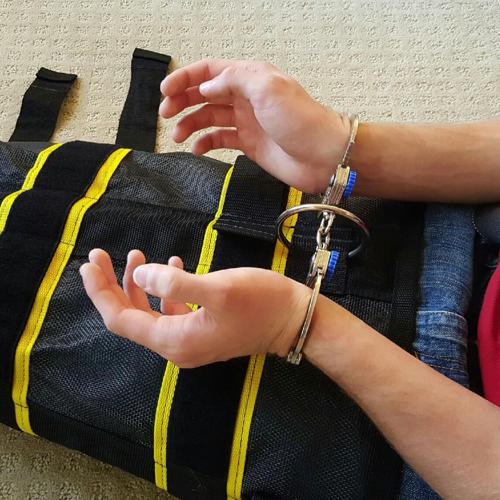
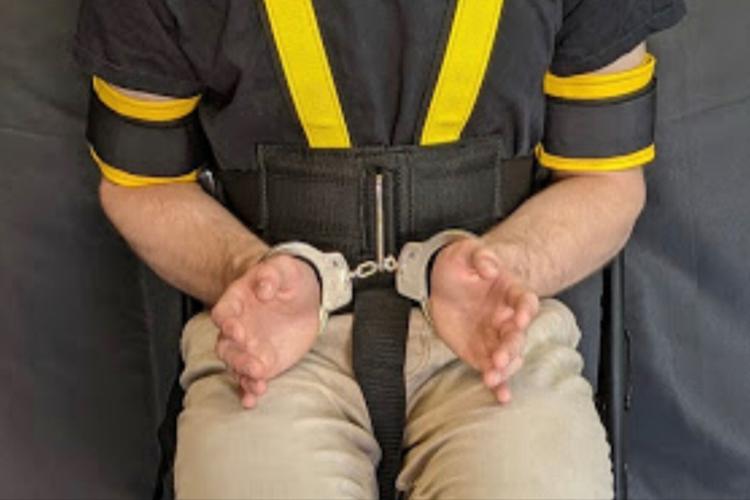
A full-body restraint device known as the WRAP has become a harrowing part of deportations for some immigrants.
The Associated Press identified multiple examples of U.S. Immigration and Customs Enforcement officers using the black-and-yellow full-body restraint device on deportation flights.
Here are the highlights from AP’s investigation:
What is the WRAP?
The WRAP first appeared in law enforcement in the late 1990s, presented as an alternative to tying a subject’s hands and feet together in a practice known as “hog-tying” and a long-awaited solution for restraining the most erratic inmates and avoiding in-custody deaths caused by handcuffs and positional asphyxia, in part by preventing a detainee from being able to remain prone.

U.S. Immigration and Customs Enforcement agency uses a custom version of Safe Restraints' WRAP equipment.
It first found widespread use in California jails and today is used by more than 1,800 departments and facilities around the country, according to the manufacturer, which says it has sold more than 10,000 devices.
Charles Hammond, CEO of the WRAP’s maker, Safe Restraints Inc., said his company made a modified version of the device for ICE, with changes meant to allow people to be kept in it during flights and long bus trips.
ICE’s version includes a ring on the front of the suit that allows a subject’s cuffed hands to be attached while still allowing for limited use to eat and drink, he said. In addition, the ICE version has “soft elbow cuffs,” Hammond said, which connect in the back so a person can move for proper circulation but can’t flip an elbow out to hit someone.
ICE’s parent agency, the U.S. Department of Homeland Security, paid Safe Restraints Inc. $268,523 since it started buying the devices in late 2015 during the Obama administration. Government purchasing records show the two Trump administrations have been responsible for about 91% of that spending. ICE would not provide AP with records documenting its use of the WRAP despite multiple requests, and it’s not clear how frequently it has been used in the current and prior administrations.

U.S. Immigration and Customs Enforcement agency uses a custom version of Safe Restraints' WRAP equipment.
What did AP’s investigation find?
Use of the WRAP was described to the AP by five people who said they were restrained in the device, sometimes for hours, on ICE deportation flights dating to 2020. And witnesses and family members in four countries told the AP about its use on at least seven other people this year.
The AP found that ICE used the device despite internal concerns voiced in a 2023 report by the civil rights division of DHS, in part due to reports of deaths involving the use of the WRAP by local law enforcement. And the AP has identified a dozen fatal cases in the past decade where local police or jailers around the U.S. used the WRAP and autopsies determined “restraint” played a role in the death.
While Hammond insists the WRAP has never been determined as the cause of death when used properly, the AP identified 43 times in which the WRAP was used by police or correctional officers in a case in which someone died. In 12 of those cases, the official autopsy determined that “restraint” played some role in the death.
The WRAP is the subject of a growing number of federal lawsuits likening incorrect usage of the device to punishment and even torture, whether used in a jail or by immigration authorities during international flights. Among advocates’ concerns is that ICE is not tracking the WRAP’s use as required by federal law when officers use force, making it difficult to discern exactly how many people are being subjected to the restraints.
The WRAP’s manufacturer says it intended the device to be a lifesaver for law enforcement confronting erratic people who were physically attacking officers or harming themselves.
But ICE officials have a much lower threshold for deploying the WRAP than the manufacturer advises, the AP found. Instead, detainees interviewed by the AP said ICE officers used the restraints on them after they had already been shackled. They said this was done to intimidate or punish them for asking to speak to their attorneys or expressed fear at being deported, often to places they fled due to violence and torture.
What do ICE and DHS say?
ICE and the U.S. Department of Homeland Security would not answer detailed questions from the AP and refused a request for the government’s policy for when and how to use the WRAP.
“The use of restraints on detainees during deportation flights has been long standing, standard ICE protocol and an essential measure to ensure the safety and well-being of both detainees and the officers/agents accompanying them,” Tricia McLaughlin, DHS’ spokesperson, said in an email to AP. “Our practices align with those followed by other relevant authorities and is fully in line with established legal standards.”
The agency would not specify those authorities or describe its practices.


Photos: Cities around the US see immigration protests

Federal officers hold down a protestor in the Brighton Park neighborhood of Chicago, on Saturday, Oct. 4, 2025, after protesters learned that U.S. Border Patrol shot a woman Saturday morning on Chicago's Southwest Side. (Anthony Vazquez/Chicago Sun-Times via AP)

A gas canister erupts on the street in the Brighton Park neighborhood of Chicago, on Saturday, Oct. 4, 2025, after protesters learned that U.S. Border Patrol shot a woman Saturday morning on Chicago's Southwest Side. (Anthony Vazquez/Chicago Sun-Times via AP)

Protestors stand and chant in the Brighton Park neighborhood of Chicago, on Saturday, Oct. 4, 2025, after protesters learned that U.S. Border Patrol shot a woman Saturday morning on Chicago's Southwest Side. (Anthony Vazquez/Chicago Sun-Times via AP)

Protestors create a line to maintain distance between ICE officers and protestors in the Brighton Park neighborhood of Chicago, on Saturday, Oct. 4, 2025, after protesters learned that U.S. Border Patrol shot a woman Saturday morning on Chicago's Southwest Side. (Anthony Vazquez/Chicago Sun-Times via AP)

A person stands by a sign that reads "Guard: Go Home!" while they protest outside the federal courthouse on Friday, Oct. 3, 2025, in Portland, Ore., as a federal court hearing on Oregon's bid to temporarily block President Donald Trump's deployment of the National Guard to Portland is held inside. (AP Photo/Jenny Kane)

A protester stands off against police and federal officers at a U.S. Immigration and Customs Enforcement facility in Portland, Ore. on Sunday, Oct. 5, 2025. (AP Photo/Ethan Swope)

Protesters gather at a U.S. Immigration and Customs Enforcement facility in Portland, Ore. on Sunday, Oct. 5, 2025. (AP Photo/Ethan Swope)

Protesters carrying flags and signs stand outside a U.S. Immigration and Customs Enforcement facility in Portland, Ore. on Sunday, Oct. 5, 2025. (AP Photo/Ethan Swope)

Law enforcement officers arrest a protester near a U.S. Immigration and Customs Enforcement facility in Portland, Ore. on Sunday, Oct. 5, 2025. (AP Photo/Ethan Swope)

Portland police officers talk to a man near a U.S. Immigration and Customs Enforcement facility in Portland, Ore., Sunday, Oct. 5, 2025. (AP Photo/Ethan Swope)

Security officers deploy near a U.S. Immigration and Customs Enforcement facility in Portland, Ore., Sunday, Oct. 5, 2025. (AP Photo/Ethan Swope)

People demonstrate above Interstate 40 in Nashville, Tenn., Friday, Sept. 26, 2025, against the deployment of the National Guard in Memphis. (AP Photo/George Walker IV)

Protestors gather for a march in Memphis, Tenn., Saturday, Sept. 27, 2025, to protest against the deployment of National Guard troops to Memphis. (AP Photo/Nikki Boertman)

Rachael Spriggs, accompanied by Sandra Pita, left, and Tikeila Rucker, center, addresses protestors gathered for a march in Memphis, Tenn., Saturday, Sept. 27, 2025, to protest against the deployment of National Guard troops to Memphis. (AP Photo/Nikki Boertman)

Protestors gather for a march in Memphis, Tenn., Saturday, Sept. 27, 2025, to protest against the deployment of National Guard troops to Memphis. (AP Photo/Nikki Boertman)

People march in Memphis, Tenn., Saturday, Sept. 27, 2025, to protest against the deployment of National Guard troops to Memphis. (AP Photo/Nikki Boertman)

Protestors gather for a march in Memphis, Tenn., Saturday, Sept. 27, 2025, to march against the deployment of National Guard troops to Memphis. (AP Photo/Nikki Boertman)

Joe Calhoun, who marched with the Memphis Sanitation Strike as an 18-year-old, joins community activists to march against the National Guard being sent to Memphis, Tenn., Saturday, Sept. 27, 2025. (AP Photo/Nikki Boertman)

A protester yells at police and federal officers during a protest at a U.S. Immigration and Customs Enforcement facility in Portland, Ore. on Sunday, Oct. 5, 2025. (AP Photo/Ethan Swope)

A protester stands draped in an American flag watches as law enforcement officers try to disperse protesters near a U.S. Immigration and Customs Enforcement facility in Portland, Ore. on Sunday, Oct. 5, 2025. (AP Photo/Ethan Swope)

Law enforcement officers arrest a protester during a protest at a U.S. Immigration and Customs Enforcement facility in Portland, Ore. on Sunday, Oct. 5, 2025. (AP Photo/Ethan Swope)

Police and federal officers throw gas canisters to disperse protesters near a U.S. Immigration and Customs Enforcement facility in Portland, Ore. on Sunday, Oct. 5, 2025. (AP Photo/Ethan Swope)

Police and Federal officers stand guard an area by the U.S. Immigration and Customs Enforcement facility in Portland, Ore. on Sunday, Oct. 5, 2025. (AP Photo/Ethan Swope)

