

ORLANDO, Fla. — A Walt Disney World vacation could soon come with a new U.S. government mandate for the theme park-loving British and tourists from dozens of other countries: Hand over five years of social media history.
For President Donald Trump, the proposed policy is about protecting America’s borders and enhancing security. But the travel industry worries stricter entry rules could deter well-heeled international visitors from destinations like Orlando, one of the world’s top tourism hotspots.
Though Florida is reporting record tourism, Canadian visitation dropped sharply in the wake of Trump’s tariffs and threats to annex the country as the 51st state.

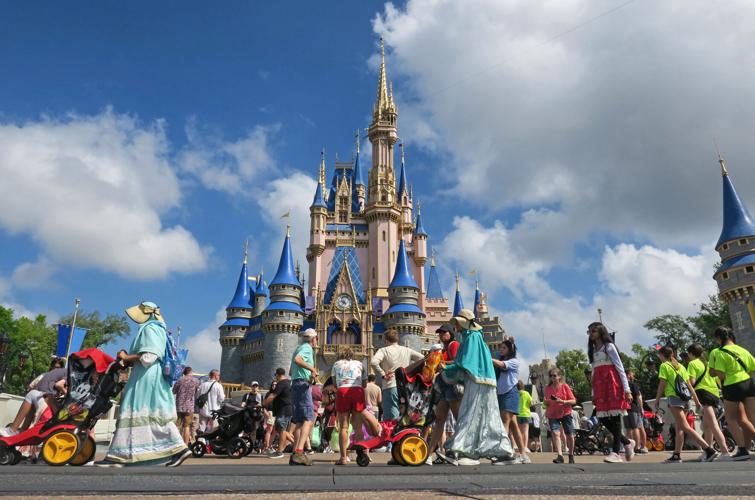
Guests walk past Cinderella Castle at the Magic Kingdom in Walt Disney World on April 2.
Now some in the travel industry fear the proposed social media mandate, announced this month, could further damage international visitation to the United States.
David Marriott recently visited Orlando from the U.K., calling it a “trip of a lifetime” for his three children. The family spent two weeks experiencing Florida’s theme parks and coastlines.
Marriott said he wants to return to the United States in the future, but the social media policy gives him pause. He worries posts criticizing Trump’s handling of the pandemic or the Jan. 6 Capitol riots could lead to travel authorization being denied.
“Watching America under Trump, it feels like you can’t have an opinion different to his,” he said.
The Trump administration hasn’t detailed exactly how the proposed social media screening would work or what content could disqualify someone from entering the United States.
The proposal, under a 60-day review, would expand the information that must be provided by tourists from visa-waiver countries, mostly in Europe, when completing their Electronic System for Travel Authorization form, or ESTA. The 42 countries on the visa-waiver list cover some of America’s closest allies, including Australia, France, Germany, Israel, Japan and the U.K.
Travelers would need to list social media accounts used within the past five years on their ESTA form, which is needed to visit for up to 90 days. The agency also intends to add new data fields, such as email addresses used within the past 10 years, addresses and phone numbers of immediate family members, and biometrics, such as a face or iris scan, fingerprints or DNA.
Debbie Churchill, who lives in the U.K., has been a regular visitor to Central Florida since the early 1990s. She joked she pities the bot handling the assignment of reviewing the mundane snapshots of her life on Facebook and Instagram.
“I can’t say I’m thrilled by the idea of being required to hand over the keys to my online presence. … I object on the grounds of privacy and security,” Churchill said. “What really bothers me, though, is the potential for stifling free speech.”
But Churchill said not traveling to Florida would be “cutting off one’s proverbial nose,” given her deep affection for the U.S.
Trump has brushed aside criticism that scrutinizing social media could hurt tourism.
“We want safety,” he told reporters. “We want security. We want to make sure we’re not letting the wrong people into our country.”
U.S. Customs and Border Protection did not answer questions from the Orlando Sentinel on what exactly the new policy would entail.
Central Florida U.S. Rep. Darren Soto said Trump’s social media screening wouldn’t make Americans safer but would harm the region’s economy.
“It could cost thousands of Central Florida jobs at a time when local families are already struggling,” said Soto, a Democrat who represents Kissimmee and other areas near Walt Disney World.
The U.S. Travel Association issued a statement that the social media rules could have a “chilling effect” on visitation to the United States.

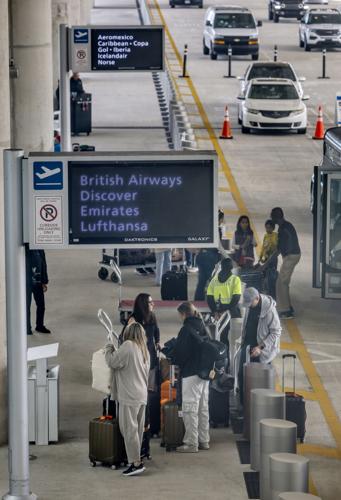
Travelers arrive at terminal C of the Orlando International Airport on Dec. 17.
“If we get this policy wrong, millions of travelers could take their business and the billions of dollars they spend elsewhere, only making America weaker,” the group warned.
International tourists comprised just under 10% of Orlando’s 75 million visitors in 2024, but they make an outsized contribution to the region’s economy, tourism officials say.
“They stay longer, spend more money,” said Casandra Matej, CEO and president of Visit Orlando. “It is very important.”
Canada, the U.K. and Brazil are the biggest source of Orlando’s international visitors.
The state’s most recent estimates for the second quarter of 2025 showed an 11.4% increase in overseas travelers compared with the same period in 2024. Canadian visitation, though, saw a 20% drop.
Arrivals to Central Florida airports through September of this year were down for Canadian travelers but up year-over-year for Brazil, Colombia and the U.K., according to data collected by Visit Orlando.
The research firm Tourism Economics forecasts international visitation to Orlando could dip 5% in 2025, driven by the decline in Canadian travelers, but recover by the end of 2026.
Trump’s tariffs and annexation threats angered many Canadians, the top source of international visitors to Orlando with nearly 1.3 million travelers in 2024. Canada’s weaker dollar also has made travel to the United States more expensive.
Photos: The biggest entertainment and fashion moments of 2025

Nicole Scherzinger poses in the press room with the award for best performance by an actress in a leading role in a musical for "Sunset Blvd" during the 78th Tony Awards at Radio City Music Hall in New York, June 8, 2025. (Photo by Evan Agostini/Invision/AP File)

Greg Tarzan Davis, from left, editor Eddie Hamilton, Angela Bassett, Tramell Tillman, Tom Cruise, director Christopher McQuarrie, Hannah Waddingham, Simon Pegg, Esai Morales, and Pom Klementieff pose for a group selfie upon their arrival to the premiere of the film 'Mission: Impossible - The Final Reckoning' at the 78th international film festival, Cannes, southern France, May 14, 2025. (Photo by Scott A Garfitt/Invision/AP File)

Cynthia Erivo poses for photographers upon her arrival at the premiere of the film "Wicked For Good" in London, Nov. 10, 2025. (Photo by Scott A Garfitt/Invision/AP File)

Miss Mexico Fatima Bosch, right, and Miss Thailand Praveenar Singh hold hands while waiting for the announcement of the winner for the 2025 Miss Universe pageant in Nonthaburi, Thailand, Nov. 21, 2025. (AP Photo/Sakchai Lalit, File)

Karol G performs during halftime at an NFL football game between the Kansas City Chiefs and the Los Angeles Chargers, in Sao Paulo, Sept. 5, 2025. (AP Photo/Andre Penner, File)

Bryan Cranston, right, presents the award for outstanding talk series to Stephen Colbert for "The Late Show with Stephen Colbert" during the 77th Primetime Emmy Awards at the Peacock Theater in Los Angeles, Sept. 14, 2025. (AP Photo/Chris Pizzello, File)

Cyndi Lauper performs during the 2025 Rock and Roll Hall of Fame Induction Ceremony at L.A. Live in Los Angeles, Nov. 8, 2025. (AP Photo/Chris Pizzello, File)

A model walks on a runway wearing a creation by Russian brand AP Design on a runway at Fashion Week in Moscow, March 13, 2025. (AP Photo/Pavel Bednyakov, File)

Bad Bunny performs during the iHeartRadio Music Awards at the Dolby Theatre in Los Angeles, March 17, 2025. (AP Photo/Chris Pizzello, File)

A model wears a design by De La Cierva y Nicolas backstage during Fashion Week in Madrid, Spain, Sept. 19, 2025. (AP Photo/Manu Fernandez, File)

Rihanna, left, and A$AP Rocky pose for photographers upon their departure from the premiere of the film 'Highest 2 Lowest' at the 78th international film festival, Cannes, southern France, May 19, 2025. (Photo by Lewis Joly/Invision/AP File)

Yungblud, Steven Tyler, and Joe Perry perform a tribute to Ozzy Osbourne during the MTV Video Music Awards at UBS Arena in Elmont, N.Y., Sept. 7, 2025. (Photo by Charles Sykes/Invision/AP File)

Elle Fanning poses for photographers at the photo call for the film 'Sentimental Value' at the 78th international film festival, Cannes, southern France, May 22, 2025. (Photo by Scott A Garfitt/Invision/AP File)

Sabrina Carpenter performs "Tear" during the MTV Video Music Awards at UBS Arena in Elmont, N.Y., Sept. 7, 2025. (Photo by Charles Sykes/Invision/AP File)

Chappell Roan performs "Pink Pony Club" during the 67th annual Grammy Awards in Los Angeles, Feb. 2, 2025. (AP Photo/Chris Pizzello, File)

Giorgio Armani waves at the end of his Prive Haute Couture Spring/Summer 2025 collection in Paris, Jan. 28, 2025. (AP Photo/Lewis Joly, File)

Jeff Bezos and Lauren Sanchez leave a hotel for their pre-wedding reception in Venice, Italy, June 26, 2025. (AP Photo/Luca Bruno, File)

Kristen Stewart poses for photographers upon arrival her at the premiere of the film 'Bono: Stories of Surrender' at the 78th international film festival, Cannes, southern France, May 16, 2025. (AP Photo/Natacha Pisarenko, File)

George Clooney kisses the hand of his wife Amal while posing for photographers on the red carpet for the film 'Jay Kelly' during the 82nd edition of the Venice Film Festival in Venice, Italy, Aug. 28, 2025. (Photo by Alessandra Tarantino/Invision/AP File)

A fan poses with a group photo of BTS, also known as the Bangtan Boys, during a celebration marking the South Korean's K-pop band's 12th debut anniversary in Goyang, South Korea, June 13, 2025. (AP Photo/Lee Jin-man, File)

Seth Rogen takes a photograph on the red carpet for the film 'The Smashing Machine' during the 82nd edition of the Venice Film Festival in Venice, Italy, Sept. 1, 2025. (Photo by Scott A Garfitt/Invision/AP File)

Adrien Brody, from left, winner of the award for best performance by an actor in a leading role for "The Brutalist," Mikey Madison, winner of the award for best performance by an actress in a leading role for "Anora," Zoe Saldana, winner of the award for best performance by an actress in a supporting role for "Emilia Perez," and Kieran Culkin, winner of the award for best performance by an actor in a supporting role for "A Real Pain," pose in the press room at the Oscars at the Dolby Theatre in Los Angeles, March 2, 2025. (Photo by Jordan Strauss/Invision/AP File

Fans pack the shore of Copacabana beach to watch Lady Gaga's free concert in Rio de Janeiro, May 3, 2025. (AP Photo/Bruna Prado, File)

Kansas City Chiefs tight end Travis Kelce and Taylor Swift kiss after the AFC Championship NFL football game against the Buffalo Bills, in Kansas City, Mo., Jan. 26, 2025. (AP Photo/Ashley Landis, File)

Alessandra Ambrosio blows a kiss on the runway of the Victoria's Secret Fashion Show in the Brooklyn borough of New York, Oct. 15, 2025. (Photo by Evan Agostini/Invision/AP File)

Tautumeitas from Latvia performs the song "Bur Man Laimi" during a dress rehearsal for the second semi-final of the 69th Eurovision Song Contest, in Basel, Switzerland, May 14, 2025. (AP Photo/Martin Meissner, File)

Audra McDonald performs "Rose's Turn" from "Gypsy" during the 78th Tony Awards at Radio City Music Hall in New York, June 8, 2025. (Photo by Charles Sykes/Invision/AP File)

Sherri Shepherd, left, celebrates with Niecy Nash at a ceremony honoring Shepherd with a star on the Hollywood Walk of Fame on Los Angeles, Nov. 3, 2025. (AP Photo/Chris Pizzello, File)

Kim Kardashian arrives at the fifth annual Academy Museum Gala at the Academy Museum of Motion Pictures in Los Angeles, Oct. 18, 2025. (Photo by Jordan Strauss/Invision/AP File)

Colombian superstar Shakira performs during her "Las Mujeres Ya No Lloran," or Women Don't Cry Anymore, world tour in Buenos Aires, Argentina, March 7, 2025. (AP Photo/Natacha Pisarenko, File)

