

ATLANTA — President Donald Trump's order accusing the Smithsonian Institution of not reflecting American history notes correctly that the country's Founding Fathers declared, “all men are created equal.”
However, it doesn't mention that the founders enshrined slavery into the U.S. Constitution and declared enslaved persons as three-fifths of a person for the purpose of the Census.
Civil rights advocates, historians and Black political leaders sharply rebuked Trump for his order, entitled “Restoring Truth and Sanity to American History.” They argue that his executive order targeting the Smithsonian Institution is his administration’s latest move to downplay how race, racism and Black Americans shaped the nation’s story.
“It seems like we’re headed in the direction where there’s even an attempt to deny that the institution of slavery even existed, or that Jim Crow laws and segregation and racial violence against Black communities, Black families, Black individuals even occurred,” said historian Clarissa Myrick-Harris, a professor at Morehouse College, the historically Black campus in Atlanta.
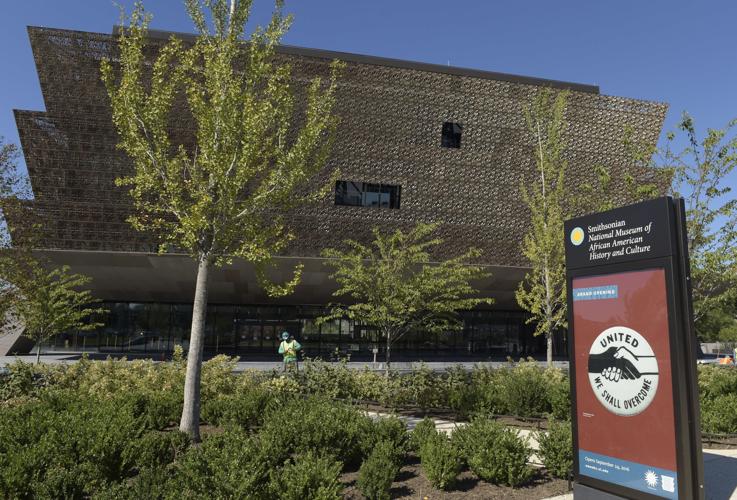
Last week's executive order cites the National Museum of African American History and Culture by name and argues that the Smithsonian as a whole is engaging in a “concerted and widespread effort to rewrite our Nation’s history.”
Instead of celebrating an “unparalleled legacy of advancing liberty, individual rights, and human happiness,” the order argues that a “corrosive … divisive, race-centered ideology” has “reconstructed” the nation “as inherently racist, sexist, oppressive, or otherwise irredeemably flawed.”
It empowers Vice President JD Vance to review all properties, programs and presentations to prohibit programs that “degrade shared American values” or “divide Americans based on race.”
Trump also ordered Interior Secretary Doug Burgum to determine if any monuments since January 2020 “have been removed or changed to perpetuate a false reconstruction of American history” or “inappropriately minimize the value of certain historical events or figures.” Trump long criticized the removal of Confederate monuments, a movement that gained steam after the May 2020 police murder of George Floyd in Minneapolis prompted nationwide protests.
Critics argued the order is the latest move by the Trump administration to quash recognition of Black Americans’ contributions to the nation and to gloss over the legal, political, social and economic obstacles they have faced.
Trump’s approach is “a literal attack on Black America itself,” said Ibram X. Kendi, a race historian and bestselling author. “The Black Smithsonian, as it is affectionately called, is indeed one of the heartbeats of Black America,” Kendi argued, and “also one of the heartbeats” of the United States at large.
Congressional Black Caucus Chair Yvette Clarke, D-N.Y., suggested Trump wants to distort the national narrative to racist ends.
“We do not run from or erase our history simply because we don’t like it,” she said. “We embrace the history of our country — the good, the bad, and the ugly.”
Trump once praised the ‘Black Smithsonian’
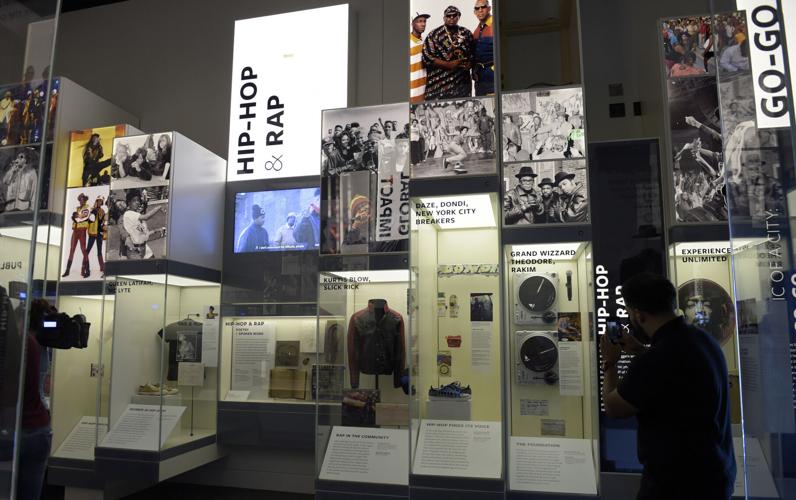
The African American museum, one of 21 distinct Smithsonian entities, opened along the National Mall in 2016, the last year that President Barack Obama held office as the nation’s first Black chief executive. The museum chronicles chattel slavery, Jim Crow segregation and its lingering effects, but also highlights the determination, successes and contributions of individual Black Americans and Black institutions throughout U.S. history.
Former NAACP President Ben Jealous, who now leads the Sierra Club, said museums that focus on specific minority or marginalized groups — enslaved persons and their descendants, women, Native Americans — are necessary because historical narratives from previous generations misrepresented or overlooked those individuals.
“Attempts to tell the general history of the country always omit too much … and the place that we’ve come to by having these museums is so we can, in total, do a better job of telling the complete story of this country,” he said.
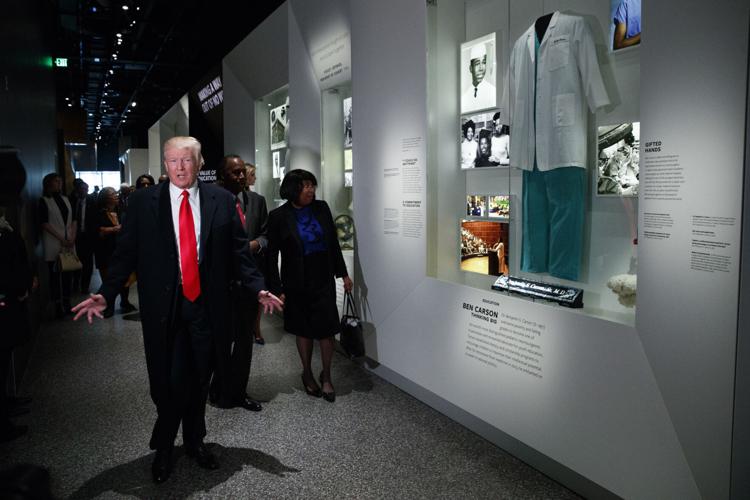
Trump visited the African American museum in 2017.
“I’m deeply proud that we now have a museum that honors the millions of African American men and women who built our national heritage, especially when it comes to faith, culture and the unbreakable American spirit,” Trump said after a tour that included Sen. Tim Scott of South Carolina and then-Housing and Urban Development Secretary Ben Carson, both of whom are Black.
Trump's war on ‘woke’ targets history
Trump won his comeback White House bid with a notable uptick in support from nonwhite voters, especially among younger Black and Hispanic men.
He ratcheted up attacks during his campaign on what he labeled “woke” culture and diversity, equity and inclusion initiatives, not just in government but the private sector. He also used racist and sexist tropes to attack Democratic nominee Kamala Harris, the first Black woman and person of South Asian descent to serve as U.S. vice president, and regularly accused her and other liberals of “hating our country.”
Since his Jan. 20 inauguration, Trump banned diversity initiatives across the federal government. The administration launched investigations of colleges that it accuses of discriminating against white and Asian students with race-conscious admissions programs intended to address historic inequities in access for Black students.
The Defense Department temporarily removed training videos recognizing the Tuskegee Airmen and an online biography of Jackie Robinson. In February, Trump fired Air Force Gen. CQ Brown Jr., a champion of racial diversity in the military, as chairman of the Joint Chiefs of Staff. Brown, in the wake of Floyd's killing, spoke publicly about his experiences as a Black man, and was only the second Black general to serve as chairman.
The administration fired diversity officers across government, curtailed some agencies' celebrations of Black History Month, and terminated grants and contracts for projects ranging from planting trees in disadvantaged communities to studying achievement gaps in American schools.
Warnings of a chilling effect
Civil rights advocates and historians expressed concern about a chilling effect across other institutions that study Black history.
Kendi noted many museums and educational centers across the country exist with little to no federal or other governmental funding sources. Some are struggling to stay open.

