

As hundreds of federal and local agents scoured the Arizona desert and chased down potential leads since Nancy Guthrie disappeared Feb. 1 from her affluent neighborhood, families of other missing people are reminded how elusive answers can be.

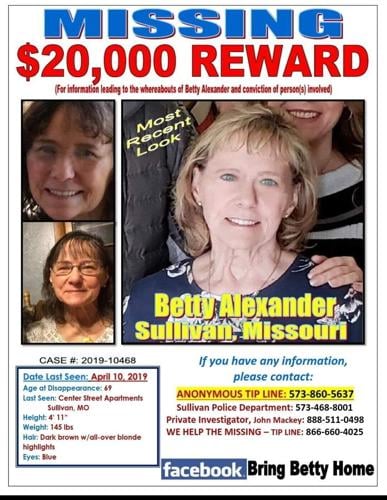
A poster that Tonya Miller made in the desperate search for her mother, Betty, who went missing in 2019.
Families who spoke to the Associated Press share the deep pain Nancy Guthrie's children, including the well-known "Today" show host Savannah Guthrie, expressed publicly.
On the other hand, people like Tonya Miller — whose mother disappeared under suspicious circumstances in Missouri in 2019 — say they feel frustrated as they watch seemingly endless resources flood into the search for Guthrie.
"Families like ours that have just your normal missing people, they have to fight to get any help," Miller, 44, said.
Miller's mother, Betty Miller, is one of the thousands of people who are listed as abducted each year, according to federal statistics. In most cases, families like Tonya Miller's say it's a full-time job advocating for a fair and thorough investigation.
Flooded with resources

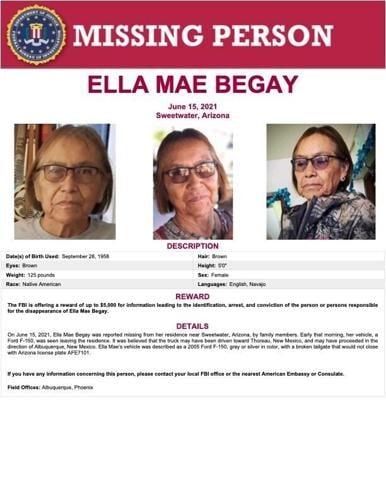
A notice for missing woman Ella Mae Begay
The country was engrossed by the Nancy Guthrie case after authorities said they believe she was taken against her will.
Multiple news outlets reported receiving ransom notes, and the Guthrie family expressed a willingness to pay — though it's not known whether ransom notes demanding money with deadlines that already passed were authentic.
In the meantime, several hundred detectives and agents are now assigned to Nancy Guthrie's investigation, the Pima County Sheriff's Department said.
FBI spokesperson Connor Hagan declined to say how many of those agents were federal law enforcement and how many were already assigned in Arizona. He also didn't clarify how the federal agency prioritizes different missing persons cases.
However, he said agents from the Critical Incident Response Group, technical experts and intelligence analysts are working to bring Guthrie home. There is also a 24-hour command post where dozens of agents parse through the 13,000 tips that flooded in from the public, among other responsibilities, according to a post the agency made.
Abductions are rare

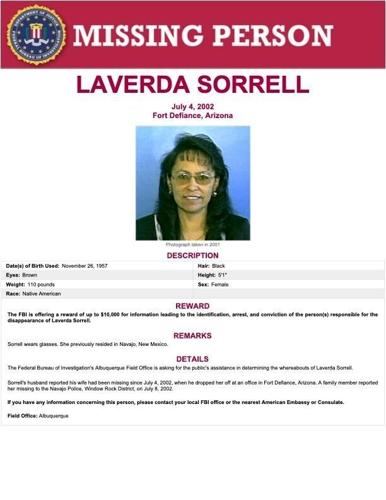
A poster for missing woman Laverda Sorrell
The vast majority of people who are reported missing are believed to be runaways — not kidnapped or abducted.
Throughout 2024, the latest year that National Crime Information Center published the data, more than 530,000 missing person records were entered. By the end of the year, more than 90,000 cases remained unresolved on that list — some going back decades.
About 95% of the hundreds of thousands of cases filed in 2024 were believed to be runaways and only 1% were listed as abductions.
Often, the abductor is a parent who doesn't have legal guardianship over a child, the report said. It's even more rare for someone to be abducted by a stranger.
Disproportionately affected
The FBI names five kidnapped or missing people, including Nancy Guthrie, from Arizona on its online database of 125 missing or kidnapped people. All five from Arizona are listed as Native American or otherwise disappeared from tribal communities, except for Guthrie.

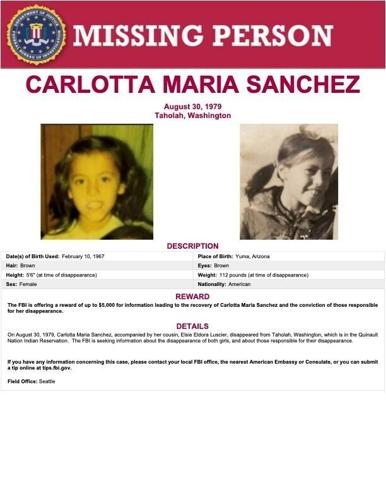
A notice for missing woman Carlotta Maria Sanchez
That racial trend holds true for the rest of the country, too.
A disproportionate number of Black and Indigenous people were among the abducted in 2024, according to the National Crime Information Center report. About a third of the 533,936 missing people listed as abducted in 2024 were Black, though the census reports only 13% of the U.S. population is Black. Similarly, almost 3% of the missing people listed as abducted were Indigenous, compared to the 1.4% of people who are Indigenous in the U.S. writ large.
"Every person deserves to be safe, and when someone is missing, there should be an immediate, coordinated, and effective response," said Lucy Simpson, chief executive officer for the National Indigenous Women's Resource Center. "For many Native women, longstanding gaps in resources, coordination, and systemic support for Tribal Nations have made prevention and response more difficult."
No answers
Experts said that sometimes the attention on high-profile cases can be a major obstacle to law enforcement operations. But Savannah Guthrie's celebrity status also garnered extensive resources from government — including a $100,000 FBI reward for accurate information about her whereabouts or that could lead to an arrest and conviction of whoever took her.

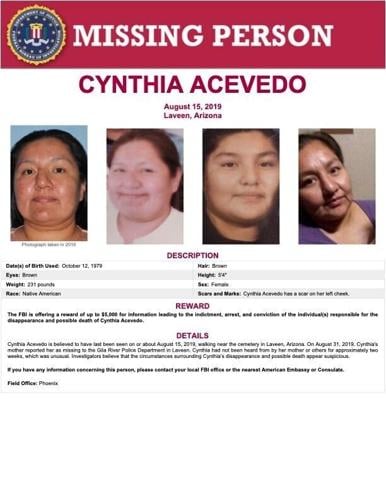
A notice for missing woman Cynthia Acevedo
That's in stark contrast, Miller said, to the dearth of help she's received in Sullivan, Missouri, where she's had to use her own time and money to search for her mom, who was last seen in her apartment in the town of about 7,000 residents. A box of Betty Miller's prescribed fentanyl patches were missing from the apartment and her prescription eye glasses were left on an armchair, Tonya Miller said. There was a massive scratch on her mom's front door that wasn't there before.
The Sullivan Police Department didn't respond to an emailed request for comment Friday.
Despite those suspicious circumstances, police didn't treat her mother's apartment like a crime scene, Tonya Miller said. She had to beg them to take fingerprints and often had to prod them to follow up on tips filed by the public. In the weeks that followed, Tonya Miller organized search parties, printed out fliers and held fundraisers to scrape together a $20,000 reward for her mother.
As the years go by, Tonya Miller said it gets harder to know how to help find her mom. She wrote letters to elected officials at all levels of government, including President Donald Trump.
"I feel so helpless," she said, "because you just don't know what to do anymore."



