

MIAMI — Dr. Alfonso Sabater pulled up two photos of Antonio Vento Carvajal’s eyes. One showed cloudy scars covering both eyeballs. The other, taken after months of gene therapy given through eyedrops, revealed no scarring on either eye.
Antonio, who’s been legally blind for much of his 14 years, can see again.
The teen was born with dystrophic epidermolysis bullosa, a rare genetic condition that causes blisters all over his body and in his eyes. But his skin improved when he joined a clinical trial to test the world’s first topical gene therapy. That gave Sabater an idea: What if it could be adapted for Antonio’s eyes?

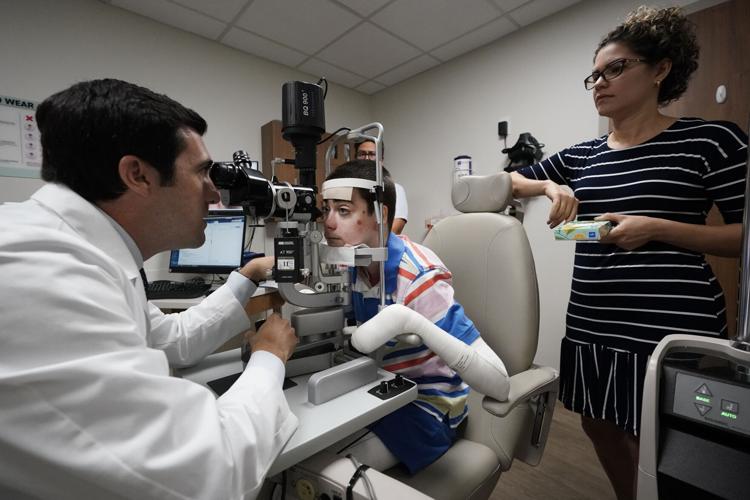
Dr. Alfonso Sabater, left, examines Antonio Vento Carvajal’s eyes alongside the boy’s mother, Yunielkys Carvajal, on July 6 at University of Miami Health System’s Bascom Palmer Eye Institute in Miami.
This insight not only helped Antonio, it also opened the door to similar therapies that could potentially treat millions of people with other eye diseases, including common ones.
Antonio’s mom, Yunielkys “Yuni” Carvajal, teared up thinking about what Sabater did for her son.
“He’s been there through everything,” she said in Spanish during a visit to the University of Miami Health System’s Bascom Palmer Eye Institute. “He’s not only a good doctor but such a good human being and provided us with hope. He never gave up.”
The family came to the U.S. from Cuba in 2012 on a special visa allowing Antonio to get treatment for his condition, which affects around 3,000 people worldwide. He had surgeries to remove scar tissue from his eyes, but it grew back. Antonio’s vision kept getting worse, eventually deteriorating so much that he didn’t feel safe walking around.
Sabater had no answers then, and tried to reassure the boy: “I’ll find a solution. I just need some time. I’m working on it.”

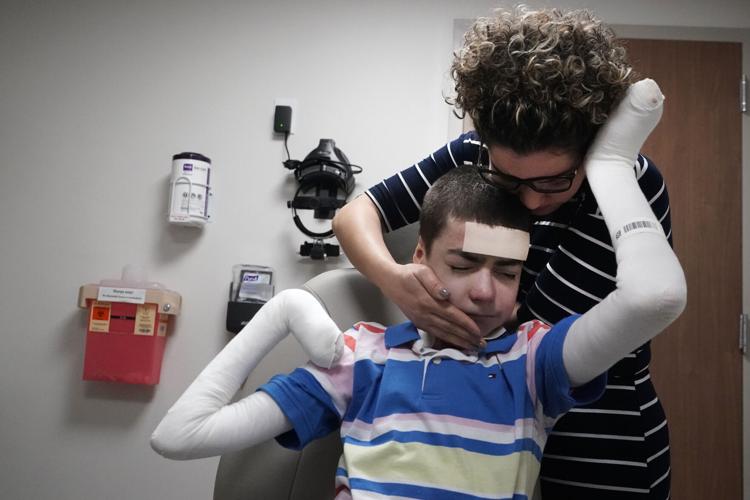
Yunielkys Carvajal gives her son, Antonio Vento Carvaja, a hug and a kiss after a July 6 doctor's visit at University of Miami Health System's Bascom Palmer Eye Institute in Miami. Antonio, who spent much of his life legally blind, can see again after months of gene therapy delivered with eyedrops.
“’Yeah, I know you’re going to do it,’” Sabater recalled Antonio saying. “That gave me the energy to continue.”
At one point, Carvajal told Sabater about the experimental gene therapy gel for Antonio’s skin lesions. He contacted drugmaker Krystal Biotech to see if it could be reformulated for the boy’s eyes.
Suma Krishnan, co-founder and president of research and development for the Pittsburgh-based company, said the idea made sense and “it didn’t hurt to try it.”
Antonio’s condition is caused by mutations in a gene that helps produce a protein called collagen 7, which holds together both skin and corneas. The treatment, called Vyjuvek, uses an inactivated herpes simplex virus to deliver working copies of that gene. The eyedrops use the same liquid as the skin version, just without the added gel.
After two years, which included testing the drug in mice, the team got “compassionate use” approval from the U.S. Food and Drug Administration and permission from university and hospital review boards. Last August, Antonio had surgery on his right eye, after which Sabater started treating him with the eyedrops.
Krishnan said they were cautious, frequently watching to see that it was safe.
Antonio’s eye recovered from the surgery, the scarring didn’t return and there was significant improvement each month, Sabater said. Doctors recently measured the vision in Antoni’s right eye at a near-perfect 20/25.

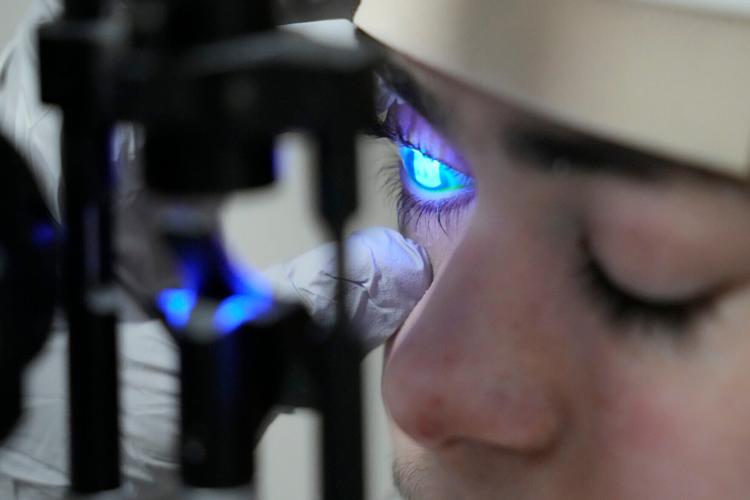
Dr. Alfonso Sabater, checks Antonio Vento Carvajal's eye under a blue light July 6 after applying a stain to check to see if more ulcers had developed.
This year, Sabater began treating Antonio’s left eye, which had even more scar tissue. That one is also steadily improving, measuring close to 20/50, which Sabater said “is pretty good vision.”
Antonio comes to the eye institute for checkups almost weekly and gets the drops once a month. During visits, Antonio must wear protective clothing covering his arms, hands, legs and feet. Like other kids with the condition — who are sometimes called “butterfly children” — his skin is so fragile that even a touch can wound him.
Antonio still uses the skin gel, which was approved by the FDA in May and can also be used off-label on eyes. It doesn’t modify DNA, so it’s not a one-time treatment like many gene therapies.
Sabater, director of the Corneal Innovation Lab at the eye institute, said gene therapy eyedrops could potentially be used for other diseases by changing the gene delivered by the virus. For example, a different gene could be used to treat Fuchs’ dystrophy, which affects 18 million people in the U.S. and accounts for about half the nation’s corneal transplants.
The prospect of treating more conditions this way is “exciting,” said Dr. Aimee Payne, a dermatology professor at the University of Pennsylvania who isn’t involved in the research. The approach “delivers gene therapy that really addresses the root cause of disease.”
With his vision restored, Antonio has enjoyed a typical teen pastime he’s wanted to do for quite a while: playing video games with his friends. And he finally feels safe walking around.
Sabater said the two-year journey seeking government and hospital approvals “was worth it. Just for Antonio, it was worth it ... but also because it opens the space to treat other patients in the future.”
10 traits you may not know can be tied to genetics
10 traits you may not know can be tied to genetics
Updated
Although the longstanding debate between nature versus nurture is often framed as one being dominant over the other, scientists today know it’s not that simple: Nature and nurture interact in complex ways.
You probably already know that your parents and family history play a big role in determining your physical features, from the color of your hair to your height. But did you know that genetics also has an influence on some of your personality traits too? To create a list of traits that have some of their origins in genetics, Top10.com collected information from scientific journals such as Nature Genetics and the Proceedings of the National Academy of Sciences.
Today, more is often known about the genetic component of inheritable medical conditions such as hemophilia, a blood clotting disorder, and Huntington’s disease, a degenerative condition affecting the brain’s nerve cells. But according to a study published in Nature Genetics, more is being discovered about how traits like extraversion, creativity, and compassion, may also have correlations to specific genetic variants.
We’ve only scratched the surface of what genetics can tell us about who we are, but researchers are hopeful that with more study, we’ll unlock more about how psychological traits are impacted by genetics and environmental factors. Here are 10 physical and psychological traits that researchers have determined have some of their origins linked to genetics.

Facial expressions
Updated
A 2006 study conducted in Israel found facial expressions associated with concentration, sadness, and anger can be inherited. Researchers videotaped 21 people born blind and 30 of their relatives born sighted. Participants were asked to solve challenging puzzles, listen to a disgusting story, recount a sad or joyful personal experience, and respond to a silly question. Those who were blind had very similar facial expressions to their sighted relatives when concentrating or feeling angry or sad. Moreover, a computer program able to recognize similar facial expressions correctly matched blind participants with their relatives 80% of the time.
Deviated septum
Updated
The septum is the bone and cartilage in the nasal cavity that divides it into two nostrils. The septum can become deviated, or crooked, making it difficult to breathe. A deviated septum is most commonly the result of trauma, such as a blow to the face. However, it is also associated with conditions that affect connective tissue, such as Marfan syndrome and Ehlers-Danlos syndrome, both of which are genetic.
Children’s insomnia
Updated
A team led by researchers at the University of Basel in Switzerland found maternal symptoms of insomnia were associated with a child’s sleep pattern as objectively measured by in-home electroencephalography. Maternal insomnia was associated with less total sleep time, more stage 2 sleep, less slow-wave sleep, a later time to sleep onset, and a later wake time for their child. The insomnia symptoms of both parents influenced their perceptions of their children’s refusal to adhere to a designated bedtime, duration of sleep, sleep anxiety, incidents of waking up during the night, and/or daytime sleepiness.
Widow’s peak
Updated
A V-shaped frontal hairline, often called a widow’s peak, is a morphogenetic trait inherited by people from their parents. It has also been associated with a number of inherited genetic conditions. Reports also exist of a link between a widow’s peak and craniofacial clefts, or malformations of part of the face. However, the association between a widow’s peak and the severity of these conditions has not yet been defined.
Caffeine response
Updated
Every person responds differently to caffeine. Scientific evidence that these responses may be genetic is increasing. Genetic factors may directly influence individual responses by changing acute or chronic reactions to caffeine. These factors may also play an indirect role by altering the psychological or physiological processes related to the effects of caffeine, such as sensitivity to anxiety and the generally reinforcing effects of substance use. Genes can also affect the body’s response to long-term caffeine use.
Sensitivity to bitter food
Updated
About one-fourth of the population has a taste receptor gene, TAS2R38, that can make foods such as leafy greens and hoppy beers taste bitter. The perceived bitterness of these foods varies among individuals and depends on how strongly compounds in foods bind to the receptor. In a 2014 study of 93 Caucasian participants, TAS2R38 was associated with a bitter taste on the papillae of the tongue when it was swabbed with ethyl alcohol. The researchers concluded that genetic variations in the TAS2Rs gene may explain why alcoholic beverages taste bitter to some people but not to others.
Sneezing in the sun
Updated
Autosomal Dominant Compelling Helioopthalmic Outburst syndrome, appropriately known as ACHOO syndrome, is characterized by sneezing after sudden exposure to bright light, usually strong sunlight. The cause of ACHOO syndrome is not well understood. However, researchers do know it is inherited as an autosomal dominant trait, so if one parent is affected, a child has half a chance of inheriting ACHOO syndrome.
Optimism
Updated
The oxytocin receptor gene, also known as the OXTR gene, codes for the oxytocin receptor, to which the hormone oxytocin binds and exerts its effects throughout the body. Studies have linked part of the OXTR gene to psychological resources including optimism. The findings of a 2011 study suggest those who inherited a certain variation of the OXTR gene from both parents are more optimistic than those who inherited the variation from one parent or not at all.
Pain tolerance
Updated
In 2014, researchers presented a paper at the American Academy of Neurology’s annual meeting identifying four genes associated with pain perception: DRD1, DRD2, COMT, and OPRK1. The researchers enrolled almost 2,800 people who took opioids for chronic pain in their study. The DRD1 gene was 33% more prevalent among those with low pain perception than those with high pain perception. The COMT gene was 25% more common among those with moderate pain perception compared to those with high pain perception, and the OPRK1 gene was 19% more common. Among those with high pain perception, the DRD2 gene was 25% more prevalent compared to those with moderate pain perception.
Identifying these genes can help physicians better understand why some of their patients perceive pain differently than others, according to author Tobore Onojighofia, a member of the American Academy of Neurology and scientist with Proove Biosciences.
Life satisfaction
Updated
A study of twins published in 2012 by an international team of researchers found genetics explain about 33% of the variation in reported life satisfaction. Although at first the researchers found people with a certain variant of the 5-HTT serotonin transporter gene reported greater life satisfaction, they had difficulty replicating their results in an independent sample. The researchers said their findings suggest more work is necessary to better understand the relationship between the 5-HTT gene variant and life satisfaction.
This story originally appeared on Top10.com and was produced and distributed in partnership with Stacker Studio.

