

Like the other Founding Fathers, George Washington was uneasy about the idea of publicly celebrating his life. He was the first leader of a new republic — not a tyrant.
Yet the nation will once again commemorate the first U.S. president, 294 years after his birth.
The meaning of Presidents Day changed dramatically, from being mostly unremarkable and filled with work for Washington in the 1700s to the consumerism bonanza it became today. For some historians, the holiday lost all discernible meaning.

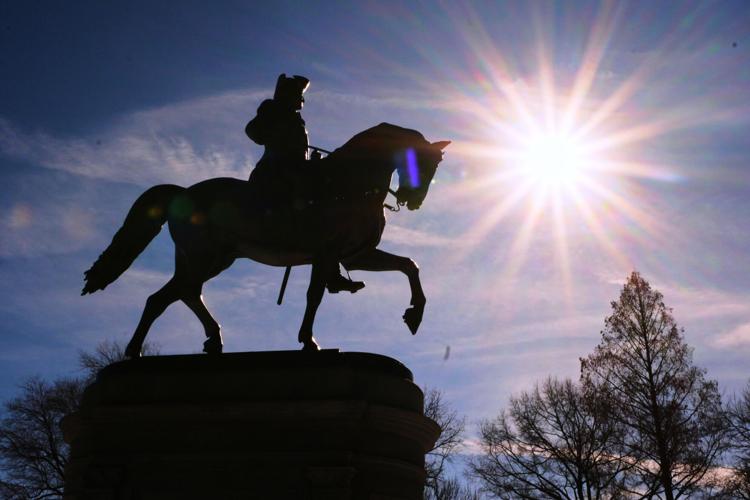
The sun shines over a statue of George Washington on horseback at the Public Garden, Feb. 13, in Boston.
Historian Alexis Coe, author of "You Never Forget Your First: A Biography of George of Washington," said she thinks about Presidents Day in much the same way as the towering monument in D.C. that bears his name.
"It's supposed to be about Washington, but can you really point to anything that looks or sounds like him?" she said. Thomas Jefferson and Abraham Lincoln "are presented as people with limbs and noses and words associated with their memorials. And he's just a giant, granite point. He has been sanded down to have absolutely no identifiable features."

Two birth dates

Washington was born Feb. 22, 1732, on Popes Creek Plantation near the Potomac River in Virginia.
Technically, he was born Feb. 11 under the ancient Julian calendar, which was still in use for the first 20 years of his life. The Gregorian calendar, intended to more accurately mark the solar year, was adopted in 1752, adding 11 days.
Either way, Washington paid little attention to his birthday according to George Washington's Mount Vernon, the website of the organization that manages his estate. Surviving records make no mention of observances at Mount Vernon, while his diary shows he was often hard at work.
"If he had it his way, he would be at home with his family," Coe said. "Maybe some beloved nieces and nephews (and friend) Marquis de Lafayette would be ideal. And Martha's recipe for an indulgent cake. But that's about it."
Congress voted during his first two terms to take a short commemorative break each year, with one exception, his last birthday in office, Coe said. By then Washington was less popular, partisanship was rampant and many members of his original Cabinet were gone, including Thomas Jefferson.
"One way to show their disdain for his Federalist policies was to keep working through his birthday," Coe said.
The Library of Congress notes that a French military officer, the comte de Rochambeau, threw a ball celebrating Washington's 50th birthday in 1782.

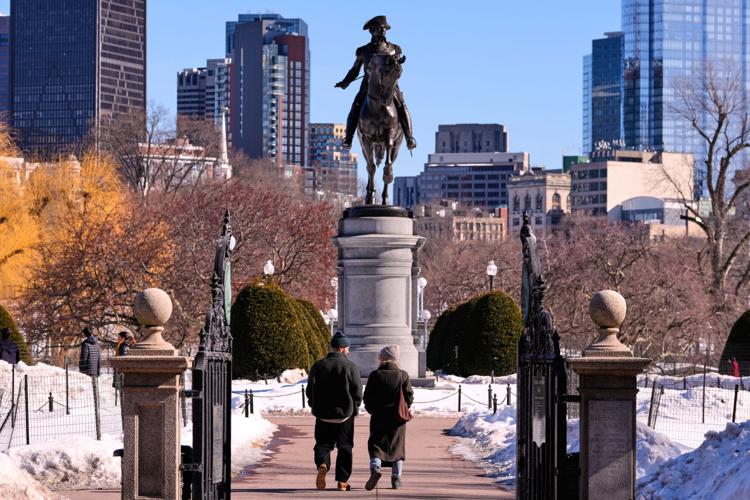
A couple walks toward a statue of George Washington on horseback at the Public Garden, Feb. 13, in Boston.
After his death
Washington was very aware of his inaugural role as president and its distinction from the British crown. He didn't want to be honored like a king, said Seth Bruggeman, a history professor at Temple University in Philadelphia.
Still, he said, a market for Washington memorabilia sprang up almost immediately after his death in 1799 at age 67, with people snapping up pottery and reproductions of etchings portraying him as a divine figure going off into heaven.
"Even in that early moment, Americans kind of conflated consumerism with patriotic memory," said Bruggeman, whose books include "Here, George Washington Was Born: Memory, Material Culture, and the Public History of a National Monument."

Making it official
In 1832, the centennial of Washington's birth, Congress established a committee to arrange national "parades, orations and festivals," according to the Congressional Research Service.
In 1879, his birthday formally made into a legal holiday for federal employees in the District of Columbia.
The official designation is as Washington's Birthday, though it came to be known informally as Presidents Day. Arguments were made to honor President Lincoln, too, as his birthdate falls on Feb. 12.
A small number of states, including Illinois, observe Lincoln's birthday as a public holiday, according to the Library of Congress. Some commemorate both Lincoln and Washington on Presidents Day.
Shift to consumerism

By the late 1960s, Washington's Birthday was one of nine federal holidays that fell on specific dates on different days of the week, according to a 2004 article in the National Archives' Prologue magazine.
Congress voted to move some of those to Mondays due to concerns in part about absenteeism among government workers when a holiday fell midweek. Lawmakers also noted clear benefits to the economy, including boosts in retail sales and travel on three-day weekends.
The Uniform Monday Holiday Act took effect in 1971, moving Presidents Day to the third Monday in February. Sales campaigns soared, historian C. L. Arbelbide wrote in Prologue.
Bruggeman said Washington and the other Founding Fathers "would have been deeply worried" by how the holiday became taken over by commercial and private interests. He noted, "they saw corporations as like little republics that potentially threatened the power of The Republic."



