



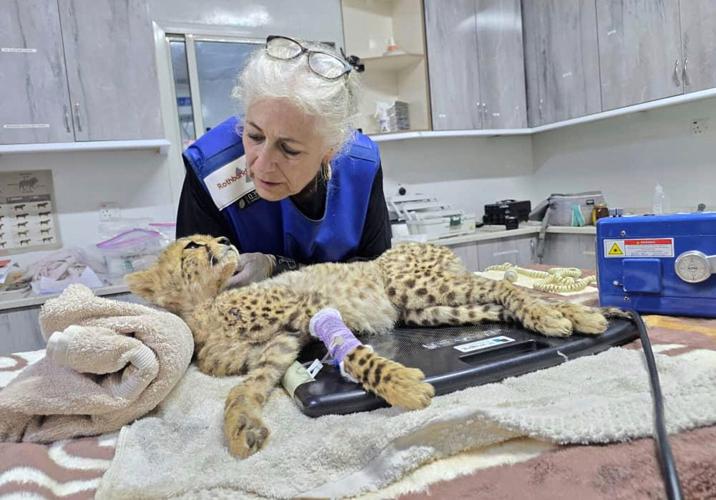
NAIROBI, Kenya — Ten cheetah cubs held in captivity since birth and destined for international wildlife trade markets were rescued in Somaliland, a breakaway region of Somalia
Laurie Marker, founder of the Cheetah Conservation Fund, which is caring for the cubs, said Wednesday they were all in a stable condition despite having been undernourished and limping due to being tied in captivity for months.

One of 10 cheetah cubs rescued from the illegal wildlife pet trade receives treatment Aug. 14 at the Cheetah Rescue and Conservation Centre in Geed-Deeble on the outskirts of Hargeisa, Somaliland, a semi-autonomous breakaway region of Somalia.
She said one 8-month-old cub was unable to walk after been tied up for six months, while a 5-month-old was "very malnourished (a bag of bones), with sores all over her body and full of botfly maggots which are under the skin."
"But with cubs like this, we need to start them on food slowly due to refeeding syndrome, similar to people in starvation," she added.
Two people who were in possession of the cubs were arrested during an Aug. 14 operation in the northern Sallahley District. Authorities urged the public to report suspected wildlife trade activities.

A rescued cub receives treatment Aug. 14 at the Cheetah Rescue and Conservation Centre in Geed-Deeble, Somaliland.
Environment Ministry Director Abdinasir Hussein Saed told journalists that the cheetah cubs joined a group of 109 others rescued in similar operations.
Somaliland is a major transit hub for the illegal wildlife trade. Hundreds of cheetahs and leopards from the Horn of Africa were transported to Gulf countries through the Gulf of Aden.
Possession of wildlife is illegal in Somaliland, and police often crack down on suspected traders.

A rescued cub receives treatment Aug. 14 at the Cheetah Rescue and Conservation Centre in Geed-Deeble, Somaliland.
"We encourage the people of Somaliland to protect wildlife in their natural habitats, as their best interests lie there," Hussein said. "We can imagine the distress of a mother being separated from her young."
"These animals are currently suffering due to being separated from their mothers, which may lead to the mothers experiencing stress and potentially dying," he said. "Once again, we emphasize the importance of protecting wildlife in their habitats."
Conservationists in the Horn of Africa previously expressed concern over the rise in demand for exotic pets in Gulf countries and the resulting illegal trade affecting ecosystems in Horn of Africa nations.
Photos: Insect and animal life around the globe

Two-month-old baby hippo Moo Deng and her mother Jona are seen at the Khao Kheow Open Zoo in Chonburi province, Thailand, Thursday, Sept. 19, 2024. (AP Photo/Sakchai Lalit)

A crow and a seagull fight for a prey in Tallinn Bay, Tallinn, Estonia, Sunday, Sept. 29, 2024. (AP Photo/Sergei Grits)

A Stag in rut bellows in early morning mist Bushy Park southwest London, Saturday, Sept. 28, 2024. (AP Photo/Alastair Grant)

Deer cross a road in the woods of the Taurus region near Frankfurt, Germany, Saturday, Sept. 28, 2024. (AP Photo/Michael Probst)

A deer walks on a road in the woods of the Taurus region near Frankfurt, Germany, Saturday, Sept. 28, 2024. (AP Photo/Michael Probst)

A raptor after killing a pigeon in a garden in Frankfurt, Germany, Saturday, Sept. 21, 2024. (AP Photo/Michael Probst)

A one horned rhinoceros and its calf graze in Pobitora wildlife sanctuary on the outskirts of Guwahati, India, Wednesday, Sept. 25, 2024. (AP Photo/Anupam Nath)

A spider waits for his prey at the center of its net covered by water droplets in the forest outside Tallinn, Estonia, Friday, Sept. 20, 2024. (AP Photo/Sergei Grits)

Giraffes roam their enclosure at the Living Desert Zoo and Gardens in Palm Desert, Calif., Thursday, Sept. 19, 2024. (AP Photo/Jae C. Hong)

A visitor looks at male Hippo Tony, at the Khao Kheow Open Zoo in Chonburi province, Thailand, Thursday, Sept. 19, 2024. (AP Photo/Sakchai Lalit)

A fawn and its mother stand together in a forest of the Taunus region in Frankfurt, Germany, Tuesday, Sept. 17, 2024. (AP Photo/Michael Probst)

A swan family watches Sunday walkers at Lake Baldeney in Essen, Germany, Sunday, Sept. 15, 2024. (AP Photo/Martin Meissner)

A beetle basks in the sun on a city meadow in Tallinn, Estonia, Monday, Sept. 9, 2024. (AP Photo/Sergei Grits)

Seagulls fly over Al Arish beach, 50 km (32,5 miles), West of Rafah border crossing between Egypt and the Gaza Strip in Al Arish, Egypt, Monday, Sept. 9, 2024. (AP Photo/Amr Nabil)

Butterflies feed on flowers nectar in a forest outside Tallinn, Estonia, Tuesday, Sept. 3, 2024. (AP Photo/Sergei Grits)

A bee and a sunflower are silhouetted against the setting sun in a field Saturday, Sept. 7, 2024, near Lawrence, Kan. The field, planted annually by the Grinter family, draws thousands of visitors during the weeklong late summer blossoming of the flowers. (AP Photo/Charlie Riedel)

Panda Yuanyuan eats her birthday cake for her 20 years old at the Taipei Zoo in Taipei, Taiwan, Friday, Aug. 30, 2024. Yuanyuan was a gift from China to mark warming ties with Taiwan in 2008. (AP Photo/Chiang Ying-ying)

A sea lion is covered in sand on San Carlos beach in Monterey, Calif., Friday, Aug. 23, 2024. (AP Photo/Nic Coury)

Flamingos in their enclosure at the Tierpark zoo in Berlin, Germany, Thursday, Aug. 22, 2024. (AP Photo/Markus Schreiber)

A snail looks up as it carries its house on the back at a terrace in Gelsenkirchen, Germany, Thursday Oct. 3, 2024. (AP Photo/Martin Meissner)

Emily, a new born Rothschild's Giraffe, born on Aug. 11, 2024. stands in front of her mother Katharina, during a name giving event at the Tierpark zoo in Berlin, Germany, Thursday, Aug. 22, 2024. (AP Photo/Markus Schreiber)

Two storks stand in their nest in Wehrheim near Frankfurt, Germany, Tuesday, Oct. 1, 2024. (AP Photo/Michael Probst)

A flock of birds fly past turbines at a wind farm, Sunday, Sept. 29, 2024, near Spearville, Kan. (AP Photo/Charlie Riedel)

Icelandic horses play at a stud farm in Wehrheim near Frankfurt, Germany, Monday, Sept. 30, 2024. (AP Photo/Michael Probst)

A raptor after killing a pigeon in a garden in Frankfurt, Germany, Saturday, Sept. 21, 2024. (AP Photo/Michael Probst)

A spider waits for his prey at the center of its net covered by water droplets in the forest outside Tallinn, Estonia, Friday, Sept. 20, 2024. (AP Photo/Sergei Grits)

Giraffes roam their enclosure at the Living Desert Zoo and Gardens in Palm Desert, Calif., Thursday, Sept. 19, 2024. (AP Photo/Jae C. Hong)

A visitor looks at male Hippo Tony, at the Khao Kheow Open Zoo in Chonburi province, Thailand, Thursday, Sept. 19, 2024. (AP Photo/Sakchai Lalit)

A lion cub, born on July 31, and mother "Indi" play in an area visible to zoo visitors for the first time, at Schwerin zoo, in Schwerin, Germany, Wednesday, Sept. 18, 2024. (Jens Büttner/dpa via AP)

Two-month-old baby hippo Moo Deng and her mother Jona are seen at the Khao Kheow Open Zoo in Chonburi province, Thailand, Thursday, Sept. 19, 2024. (AP Photo/Sakchai Lalit)

Geese stand on an outdoor table in a flooded neighbourhood in Ostrava, Czech Republic, Tuesday, Sept. 17, 2024. (AP Photo/Darko Bandic)

A fawn and its mother stand together in a forest of the Taunus region in Frankfurt, Germany, Tuesday, Sept. 17, 2024. (AP Photo/Michael Probst)

A swan family watches Sunday walkers at Lake Baldeney in Essen, Germany, Sunday, Sept. 15, 2024. (AP Photo/Martin Meissner)

A fourteen-pointer rests in the forest as rutting time begins in the Taunus region in Frankfurt, Germany, Tuesday, Sept. 17, 2024. (AP Photo/Michael Probst)

Seagulls fly over Al Arish beach, 50 km (32,5 miles), West of Rafah border crossing between Egypt and the Gaza Strip in Al Arish, Egypt, Monday, Sept. 9, 2024. (AP Photo/Amr Nabil)

A beetle basks in the sun on a city meadow in Tallinn, Estonia, Monday, Sept. 9, 2024. (AP Photo/Sergei Grits)

A bee and a sunflower are silhouetted against the setting sun in a field Saturday, Sept. 7, 2024, near Lawrence, Kan. The field, planted annually by the Grinter family, draws thousands of visitors during the weeklong late summer blossoming of the flowers. (AP Photo/Charlie Riedel)

A stork stands in the nest in Wehrheim, near Frankfurt, Germany, Monday, Sept. 9, 2024. (AP Photo/Michael Probst)

Butterflies feed on flowers nectar in a forest outside Tallinn, Estonia, Tuesday, Sept. 3, 2024. (AP Photo/Sergei Grits)

A bee flies to a sunflower on a field in the outskirts of Frankfurt, Germany, Wednesday, Aug. 28, 2024. (AP Photo/Michael Probst)

Panda Yuanyuan eats her birthday cake for her 20 years old at the Taipei Zoo in Taipei, Taiwan, Friday, Aug. 30, 2024. Yuanyuan was a gift from China to mark warming ties with Taiwan in 2008. (AP Photo/Chiang Ying-ying)

A sea lion is covered in sand on San Carlos beach in Monterey, Calif., Friday, Aug. 23, 2024. (AP Photo/Nic Coury)

Flamingos in their enclosure at the Tierpark zoo in Berlin, Germany, Thursday, Aug. 22, 2024. (AP Photo/Markus Schreiber)

Emily, a new born Rothschild's Giraffe, born on Aug. 11, 2024. stands in front of her mother Katharina, during a name giving event at the Tierpark zoo in Berlin, Germany, Thursday, Aug. 22, 2024. (AP Photo/Markus Schreiber)

A fourteen-pointer rests in the forest as rutting time begins in the Taunus region in Frankfurt, Germany, Tuesday, Sept. 17, 2024. (AP Photo/Michael Probst)

A stork stands in the nest in Wehrheim, near Frankfurt, Germany, Monday, Sept. 9, 2024. (AP Photo/Michael Probst)

A bee flies to a sunflower on a field in the outskirts of Frankfurt, Germany, Wednesday, Aug. 28, 2024. (AP Photo/Michael Probst)

Two storks stand in their nest in Wehrheim near Frankfurt, Germany, Tuesday, Oct. 1, 2024. (AP Photo/Michael Probst)

