

PHOENIX — After recording the warmest monthly average temperature for any U.S. city ever in July, Phoenix climbed back up to dangerously high temperatures Wednesday. That could mean trouble not just for people but for some plants, too.
Residents across the sprawling metro are finding the extended extreme heat has led to fried flora, and have shared photos and video of their damaged cacti with the Desert Botanical Garden. Nurseries and landscapers are inundated with requests for help with saguaros or fruit trees that are losing leaves.
Phones have been “ringing nonstop” about everything from a cactus to a citrus tree or ficus, said Sophia Booth, a landscape designer at Moon Valley Nursery, which has nearly a dozen locations across the Phoenix suburbs.

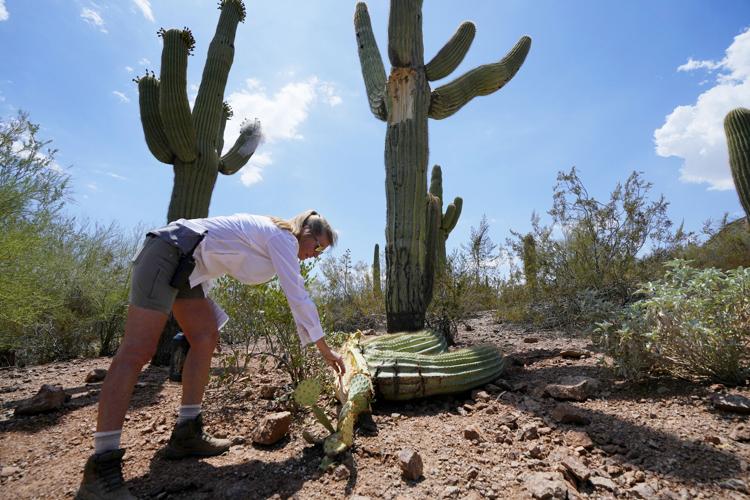
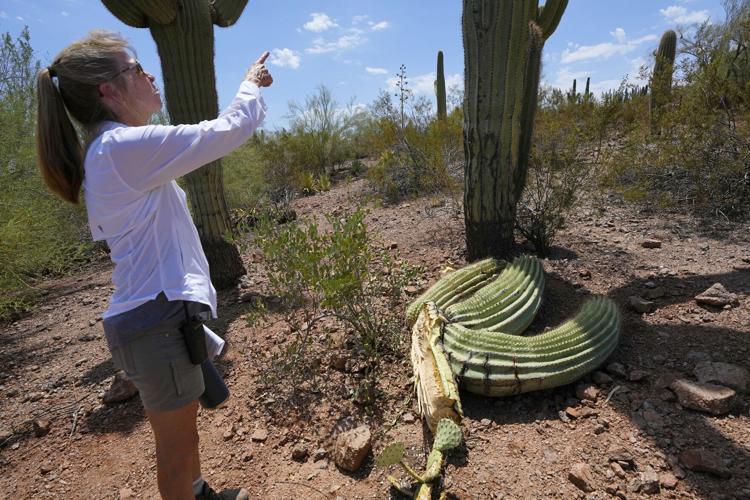
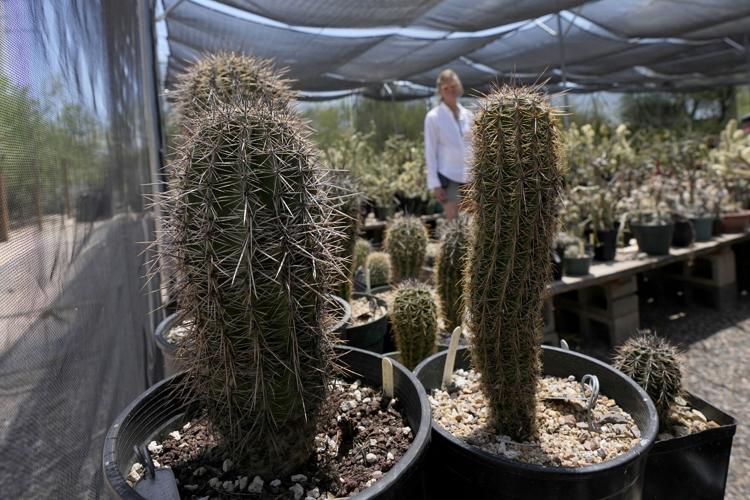
Kristen Kindl, Living Collections Coordinator at the Desert Botanical Garden, examines a damaged saguaro cactus Wednesday after multiple arms dropped off the cactus at the garden in Phoenix.
“A lot of people are calling and saying their cactus is yellowing really hard, fell over or like broken arms, that sort of thing,” Booth said. “Twenty-year-old trees are losing all their leaves, or they’re turning a crisp brown.”
She advises people to give water and specialty fertilizer to a distressed tree or plant every other day and not to trim them.
At the Desert Botanical Garden, three of the treasured institution's more than 1,000 saguaro cacti have toppled over or lost an arm in the last week, a rate that officials there say is highly unusual.
These saguaros, a towering trademark of the Sonoran Desert landscape, were already stressed from record-breaking heat three years ago, and this summer's historic heat — the average temperature in Phoenix last month was 102.7 degrees Fahrenheit — turned out to be the cactus needle that broke the camel's back.

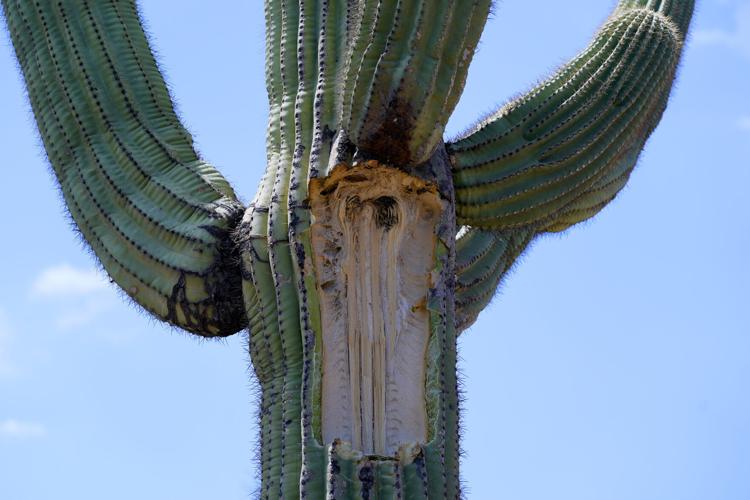
A damaged saguaro cactus lost multiple arms at the Desert Botanical Garden in Phoenix.
“Since 2020, we have had elevated mortality in our population of saguaros compared to mortality rates pre-2020,” said Kimberlie McCue, the garden's chief science officer. “So part of our thinking is that there are still saguaros today that were compromised from what they went through in 2020. And that this could be sending them over the edge.”
Saguaros can live up to 200 years and grow as tall as 40 feet. Some in the Desert Botanical Garden date beyond its opening 85 years ago, and the largest there measure almost 30 feet, according to McCue.
People commonly assume that cacti are made to endure scorching heat, but even they can have their limits, McCue said. It wasn't just this summer's 31-day streak of highs at or above 110 degrees Fahrenheit, but also the multiple nights when the low never dipped below 90 degrees. Nighttime is when cacti open their pores to get rid of retained water and take in carbon dioxide, she explained.

Kristen Kindl examines a damaged saguaro cactus Wednesday after multiple arms dropped off the cactus at the Desert Botanical Garden in Phoenix.
“With water loss, if they become dehydrated, that can compromise the structural integrity that they have in their tissues," McCue said.
A cactus' size can also influence its susceptibility, said Kevin Hultine, the garden's director of research, and bigger plants with more mass are more prone to the effects of heat and drought.
“Larger (and older) plants have more arms and thus, they tend to be the first to start to lose structural integrity,” Hultine said via email. “The first sign of heat-related stress in a population are arms falling from large plants. Eventually, the entire plant might fall over from the stress.”
There is hope that the arrival of thunderstorms during the monsoon season, which traditionally starts June 15, could bring more delayed moisture that will help struggling flora. The U.S. monsoon is characterized by a shift in wind patterns that pull moisture in from the tropical coast of Mexico. It sets up differently in other parts of the world. In Arizona, about half the rain that falls during the year comes during the monsoon.
It can be a mixed bag — cooling sweltering cities like Las Vegas and Phoenix but bringing the risk of flooding to mountain towns and low-lying deserts alike. It carries a promise of rain but doesn’t always deliver. And even when it does, the moisture isn’t shared equally across the Four Corners region and beyond. The last two seasons were impressive, and the two before that largely duds.

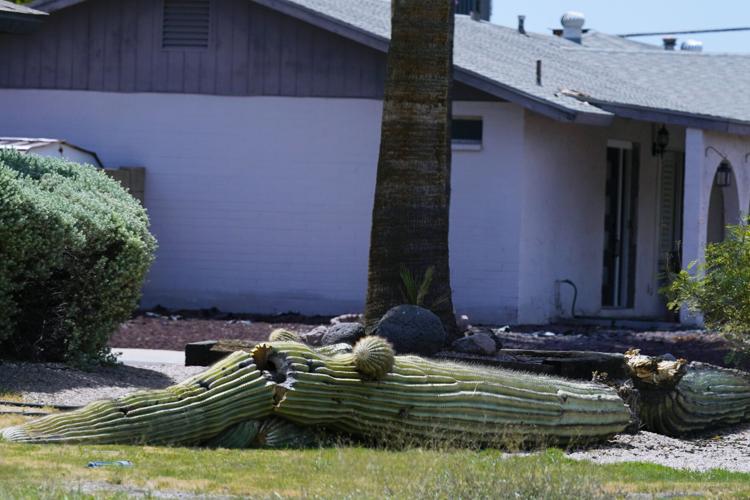
A fallen saguaro cactus is spread out in pieces Wednesday in front of a home in Tempe, Ariz.
In the southern Arizona city of Tucson, which has already seen some monsoon activity, the outdoor living Sonoran Desert Museum isn't running into the same problems with its succulents, McCue said.
“We have the double whammy of this heat dome that seems to have decided to sit over Phoenix. And we’re also this massively spread out space with highways and parking lots,” McCue said. However, “the story isn’t complete yet.”
As of Wednesday, there was no rain in the forecast anytime soon, according to the National Weather Service. After two days of a slight drop, high temperatures reached 111 and are expected to be 110 degrees or more for the next 10 days.
There has been some monsoonal activity in southern and northern Arizona, but Phoenix is “stuck in the middle,” meteorologist Matt Salerno said.
There will likely be some record-breaking before then, however. The Weather Service plans to issue an extreme heat warning Friday through Monday, when the highs will be between 111 and 117 degrees.

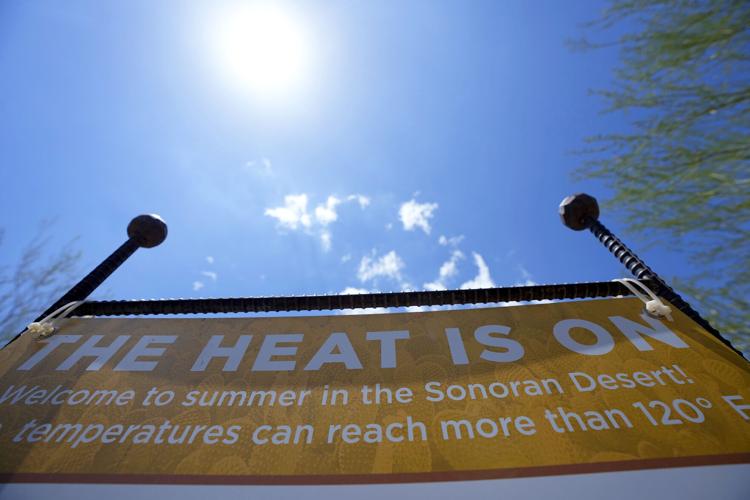
Patrons are warned about the heat Wednesday at the Desert Botanical Garden entrance in Phoenix.
In the meantime, the Desert Botanical Garden has been working to propagate cacti that seem better able to endure searing conditions after staffers noticed the 2020 heat was more difficult for some plants than others. Some just seemed to have a genetic makeup that allowed them to thrive.
“We want to try and capture that and grow more saguaros from seed here to add into our population at the garden with the idea that over time, that is going to bring more resiliency into into our population here," McCue said.

Kristen Kindl, Living Collections Coordinator at the Desert Botanical Garden, examines young saguaro cactus plants put under protective netting due to excessive heat in Phoenix.
Photos: Hot weather has US, world sweltering

A jet takes flight from Sky Harbor International Airport as the sun sets Wednesday in Phoenix. Millions of people across the Southwest are living through a historic heat wave, with even the heat-experienced desert city of Phoenix being tested since temperatures have hit 110 degrees Fahrenheit for 13 consecutive days.

Tourists protect a sleeping child from the sun Wednesday as they visit the Hollywood sign landmark in Los Angeles. Forecasters in Southern California say blistering conditions Thursday will build throughout the weekend in the central and southern parts of California, where many residents should prepare for the hottest weather of the year.

Children cool off in a fountain Wednesday just outside of Jerusalem's Old City.

A man runs Thursday along a small road on the outskirts of Frankfurt, Germany, as the sun rises.

Ja-Veah Cheney, 9, pours water over her head Wednesday as she takes shelter from the sweltering heat at the splash pad station at Riverside Park in New Bedford, Mass. Across the U.S., more than 111 million people are under extreme heat advisories, watches and warnings.

A homeless man sleeps under the sun Wednesday in the Hollywood district of Los Angeles. After a historically wet winter and a cloudy spring, California's summer was in full swing Thursday as a heat wave that's been scorching much of the U.S. Southwest brings triple digit temperatures and an increased risk of wildfires. Blistering conditions will build Friday and throughout the weekend in the central and southern parts of California, where many residents should prepare for the hottest weather of the year, the National Weather Service warned.

A man jumps into the sea on a breakwater Wednesday in Barcelona, Spain.

A woman carries her baby and a bottle of water on her head Saturday in Niger.

Migrants stop for a water break Tuesday as they walk in the Rio Grande behind concertina wire as they try to enter the U.S. from Mexico in Eagle Pass, Texas.

An Icelandic horse is sprayed with water at a stud farm in Wehrheim near Frankfurt, Germany, one of several nations gripped in potentially the hottest temperatures ever recorded in Europe.

Youths jump into a commercial swimming pool to cool themselves off Thursday in Peshawar, Pakistan. Countries across the world are preparing emergency measures amid a heat wave projected to get much worse heading into the weekend.

A woman enjoys the sun in the Tuileries gardens Monday in Paris, where temperatures are expected to keep rising.

Salvation Army volunteer Francisca Corral, center, gives water to a man Tuesday at their Valley Heat Relief Station in Phoenix.

People spend time in a public pool Saturday in Wehrheim near Frankfurt, Germany.

A woman uses an umbrella to take shelter from the sun Thursday as she walks in downtown Rome. Temperatures in parts of Mediterranean Europe were forecast to reach as high as 113 degrees starting Friday as a high-pressure system grips the region. Cerberus is named for the three-headed dog in ancient Greek mythology who guarded the gates to the underworld.

A man holds an umbrella Thursday as he and other tourists enters the ancient Acropolis hill during a heat wave, in Athens, Greece. In Athens and other Greek cities, working hours were changed for the public sector and many businesses to avoid the midday heat, while air-conditioned areas were opened to the public. “It’s like being in Africa,” 24-year-old tourist Balint Jolan, from Hungary, said. “It’s not that much hotter than it is currently at home, but yes, it is difficult.”

A boy shows off his swimming skills Wednesday while cooling off in the river Arges, outside Bucharest, Romania.

A woman fans herself Monday in Madrid, Spain. “Italy, Spain, France, Germany and Poland are all facing a major heat wave, with temperatures expected to climb to 48 degrees Celsius on the islands of Sicily and Sardinia – potentially the hottest temperatures ever recorded in Europe” the European Space Agency said Thursday.

A man cools off at a fountain Thursday during a sunny day in Belgrade, Serbia.

A woman wearing sun protection, headgear and sunglasses swims Monday as residents cool off on a sweltering day at an urban waterway in Beijing.

Youngsters cool off Wednesday in the river Arges, outside Bucharest, Romania.

A newly married couple poses for photos Wednesday during sunset as a man takes a dip in the water in Lagonisi southeast of Athens.

