

SAN FRANCISCO — Benjamin Franklin was so busy as an inventor, publisher, scientist, diplomat and U.S. founding father that it's easy to lose track of his accomplishments.
Add one more to the roster: his early work in printing colonial paper currency designed to counter a constant threat of counterfeiting.
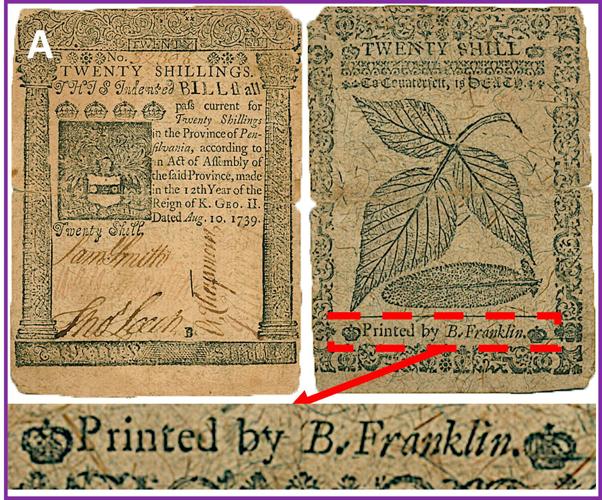
Franklin was an early innovator of printing techniques that used colored threads, watermarks and imprints of natural objects such as leaves to make it far harder for others to create knockoffs of his paper bills.
A team at the University of Notre Dame shed new light on his methods using advanced scanning techniques that reveal some of Franklin's methods in greater detail — along the way, also providing one more reason Franklin appears on the $100 bill.

A 20 shillings Pennsylvania note Benjamin Franklin printed on Aug. 10, 1739, features "nature printed" patterns of leaves that counterfeiters found difficult to duplicate.
The new research, published recently in the Proceedings of the National Academy of Sciences, describes data gathered with techniques such as spectroscopy and fluorescence tests, which use light to identify elements such as carbon, calcium and potassium in test samples. Researchers also used electron microscopes for imaging fine details.
The intent, said lead author Khachatur Manukyan, a Notre Dame associate professor of physics, was to learn more about the materials used by Franklin and his network of affiliated printers and how they served to distinguish their bills from cheaper copies.
"The goal was to decode what type of material they used," Manukyan said. "And then we found some very interesting differences between this money and other printers."
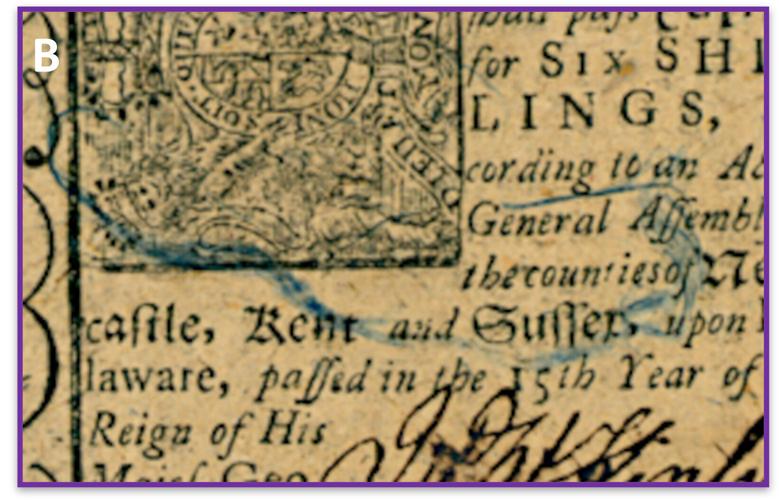
The researchers examined Franklin's penchant for including watermarks, tiny indigo-dyed threads and "fillers" of special crystal in printed bills to create barriers to copycats. The paper also highlights Franklin's use of "nature printing," a technique by which he transferred the detailed vein patterns of tree leaves to printing plates.
Counterfeiters naturally sought to keep their costs low, and thus were often slow to invest in improving their own printing techniques. Franklin's fillers served to make bills hardier and thus extend their life over the cheaper paper preferred by criminals, while his dyed threads added another production barrier.
Similarly, Franklin's nature-printed images produced fine details that were particularly difficult for less skilled printers to duplicate.

Blue threads can be seen in a 6 shillings Delaware note printed by J. Adams on Jan. 1, 1776, that counterfeiters found difficult to duplicate.
The Notre Dame team also learned that Franklin developed his own graphite-based ink at a time when competing printers were mostly using inks derived from "boneblack," a charcoal-like substance produced by heating animal bones to high temperatures in a kiln that limited the flow of oxygen. The significance of Franklin's graphite-based ink isn't clear and needs further study.
Later, though, the Revolutionary War brought on such a surge of counterfeiting — much of it, apparently, courtesy of the British Army — that the subsequent U.S. government shunned paper bills for decades in favor of coinage. It didn't reconsider until the onset of the Civil War in 1861, when the federal government first authorized the printing of dollar bills called "greenbacks."
Among the features in those U.S. banknotes were, of course, colored threads. These remain in use today, albeit in a more modern form. Today's U.S. currency, for instance, features an embedded "security thread" in bills denominated $5 or more, although it's now a thin vertical band that fluoresces under ultraviolet light.
Popular videos from the past week you may have missed
Drone footage shows a Great White shark lurking near surfers in California, servicewomen in Ukraine are fighting for their own uniforms after only using men's, and more popular videos from the past week you may have missed.

Incredible drone footage captured above San Onofre, California shows a Great White Shark swimming next to surfers, just off of the local beach…

At a training ground on the edge of Kyiv, a group of women run through an obstacle course and fire Kalashnikovs, putting the new uniforms fina…

Despite over 100 years of challenges, wolverines could be returning to the American West.

Swimming in the Seine in Paris, long banned because of health risks from pollution, is set to be authorized in 2025, shortly after the end of …

Feline Infectious Peritonitis (FIP) has claimed the lives of 300,000 cats in Cyprus since January, according to animal advocates who are plead…

They are drenched in sweat, their hands bloodied from clapping, and their voices hoarse from shouting - meet Japan's predominantly male and un…

A rare moment was captured on CCTV cameras as a critically endangered baby Sumatran tiger was born at West Midland Safari Park. The heartwarmi…

A volcano erupted on the Reykjanes peninsula in southwest Iceland, near the capital Reykjavik, following intense seismic activity in the area,…

The repertoire for Perpetual Motion includes 33 dances, 13 of which are prize-winning new dances, while seven are from Latvia’s Golden Foundat…

A volcano in southwestern Iceland began erupting Monday following heightened seismic activity in the area, the country’s meteorological author…

Fourteen giraffe have been successfully relocated to Angola's Iona National Park after an epic 36-hour journey.

A rare snowfall dusted Johannesburg and other high-lying parts of South Africa on Monday, with weather services warning of potential road clos…

Birth rates in countries around the world are beginning to go down and that’s especially true in places like China, which once had a one child…

The United Nations says the bee population is in sharp decline.

