

RENO, Nev. — The blank canvas of desert wilderness in northern Nevada seemed the perfect place in 1992 for artistic anarchists to relocate their annual burning of a towering, anonymous effigy. It was goodbye to San Francisco’s Baker Beach, hello to the Nevada playa, the long-ago floor of an inland sea.
The tiny gathering became Burning Man's surrealistic circus, fueled by acts of kindness and avant-garde theatrics, sometimes with a dose of hallucinogens or nudity. The spectacle flourished as the festival ballooned over the next three decades.
Some say it grew too much, too fast.

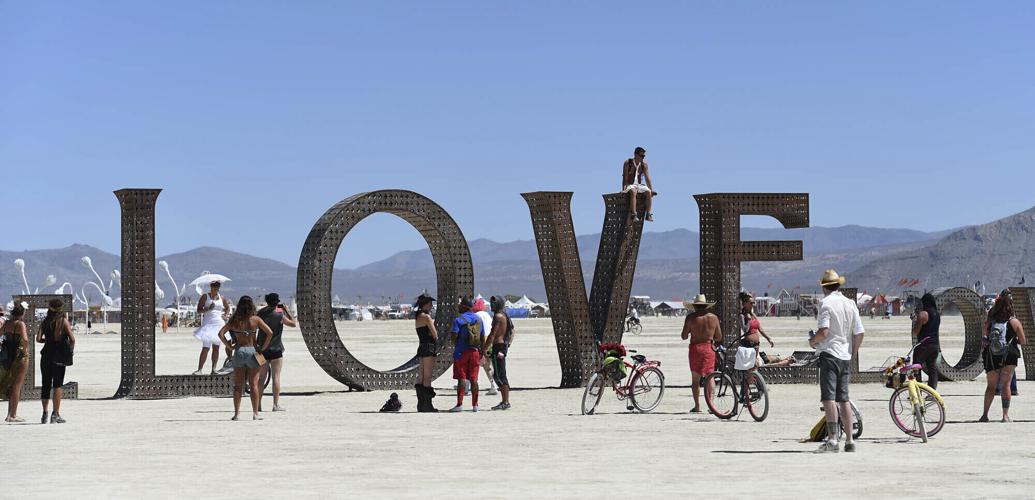
Participants walk around Aug. 27, 2014, at the Burning Man festival on the Black Rock Desert of Gerlach, Nev. Burning Man organizers don't foresee major changes in 2024.
Things came to a head in 2011 when tickets sold out for the first time. Organizers responded with a short-lived lottery system that left people out of what was supposed to be a radically inclusive event. As Burning Man matured, luxurious accommodations proliferated, as did the population of billionaires and celebrities.
Katherine Chen, a sociology professor in New York City who wrote a 2009 book about the event's “creative chaos,” was among those who wondered whether Burning Man "would be a victim of its own success.”
Exponential growth led to increasing questions about whether organizers had veered too far from the core principles of radical inclusion, expression, participation and the pledge to “leave no trace.”
That last hurdle was never harder to clear than this year as “Burners” tried to leave over Labor Day weekend after torching the 80-foot wooden sculpture that is “the Man.”
A rare rainstorm turned the Black Rock Desert into a muddy quagmire 110 miles north of Reno, delaying the departure of 80,000 revelers. Once out, organizers had six weeks to clean up under terms of a federal permit.

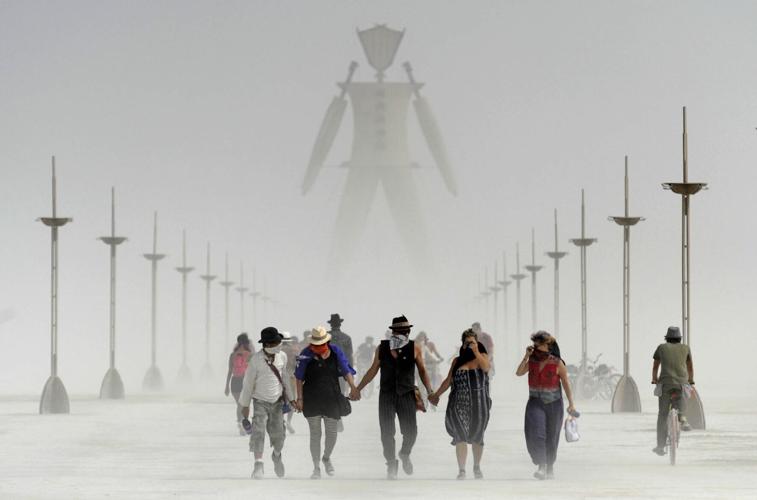
Burning Man participants walk through dust Aug. 29, 2014, at the storied Burning Man festival on the Black Rock Desert of Gerlach, Nev.
By the smallest of margins, they passed the test last month, with a few adjustments recommended for the future. The verdict from the U.S. Bureau of Land Management means Burning Man is in line to use federal land again next year.
Debate over the event’s future, however, is sure to continue as divisions grow between the aging hippie-types and wealthier, more technologically inclined newcomers. Veteran participants fear the newer set is losing touch with Burning Man’s roots.
The event has made a quantum leap from a gathering of hundreds to one that temporarily becomes Nevada’s third largest city after metropolitan Las Vegas and Reno. The festival drew 4,000 in 1995 and topped 50,000 in 2010.
It’s no wonder seasoned Burners sound a bit like griping cribbage players on a rural town square when they mutter: “It ain’t like it used to be.”

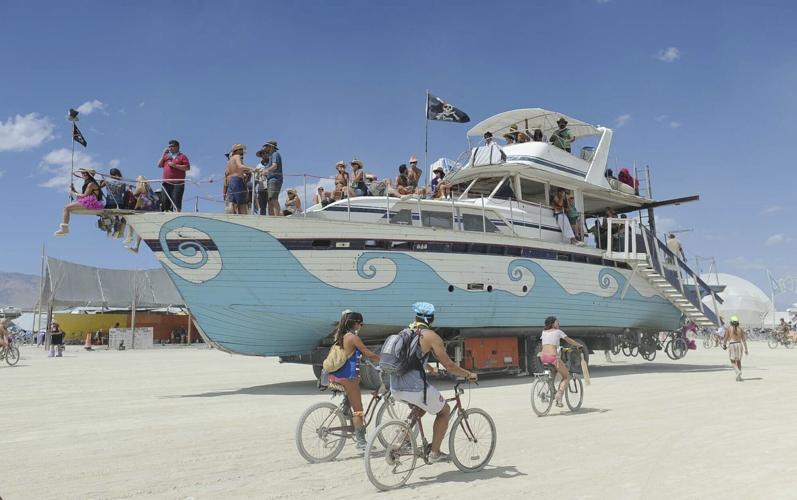
An old wooden yacht art car rolls through the playa Aug. 31, 2012 at Burning Man. The event is permitted tentatively for the same 80,000 attendance cap next year.
“Back then, it was much more raw,” said Mike “Festie” Malecki, 63, a retired Chicago mortician turned California sculptor who made his 13th trip this year to the land of colorful theme camps, towering sculptures, drum circles and art cars.
“There are more (people) who come out to party and don’t participate. We call them spectators," he said.
Senior organizers long have wrestled with whether to become more civilized or remain what co-founder Larry Harvey described as a “repudiation of order and authority.”
Ron Halbert, a 71-year-old from San Francisco, has worked support for Burning Man’s 90-piece orchestra for 20 years and remains optimistic.
“It’s still the gathering of the tribe,” he said.
The event is permitted tentatively for the same 80,000 attendance cap next year. Organizers are considering some minor changes, though generally resist making new rules, Executive Director Marian Goodell said.
Critics on social media howled at the mayhem left behind this year, posting photos of garbage piles, abandoned vehicles and overflowing portable toilets while ridiculing the “hippies” and their leave-no-trace mantra.
But that mayhem may have actually helped bring Burning Man back to its roots.

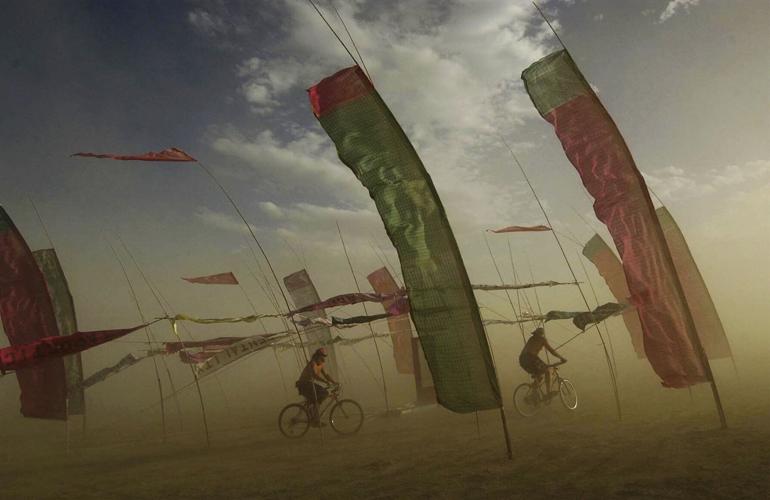
Bicyclists make their way through an art installation Sept. 1, 2004, at the Burning Man counter-culture arts festival in Gerlach, Nev.
“The rain weeded out the people who didn’t want to be there for the right reason,” Katrina Cook of Toronto said.
Twenty years ago, the psychedelic celebration like none other already was attracting academic scholars — anthropologists, sociologists, political scientists, economists and communications professors — curious about how the makeshift civilization functioned without real-world rules.
Burning Man references started popping up in TV episodes and talk show punchlines. The rich and famous began venturing to Black Rock City, as the festival's temporary metropolis is called.
A full-blown exhibit about the phenomenon debuted in 2018 at the Smithsonian American Art Museum in Washington. Even then, veteran Burners complained about the event becoming as much a curiosity to see as to do.
That's in part the problem veterans have with the advent of glamour camping, or glamping, in which private companies provide packaged trips to concierge camps with luxury RVs and lavish meals under chandeliers. Some believe the camps violate Burning Man principles.
The growing number of billionaires and celebrities who fly in on private jets to Black Rock City's temporary airstrip “seems to be everyone's favorite thing to hate,” Goodell said. But wealth shouldn't be a cause for shame, she said.
Burning Man's purpose remains the same: building a creative, stimulating environment, the essence of which people can take back to their own communities.
“We thought that from the beginning," Goodell said. "We just didn’t know it would be 80,000 people.”
Photos: Scenes from Burning Man through the years

Burning Man festival participants gather at sunrise under the wood and neon structure that is the centerpiece of the event in the Black Rock Desert north of Gerlach, Nev., Monday, Aug. 26, 2002. More than 30,000 are expected to attend this year's week-long festival. (AP Photo/Debra Reid)

The Temple of Hope, an art installation created by Mark Grieve, is set on fire Sunday, September 3, 2006, at the 20-year-old art festival in Nevada's Black Rock Desert. (AP Photo/Ron Lewis)

The Man, a stick figured symbol of the Burning Man art festival, is silhouetted against a morning sunrise Saturday, Sept. 2, 2006, at the 20-year-old art festival in Nevada's Black Rock Desert. (AP Photo/Ron Lewis)

Mr. Mega Bolt creates lightning bolts as an expression of performance art during the Burning Man festival in the Black Rock Desert near Gerlach, Nev. on Thursday, Sept. 2, 1999. The gathering, intented to be a celebration of radical free expression and self reliance, will host 20,000 people before its culmination on Saturday. (AP Photo/Laura Rauch)

A festival participant, wearing a ram's skull costume, pays his respects to the Burning Man, Thursday, Sept. 2, 1999, during the Burning Man festiva in the Black Rock Desert near Gerlach, Nev. The gathering, intented to be a celebration of radical free expression and self reliance, will host 20,000 people before its culmination on Saturday when the Burning Man will go up in flames. (AP Photo/Joey Wallis)

A member of the Death Guild uses a cable-swing to transport herself from their campsite across the street to a structual rendition of the movie Mad Max's Thunderdome at Burning Man Sunday, Sept. 5, 1999, near Gerlach, Nev. The group held nightly dancing and fire juggling exhibitions in the structure. Billed as the largest outdoor arts festival in North America, Burning Man is a psychedelic adventure that combines wilderness camping with avante garde performance _ a Mardi Gras-like celebration on whatappears to be the surface of the moon. (AP Photo/ David Hunter)

Burning Man participants watch fireworks before a 70 foot wooden effigy is torched at the end of the 16th annual Burning Man counterculture festival on Saturday, Sept. 1, 2001, near Gerlach, Nev. (AP Photo/Debra Reid)

A cyclist rides by an art installation Monday, August 28, 2006, at the 20-year-old art festival in Nevada's Black Rock Desert. (photo by Ron Lewis)

A couple holds hands while cycling near The Man, a stick figured symbol of the Burning Man art festival, during a morning sunrise Saturday, Sept. 3, 2006, at the 20-year-old art festival in Nevada's Black Rock Desert. (AP Photo/Ron Lewis)

New York City artist Kate Raudenbush tightens bolts on her sculpture at Burning Man Sunday, August 27th, 2006, at the 20-year-old weeklong art festival in Nevada's Black Rock Desert. (AP Photo/Ron Lewis)

Burning Man participants are reflected in an art piece on the playa of the Black Rock Desert in Gerlach, Nev., during the Burning Man festival on Friday morning, Aug. 31, 2007. (AP Photo/Brad Horn)

FILE - In this Aug. 31, 2007 file photo, Burning Man festival participants walk in Center Camp in Gerlach, Nev. The #MeToo movement is making its way to Burning Man that begins Aug. 26-Sept. 3, 2018. Organizers are reminding attendees that just because the counterculture festival in the Nevada desert is known for occasional nudity and kinky landmarks like the "Orgy Dome," it doesn't mean it's a free-for-all when it comes to touching or non-consensual sex. (AP Photo/Brad Horn, File)

FILE - In this Aug. 28, 2008 file photo, Burning Man participants walk on the playa at the Black Rock Desert near Gerlach, Nev. The #MeToo movement is making its way to Burning Man that begins Aug. 26-Sept. 3, 2018. Organizers are reminding attendees that just because the counterculture festival in the Nevada desert is known for occasional nudity and kinky landmarks like the "Orgy Dome," it doesn't mean it's a free-for-all when it comes to touching or non-consensual sex. (AP Photo/Brad Horn, File)

FILE - In this Aug. 31, 2007 file photo, a woman sits in a shelter during a dust storm on the playa of the Black Rock Desert in Gerlach, Nev., during the Burning Man festival. The #MeToo movement is making its way to Burning Man that begins Aug. 26-Sept. 3, 2018. Organizers are reminding attendees that just because the counterculture festival in the Nevada desert is known for occasional nudity and kinky landmarks like the "Orgy Dome," it doesn't mean it's a free-for-all when it comes to touching or non-consensual sex. (AP Photo/Brad Horn, File)

FILE - In this Aug. 26, 2002 file photo the sun rises behind a wood and neon statue, the center piece of the annual Burning Man festival north of Gerlach, Nev. Burning Man organizers are considering requiring attendees to prove they've been vaccinated for COVID-19 if they move forward with plans to hold this year's counter-culture festival in the Nevada desert. But they have backed off an earlier announcement that they'd already decided to make shots mandatory, and won't decide for sure until the end of the month whether the event that was canceled last year due to the pandemic will even take place. (AP Photo/Debra Reid, File)

This image provided by Maxar Technologies on Aug. 29, 2022 shows center camp and rods ring road at the Burning Man Festival in Black Rock City, Nev. (Maxar Technologies via AP)

This image provided by Maxar Technologies on Aug. 29, 2022 shows an overview of Burning Man Festival in Black Rock City, Nev. (Maxar Technologies via AP)

Burning Man festival participants cruise the playa of the Black Rock Desert in Gerlach, Nev., on Friday morning, Aug. 31, 2007. (AP Photo/Brad Horn)

Burning Man festival participants enjoys the playa near an art installation in the Black Rock Desert in Gerlach, Nev., on Friday morning, Aug. 31, 2007. (AP Photo/Brad Horn)

** RETRANSMITTING FOR LARGER FILE SIZE ** A woman sits in a shelter during a dust storm on the playa of the Black Rock Desert in Gerlach, Nev., during the Burning Man festival on Friday, Aug. 31, 2007. (AP Photo/Brad Horn)

A stilt walker cruises the playa during the Burning Man festival in Gerlach, Nev., on Friday, Aug. 31, 2007. (AP Photo/Brad Horn)

** RETRANSMITTING FOR LARGER FILE SIZE ** Burning Man participants wait for the Critical Titts bike event to begin on the playa at the Black Rock Desert in Gerlach, Nev., on Friday, Aug. 31, 2007. (AP Photo/Brad Horn)

A rainbow is cast over the Black Rock Desert in Gerlach, Nev., during the Burning Man festival on Friday, Aug. 31, 2007. (AP Photo/Brad Horn)

A woman walks through a dust storm on the playa of the Black Rock Deset in Gerlach, Nev., on Friday, Aug. 31, 2007, during the Burning Man festival. (AP Photo/Brad Horn)

Tyson 'Solar' Puls puts gas into his RV at a gas station in Reno, Nev., on Sunday, Aug. 24, 2008, before traveling to the Black Rock Desert for the Burning Man Festival. (AP Photo/Brad Horn)

A Burning Man participant sleeps on a trampoline on the playa at the Black Rock Desert during the annual Burning Man festival near Gerlach, Nev., on Thursday, Aug. 28, 2008. Burning Man is an annual cultural event which starts on the Monday before, and ends on the day of, the Labor Day holiday. (AP Photo/Brad Horn)

Burning Man participants ride on the playa at the Black Rock Desert near Gerlach, Nev., on Thursday, Aug. 28, 2008, during the Burning Man festival. (AP Photo/Brad Horn)

A camel powered by two men travels across the playa at the Black Rock Desert near Gerlach, Nev., on Friday, Aug. 29, 2008, during the Burning Man festival. (AP Photo/Brad Horn)

A Burning Man participant blows fire on the playa at the Black Rock Desert during the Burning Man festival near Gerlach, Nev., on Thursday, Aug. 28, 2008. (AP Photo/Brad Horn)

A Burning Man participant cuts metal on the playa at the Black Rock Desert during the Burning Man festival on Thursday, Aug. 28, 2008 near Gerlach, Nev.. (AP Photo/Brad Horn)

Passengers arrive at the airport at Black Rock City during the Burning Man festival on Friday, Aug. 29, 2008, near Gerlach, Nev., during the Burning Man festival. (AP Photo/Brad Horn)

A an aerial view of the center camp in Black Rock City is seen during the Burning Man festival near Gerlach, Nev., on Friday, Aug. 29, 2008. (AP Photo/Brad Horn)

A Burning Man participant watches fire at an art installation at the Black Rock Desert near Gerlach, Nev., during the Burning Man festival on Friday evening, Aug. 29, 2008. Burning Man is an annual art event and temporary community based on radical self expression and self-reliance in the Black Rock Desert of Nevada. (AP Photo/Brad Horn)

Burning Man participants wait for a dust storm to clear in the Jazz Cafe at the Black Rock Desert during the Burning Man festival on Saturday, Aug. 30, 2008. (AP Photo/Brad Horn)

ZigZag, left, and Christ, kiss during a dust storm on the playa during the Burning Man festival near Gerlach, Nev., on Saturday, Aug. 30, 2008, at the Black Rock Desert. (AP Photo/Brad Horn)

Burning Man participants wait for a dust storm to clear near Gerlach, Nev., during the Burning Man festival at the Black Rock Desert on Saturday, Aug. 30, 2008. (AP Photo/Brad Horn)

Burning Man participants wait for a dust storm to clear during the Burning Man festival near Gerlach, Nev., on Saturday, Aug. 30, 2008. (AP Photo/Brad Horn)

