

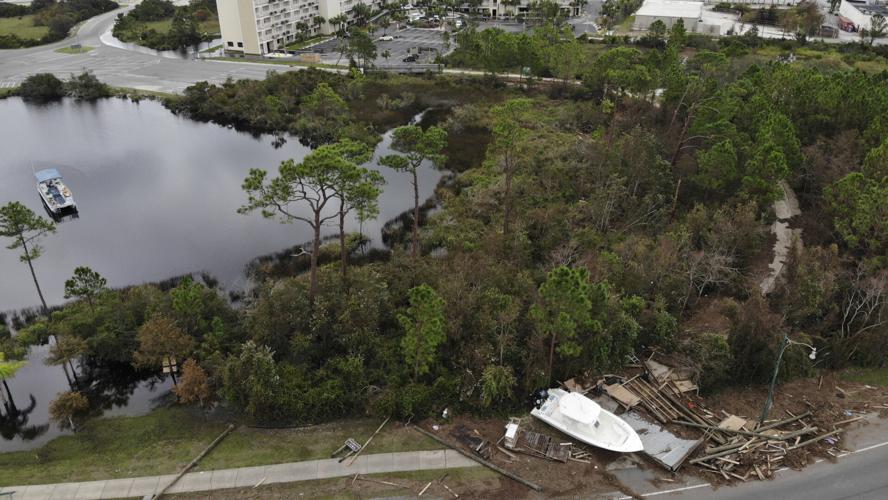
A new Alabama study of hurricane-affected homes sends a clear message to insurers and homeowners nationwide: climate-resilient construction methods can protect homes — and save a lot of money.
The first-of-its-kind analysis, released last week, reviews thousands of insurance claims linked to Hurricane Sally, which struck Alabama’s coast in 2020 with wind speeds up to 105 miles per hour.

Damage is seen Sept. 17, 2020, in Orange Beach, Ala., after Hurricane Sally.
Homes retrofitted or built to Fortified standards, a voluntary construction code created by the nonprofit Insurance Institute for Business and Home Safety for wind and rain mitigation, saw significantly fewer and less costly claims.
If every affected house in Mobile and Baldwin counties met Fortified standards, insurance companies could have spent 75% less in payouts, saving up to $112 million, and policyholders could have paid up to 65% less in deductibles, saving almost $35 million, according to the study.
The results show “mitigation works and that we can build things that are resilient to climate change,” said Dr. Lars Powell, director of the Center for Risk and Insurance Research at the University of Alabama’s Culverhouse College of Business, which led the study with the Alabama Department of Insurance.
Across the United States, insurance markets are buckling under the pressure of more frequent and expensive climate events, and federal support is shrinking for resilience projects that could reduce that damage.
Officials and researchers involved with the study say it proves Alabama’s proactive approach to the challenge — mandatory, sizable insurance discounts for those who use Fortified and a grant program to help them afford it — could be a national model for increasing insurability and safety.
IBHS created Fortified to strengthen buildings against storm damage based on decades of research at its facility, where it uses a giant wind tunnel to pummel model houses with rain, hail and wind up to 130 miles per hour.
“We are having record breaking year after record breaking year of disasters and insured losses, and we have been searching for meaningful ways to reduce the severity and the frequency of those losses,” said Fred Malik, managing director of the Fortified program.
The three levels of designations — Fortified Roof, Silver and Gold — employ methods like improving roof fasteners, using impact-rated doors and windows, and more securely anchoring walls to their foundation. The program requires third-party verification of work.
About 80,000 homes across 32 states now have Fortified designations, with more than 53,000 in Alabama.

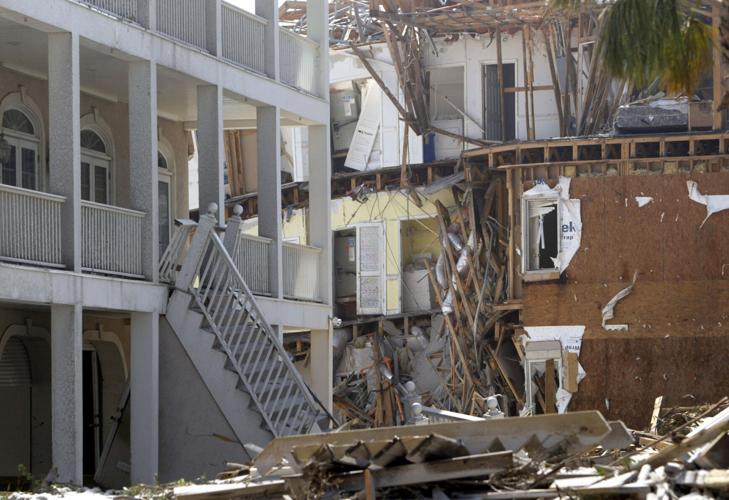
Buildings destroyed by Hurricane Ivan are seen Sept. 16, 2004, in Orange Beach, Ala.
The state began looking for ways to improve storm outcomes after Hurricane Ivan in 2004 jolted the state’s insurance market. “Ivan was absolutely devastating,” Alabama Insurance Commissioner Mark Fowler said. “Our market was going crazy, insurers were leaving.”
It became the only state to implement mandatory minimum insurance discounts for Fortified homes, currently as much as half off the wind portion of homeowners’ premiums. It also launched the Strengthen Alabama Homes incentive program, offering grants of up to $10,000 for homeowners retrofitting their houses to Fortified standards.
The state doled out $86 million for 8,700 Fortified retrofits since 2015. Fowler credits the initiative with also catalyzing demand for new Fortified construction and incentivizing contractors and inspectors to learn the standards.
“It worked like gangbusters,” he said. “We’ve seen the market substantially stabilized.”
Alabama will expand its grant program to three new counties this year, and the approach caught the attention of other states seeking resilience solutions.

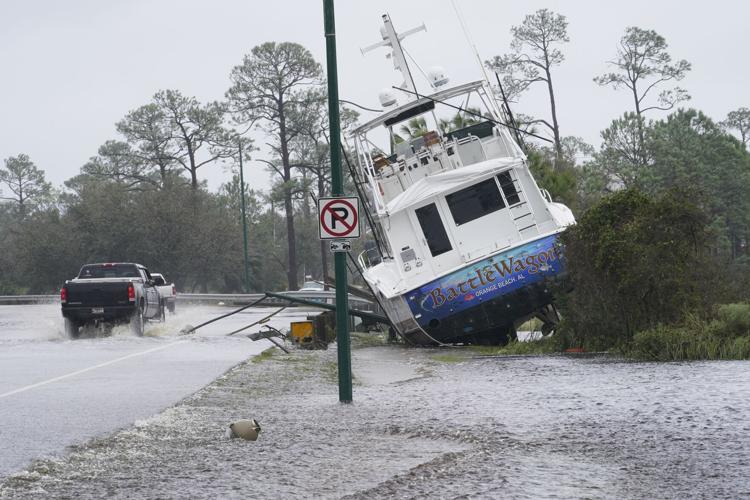
A boat is washed up near a road Sept. 16, 2020, in Orange Beach, Ala., after Hurricane Sally moved through the area.
Hurricane Sally offered researchers their first chance to assess the program’s benefits in a real storm. “It really was a prototypical storm that anybody who lives on the hurricane coast is liable to see in any given year,” Malik said.
They collected insurance data on more than 40,000 houses in the affected area — a total insured value of $17 billion.
Fortified construction reduced claim frequency by 55% to 74%, depending on the designation level, and loss severity by 14% to 40%. Despite representing almost one-quarter of the policies studied, Fortified homes accounted for only 9% of claims.
They even fared better than houses built to similar codes but without the official designation, likely due to the program’s more stringent verification requirements.
“It really does start to bring home that there is value for everybody involved,” Malik said. “There’s value for the insurers, there’s value for the homeowner.”
Fortified doesn’t address all types of hurricane losses. Nearly half the claims in the study were from fallen trees, which require separate mitigation strategies.
The enhanced standards add cost: between 0.5% and 3% more for new construction, and 6% and 16% for retrofits. Still, the long-term benefits spurred even disaster recovery nonprofits like Habitat for Humanity, Team Rubicon and SBP to use Fortified, often with the philanthropic support of insurers like Travelers and Allstate.
“Helping disaster-impacted homeowners build back smarter with storm-resilient construction and IBHS Fortified standards helps break the cycle of disaster and loss,” said Thomas Corley, chief operating officer at the New Orleans-based nonprofit SBP, which built 671 homes to Fortified standards in nine states.

How do hurricanes affect baby names?
How do hurricanes affect baby names?
Updated
When a hurricane makes landfall, its effects go beyond the physical devastation and disruption to communities in its path. Storms leave lasting societal imprints on many facets of life—even what parents name their children.
Spokeo compared data from the National Oceanic and Atmospheric Administration and Social Security Administration to see how storm names impact baby names. With massive storms becoming more frequent and public awareness increasing, the relationship between hurricanes and naming trends could become even more pronounced.
According to data maintained by NOAA, the number of weather events causing more than $1 billion in damage has been on the rise.
In the 1980s and 1990s, about five weather events per year caused over $1 billion in damage. Since 2010, that number has risen to 16 annually—tripling in frequency over three decades.
When Hurricane Andrew tore through South Florida in 1992, storms of that magnitude were few and far between. But in recent years, even more destructive storms have occurred every couple of years, with two mammoth hurricanes—Harvey and Maria—hitting in just one year.
With Hurricane Helene making headlines in 2024 as the deadliest U.S. hurricane since Katrina, it's possible the name could see a drop in popularity. The same goes for Hurricane Milton and its possible effects. Baby name data maintained by the Social Security Administration allows each name's popularity to be analyzed alongside storm data.
The connection between storm names and baby naming trends may be subtle, but the impact of extreme weather reaches further than one might expect.
Editor's note: The Social Security Administration collects data on baby names based on a binary understanding of sex and gender; however, we recognize that names aren't inherently gendered.

What's the deal with naming storms?
Updated
Hurricanes weren't always given human names.
While storms of the past were sometimes named after saints (such as Hurricane Santa Ana in 1825), before the 1950s, most storms were identified by latitude and longitude coordinates, making tracking and reporting confusing. In 1953, the U.S. began using female names for hurricanes, a practice expanded in 1979 to include both female and male names on a six-year rotating list managed by the World Meteorological Organization.
Hurricanes are named primarily for clear communication. Using simple, easily recognizable names reduces confusion and ensures the public can follow forecasts and warnings. With the potential for multiple storms to be active simultaneously, distinct names help prevent misinformation and misinterpretation, which can be crucial for emergency preparedness.
When a storm is particularly deadly or costly, its name is retired. For example, names like Katrina (2005), Sandy (2012), Maria (2017), and Harvey (2017) have been permanently removed from the rotation. The WMO replaces retired names with new ones.
Some mixed naming patterns, but more often a decline in popularity
Updated
After a major hurricane strikes, the popularity of its name often declines. This effect is particularly strong for storms that cause significant destruction and loss of life.
Names like Katrina and Harvey saw sharp declines in rankings following their respective storms, suggesting that parents may avoid names associated with tragedy.
However, some names remain stable or even rise in popularity, likely due to pre-existing social or cultural trends. For example, the name Ian continued a rise in popularity that began in 2021, even after the 2022 storm. The name Maria initially dipped in popularity after Hurricane Maria in 2017, but then rebounded and steadily climbed since 2020.
While some names plummet in rank, others decline more gradually.
A few, like Florence and Irene, gained popularity after their storms, indicating that not all hurricane names become less desirable.
The effect on baby boys' names
Updated
Several well-known boys' names have experienced noticeable declines in popularity following devastating hurricanes.
One of the most striking examples is Andrew, which plummeted in rank after Hurricane Andrew tore through Florida in 1992. Once a highly favored name, Andrew saw a sharp decline after the storm and continued to drop steadily in the following decades.
Harvey followed a similar pattern, rising in popularity until the catastrophic flooding of Hurricane Harvey in Texas in 2017. The name saw an immediate and sharp decline the following year, suggesting a strong public reaction to the storm's devastation.
Other names, like Matthew and Michael, experienced similar declines. Hurricane Matthew in 2016 and Hurricane Michael in 2018 both corresponded with noticeable drops in their popularity. These names were already declining, but the storms appeared to accelerate their downward trends.
Girls' names see similar effects
Updated
Just like with boys' names, hurricanes have influenced the popularity of certain girls' names—often leading to a sharp decline in some instances.
Katrina is one of the most striking examples. After Hurricane Katrina devastated the Gulf Coast in 2005, the name's popularity plummeted, dropping rapidly in the years that followed.
Maria, however, did not see a decline as steep as Katrina's. Its ranking fluctuated in the years following the storm, suggesting that while some parents may have avoided it, the name retained cultural significance that helped buoy its usage.
A more complex trend can be seen with Isabel, which dipped in popularity after Hurricane Isabel in 2003, briefly rebounded, and then experienced a long-term decline. While some names may initially recover, they can still face a gradual drop in usage over time.
Overall, the data suggests that a storm's severity and media coverage play key roles in shaping naming trends.
Additional data reporting by Elena Cox. Story editing by Carren Jao. Copy editing by Kristen Wegrzyn.
This story originally appeared on Spokeo and was produced and distributed in partnership with Stacker Studio.

