

DUBAI, United Arab Emirates — The Islamic State group claimed responsibility Thursday for two suicide bombings targeting a commemoration for an Iranian general slain in a 2020 U.S. drone strike, the worst militant attack to strike Iran in decades as the wider Middle East remains on edge.
Experts who follow the group confirmed that the statement, circulated online among jihadists, came from the extremists, who likely hope to take advantage of the chaos gripping the region amid Israel’s war on Hamas in the Gaza Strip.
Meanwhile, U.S. Secretary of State Antony Blinken headed to the region for the fourth time in three months on a tour expected to focus largely on easing resurgent fears that the Israel-Hamas war could erupt into a broader conflict.
With international criticism of Israel’s operations in Gaza mounting, growing U.S. concerns about the end game, and more immediate worries about a recent explosion in attacks in the Red Sea, Lebanon, Iran and Iraq, Blinken will have a packed and difficult agenda.
“We don’t expect every conversation on this trip to be easy,” State Department spokesman Matthew Miller said. “There are obviously tough issues facing the region and difficult choices ahead. But the secretary believes it is the responsibility of the United States of America to lead diplomatic efforts to tackle those challenges head on, and he’s prepared to do that in the days to come.”

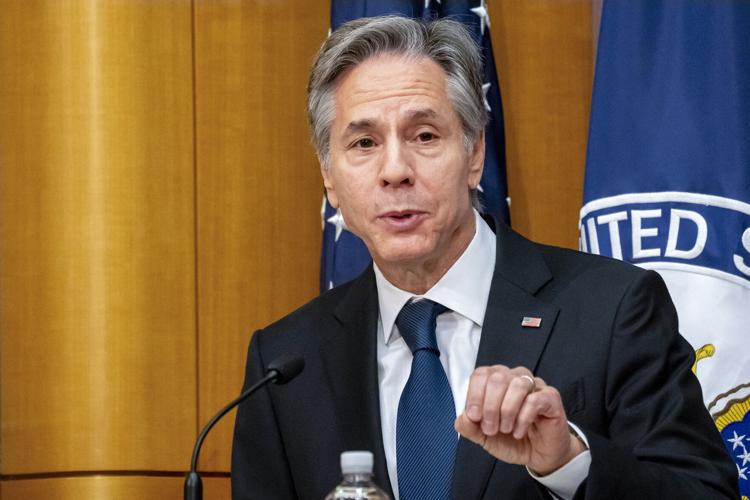
Secretary of State Antony Blinken speaks Dec. 7 at the State Department in Washington.
Blinken was scheduled to leave late Thursday on his latest extended Mideast tour, which will take him to Turkey, Greece, Jordan, Qatar, the United Arab Emirates, Saudi Arabia, Israel, the West Bank and Egypt.
Wednesday’s attack in Kerman, Iran, killed at least 84 people and wounded an additional 284. It targeted a ceremony honoring Revolutionary Guard Gen. Qassem Soleimani, held as an icon by supporters of the country’s theocracy and viewed by the U.S. military as a deadly foe who aided militants who killed American troops in Iraq.
On Thursday, chunks of asphalt appeared missing from the roadway where one bomb went off, suggesting the bomb was packed with shrapnel to increase its deadly effects. Another spot still bore congealed blood from the wounded.
“The moment I turned around to tell my husband’s sister, ‘Let’s go to the square,’ the bomb exploded,” 38-year-old Mahdieh Sazmand told The Associated Press from her Kerman hospital bed. “If we were just 10 steps further we would have been right over the bomb.”

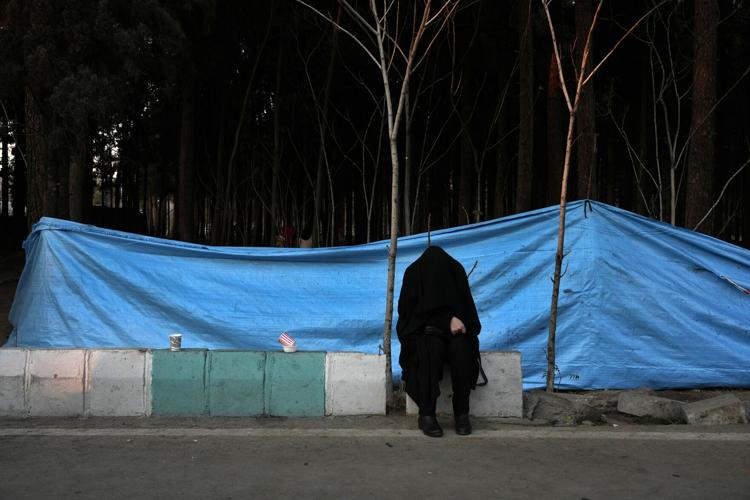
A woman weeps Thursday at the scene of Wednesday’s explosion in the city of Kerman, Iran.
The Islamic State group claim said the bombers carried out the attacks with explosive vests. It also used disparaging language when discussing Shiites, which the Islamic State group views as heretics.
The group likely hoped to see Iran strike at Israel, widening its war on Hamas into a regional conflict that Islamic State could potentially take advantage of, said Aaron Y. Zelin, a senior fellow at The Washington Institute for Near East Policy.
“This falls under the modus operandi of IS, especially since it was such a mass casualty attack,” Zelin said. “They are kind of like the Joker. They want to see the world burn. They don’t care how it happens as long as it benefits them.”
The Islamic State group previously claimed a June 2017 attack in Tehran on parliament and a mausoleum of Ayatollah Ruhollah Khomeini that killed at least 18 people and wounded more than 50. The group has claimed two other assaults as well.

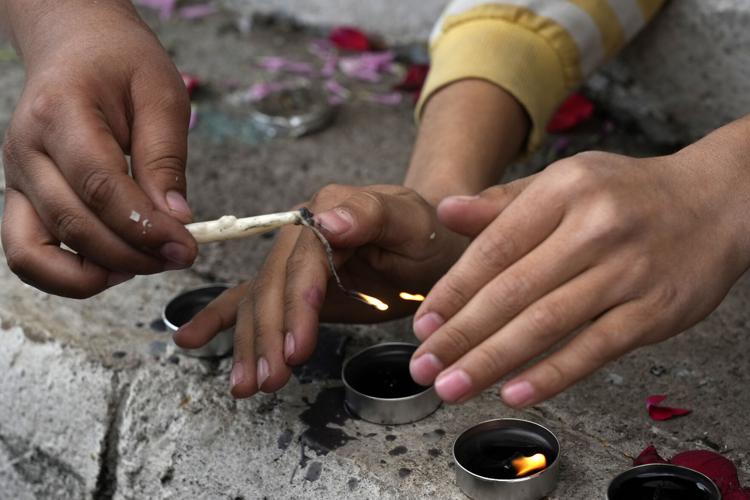
Children light candles Thursday at the scene of Wednesday’s explosion in the city of Kerman, Iran.
The extremist group, which once held vast territory across Iraq and Syria in a self-described caliphate it declared in 2014, ultimately were beaten back by U.S.-led forces. It has been in disarray in the years since, though it has mounted major assaults.
In neighboring Afghanistan, for instance, the Islamic State group is believed to have grown in strength since the fall of the Western-backed government there to the Taliban in 2021.
The claim came as the extremists separately called on supporters around the world to avenge the bloodshed in the Gaza Strip by attacking Christians and Jews. The group also criticized Palestinian factions for allying with Iran, saying that Tehran has taken advantage of the situation to appear as the defender of Palestinians.
Iranian government officials did not immediately acknowledge the claim, though state media reported on it. Officials indirectly blamed Israel for the attack and in Kerman on Thursday, passers-by stepped on signs bearing the image of the Israeli flag with the slogan “Death to Israel” written in Farsi across them.

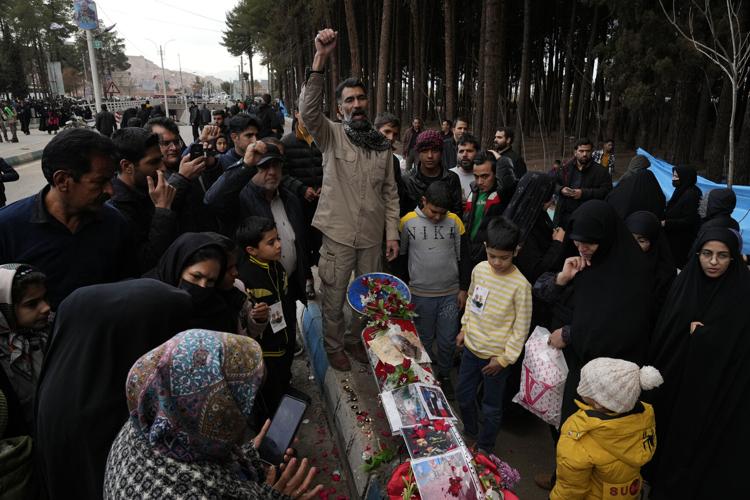
People chant slogans Thursday at the scene of Wednesday’s bomb explosion in the city of Kerman, Iran.
The Iranian state media reports gave new distances for how far apart the blasts happened, describing them as occurring about a mile and about 1½ miles away from Soleimani’s crypt. The official said the bombers likely chose the locations because they were outside of the security perimeter for the commemoration.
An earlier death toll of 103 was twice revised lower after officials realized that some names were repeated on a list of victims and due to the severity of wounds suffered by some of the dead, health authorities said. Many of the wounded were in critical condition, however, so the death toll could rise.
Today in history: Jan. 4
1935: Franklin D. Roosevelt
Updated
In 1935, President Franklin D. Roosevelt, in his State of the Union address, called for legislation to provide assistance for the jobless, elderly, impoverished children and the disabled.
1948: Burma
Updated
In 1948, Burma (now called Myanmar) became independent of British rule.
1964: Pope Paul VI
Updated
In 1964, Pope Paul VI began a visit to the Holy Land, the first papal pilgrimage of its kind.
1974: Richard Nixon
Updated
In 1974, President Richard Nixon refused to hand over tape recordings and documents subpoenaed by the Senate Watergate Committee.
1987: Amtrak
Updated
In 1987, 16 people were killed when an Amtrak train bound from Washington, D.C., to Boston collided with Conrail locomotives that had crossed into its path from a side track in Chase, Maryland.
1999: Jesse Ventura
Updated
In 1999, former professional wrestler Jesse Ventura took the oath of office as Minnesota’s governor.
1999: The Euro
Updated
In 1999, Europe’s new currency, the euro, got off to a strong start on its first trading day, rising against the dollar on world currency markets.
2006: Ariel Sharon
Updated
In 2006, Israeli Prime Minister Ariel Sharon suffered a significant stroke; his official powers were transferred to his deputy, Ehud Olmert (EH’-hood OHL’-murt). (Sharon remained in a coma until his death in January 2014.)
2007: Nancy Pelosi
Updated
In 2007, Nancy Pelosi was elected the first female speaker of the House as Democrats took control of Congress.
2012: Richard Cordray
Updated
Ten years ago: Defying Republican lawmakers, President Barack Obama barreled past the Senate by using a recess appointment to name Richard Cordray the first director of the Consumer Financial Protection Bureau.
2013: Cotton Bowl.
Updated
No. 10 Texas A&M beat No. 12 Oklahoma, 41-13, in the Cotton Bowl.
2015: Pope Francis
Updated
In 2015, Pope Francis named 156 new cardinals, selecting them from 14 countries, including far-flung corners of the world, to reflect the diversity of the Roman Catholic church and its growth in places like Asia and Africa.
2017: Obamacare
Updated
Five years ago: President Barack Obama urged congressional Democrats to “look out for the American people” in defending his legacy health care overhaul, while Vice President-elect Mike Pence stood firm in telling Republicans that dismantling “Obamacare” was No. 1 on Donald Trump’s list.
2018: The Dow Jones Industrial Average
Updated
The Dow Jones Industrial Average burst through the 25,000 mark, closing at 25,075.13 just five weeks after its first close above 24,000.
2021: Donald Trump
Updated
One year ago: At a campaign rally in Georgia for the Republican candidates in the state’s U.S. Senate runoff elections the following day, President Donald Trump declared that he would “fight like hell” to hold on to the presidency and appealed to Republican lawmakers to reverse his election loss.
2021: Julian Assange
Updated
One year ago: A British judge rejected the United States’ request to extradite WikiLeaks founder Julian Assange to face espionage charges, saying it would be “oppressive” because of his mental health. (An appellate court later overturned that ruling; Assange’s lawyers are seeking to appeal.)

