


WASHINGTON — Retired Supreme Court Justice Sandra Day O'Connor, an unwavering voice of moderate conservatism and the first woman to serve on the nation's highest court, died Friday. She was 93.
O'Connor died in Phoenix, of complications related to advanced dementia and a respiratory illness, the Supreme Court said in a news release.
Chief Justice John Roberts mourned her death. "A daughter of the American Southwest, Sandra Day O'Connor blazed an historic trail as our Nation's first female Justice," Roberts said in statement. "She met that challenge with undaunted determination, indisputable ability, and engaging candor."
In 2018, she announced that she was diagnosed with "the beginning stages of dementia, probably Alzheimer's disease." Her husband, John O'Connor, died of complications of Alzheimer's in 2009.

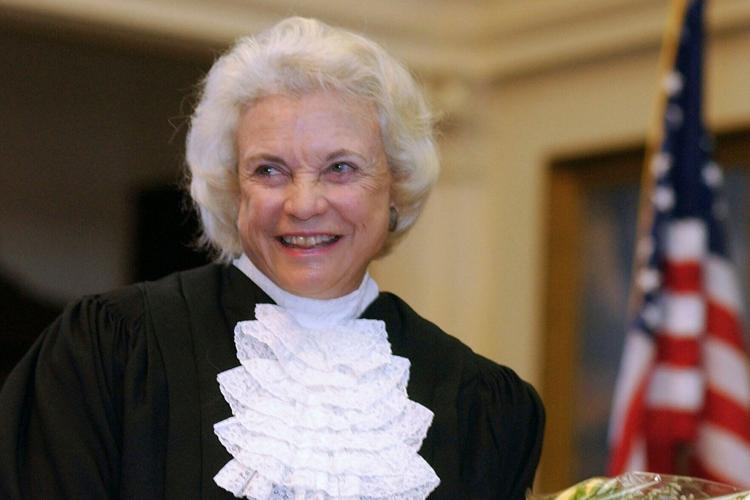
U.S. Supreme Court Justice Sandra Day O'Connor is shown Jan. 6, 2003, before administering the oath of office to members of the Texas Supreme Court in Austin, Texas.
O'Connor's nomination in 1981 by President Ronald Reagan and subsequent confirmation by the Senate ended 191 years of male exclusivity on the high court. A native of Arizona who grew up on her family's sprawling ranch, O'Connor wasted little time building a reputation as a hard worker who wielded considerable political clout on the nine-member court.
The granddaughter of a pioneer who traveled west from Vermont and founded the family ranch some three decades before Arizona became a state, O'Connor had a tenacious, independent spirit that came naturally. As a child growing up in the remote outback, she learned early to ride horses, round up cattle and drive trucks and tractors.
"I didn't do all the things the boys did," she said in a 1981 Time magazine interview, "but I fixed windmills and repaired fences."
On the bench, her influence could best be seen, and her legal thinking most closely scrutinized, in the court's rulings on abortion, perhaps the most contentious and divisive issue the justices faced. O'Connor balked at letting states outlaw most abortions, refusing in 1989 to join four other justices who were ready to reverse the landmark 1973 Roe v. Wade decision that said women have a constitutional right to abortion.

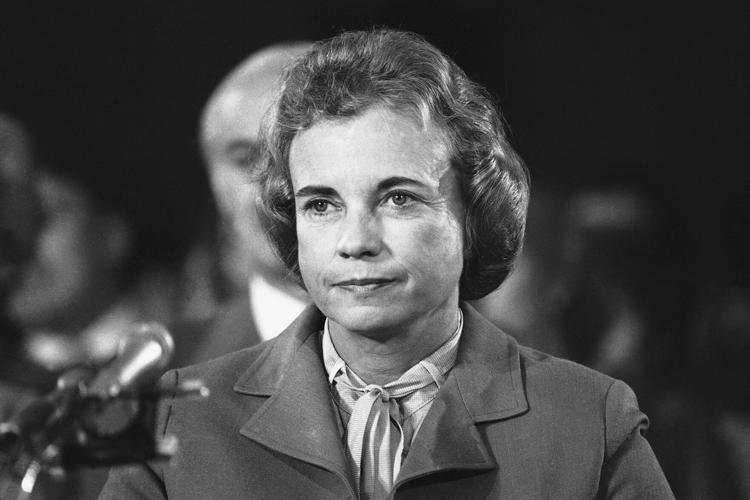
Judge Sandra Day O'Connor, arrives Sept. 9, 1981, for the start of her confirmation hearings before the Senate Judiciary Committee in Capitol Hill in Washington.
In 1992, she helped forge and lead a five-justice majority that reaffirmed the core holding of the 1973 ruling.
"Some of us as individuals find abortion offensive to our most basic principles of morality, but that can't control our decision," O'Connor said in court, reading a summary of the decision in Planned Parenthood v. Casey. "Our obligation is to define the liberty of all, not to mandate our own moral code."
Thirty years after that decision, a more conservative court did overturn Roe and Casey, and the opinion was written by the man who took her high court seat, Justice Samuel Alito. He joined the court upon O'Connor's retirement in 2006, chosen by President George W. Bush.
In 2000, O'Connor was part of the 5-4 majority that effectively resolved the disputed 2000 presidential election in favor of Bush over Democrat Al Gore.

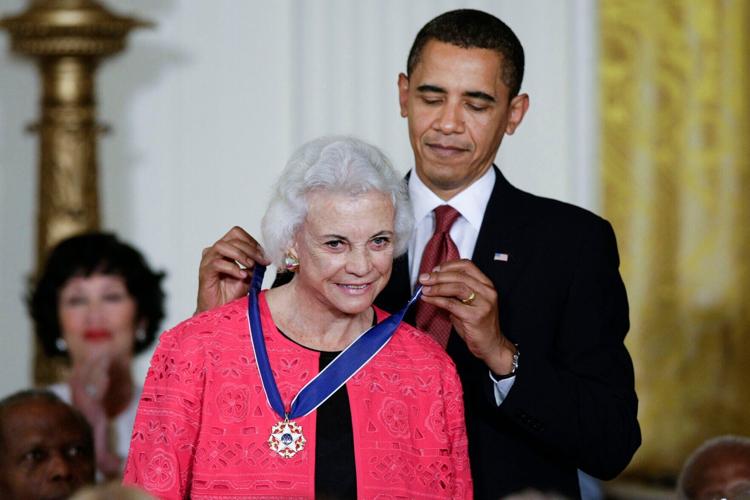
President Barack Obama presents the 2009 Presidential Medal of Freedom to Sandra Day O'Connor, Aug. 12, 2009, in Washington.
O'Connor was regarded with great fondness by many of her colleagues. When she retired, Justice Clarence Thomas, a consistent conservative, called her "an outstanding colleague, civil in dissent and gracious when in the majority."
She could, nonetheless, express her views tartly. In one of her final actions as a justice, a dissent to a 5-4 ruling to allow local governments to condemn and seize personal property to allow private developers to build shopping plazas, office buildings and other facilities, she warned that the majority had unwisely ceded yet more power to the powerful.
"The specter of condemnation hangs over all property," O'Connor wrote. "Nothing is to prevent the state from replacing … any home with a shopping mall, or any farm with a factory."
O'Connor, whom commentators had once called the nation's most powerful woman, remained the court's only woman until 1993, when, much to O'Connor's delight and relief, President Bill Clinton nominated Justice Ruth Bader Ginsburg. The current court includes a record four women.
The enormity of the reaction to O'Connor's appointment surprised her. She received more than 60,000 letters in her first year, more than any one member in the court's history.
"I had no idea when I was appointed how much it would mean to many people around the country," she once said. "It affected them in a very personal way. People saw it as a signal that there are virtually unlimited opportunities for women. It's important to parents for their daughters, and to daughters for themselves."
On the bench, O'Connor generally favored states in disputes with the federal government. She often sided with police when they faced claims of violating people's rights. In 1985, she wrote for the court as it ruled that the confession of a criminal suspect first warned about his rights may be used as trial evidence, even if police violated the suspect's rights in obtaining an earlier confession.

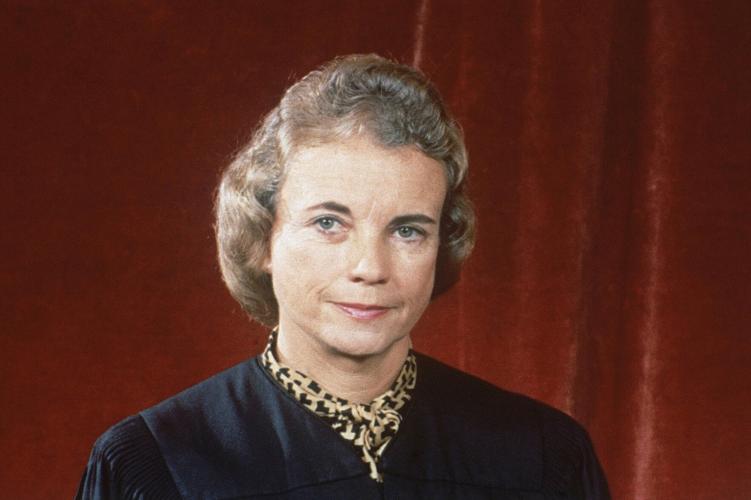
Supreme Court Associate Justice Sandra Day O'Connor poses for a photo in 1982.
A 1991 decision written by O'Connor said police do not violate the Constitution's ban against unreasonable searches and seizures when they board buses and randomly ask passengers to consent to being searched. In a 1994 decision, O'Connor said police officers need not stop questioning and seek clarification when a criminal suspect makes what might have been an ambiguous request for legal help.
O'Connor was embarrassed in 1989 after conservative Republicans in Arizona used a letter she had sent to support their claim that the United States is a "Christian nation." The 1988 letter, which prompted some harsh criticism of O'Connor by legal scholars, cited three Supreme Court rulings in which the nation's Christian heritage was discussed.
O'Connor said she regretted the letter's use in a political debate. "It was not my intention to express a personal view on the subject of the inquiry," she said.
Funeral plans were not immediately available.
Photos: Sandra Day O'Connor through the years

Judge Sandra Day O’Connor, speaking before senate hearing on her nomination to U.S. Supreme Court in Washington on Sept. 9, 1981. (AP Photo)
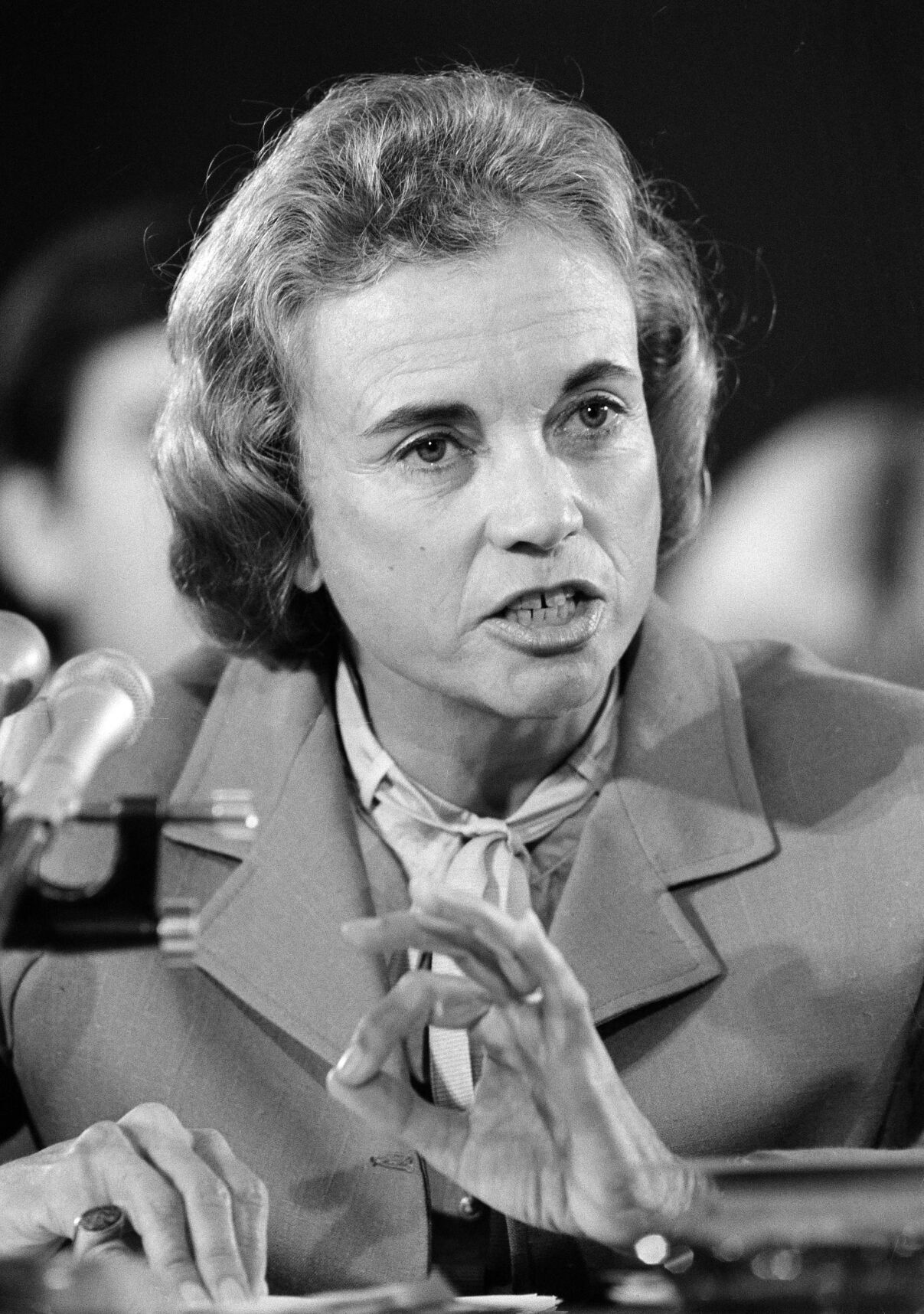
Supreme Court nominee Sandra Day O'Connor speaks while appearing before the Senate Judiciary Committee, Sept. 9, 1981, during her confirmation hearings. (AP Photo/Ron Edmonds)

Supreme Court Justice Sandra Day O'Connor makes a point while talking with students at the University of Louisville Brandeis School of Law Wednesday, May 14, 2003, in Louisville, Ky. The forum covered a wide range of topics including improvements to the jury system, hard work and growing older. (AP Photo/Ed Reinke)

Supreme Court Justice Sandra Day O'Connor pauses during a "constitutional conversation" with fellow justices Antonin Scalia and Stephen Breyer at the National Archives on Thursday, April 21, 2005 in Washington. (AP Photo/Evan Vucci)

Sandra Day O’Connor, of Arizona, sits with Barry Goldwater, R-Ariz., speaking before senate hearing on her nomination to U.S. Supreme Court in Washington on Sept. 9, 1981. (AP Photo)

Sen. Barry Goldwater (R-Ariz.), and Supreme Court nominee Judge Sandra Day O’Connor chat prior to the start of her confirmation hearings before the Senate Judiciary Committee, Sept. 9, 1981 on Capitol Hill in Washington. O’Connor is a judge in the state of Arizona. (AP Photo)

Supreme Court Justice-designate Sandra Day O’Connor, right, poses with first lady Nancy Reagan, Chief Justice of the United States Warren Burger and President Ronald Reagan during a reception for U.S. Apellate Court judges at the White House in Washington, Sept. 24, 1981.

Retired U.S. Supreme Court Justice Sandra Day O'Connor pauses after addressing a meeting of Pennsylvania judges and lawyers in Harrisburg, Pa., Wednesday, Sept., 19, 2007. (AP Photo/Carolyn Kaster)

U.S. Supreme Court Justice Sandra Day O’Connor chats with other lawyers before addressing the American Bar Association members conference on Saturday, August 4, 1984 in Chicago. O’Connor told the group that an ABA task force report shows that case loads can be reduced if judges take more active roles in trial proceedings. At right is FBI Director William Webster. (AP Photo/Mark Elias)

President Barack Obama presents the 2009 Presidential Medal of Freedom to Sandra Day O?Connor who was the first woman to sit on the Supreme Court, serving from 1981 until her retirement in 2006, during ceremonies at the White House in Washington, Wednesday, Aug. 12, 2009. (AP Photo/J. Scott Applewhite)

From left, Diane Sawyer, the honorable Ruth Bader Ginsburg and the honorable Sandra Day O’Connor, are seen on stage at the Women's Conference Tuesday, Oct. 26, 2010, in Long Beach, Calif. (AP Photo/Jae C. Hong)

FILE - In this Jan. 6, 2003 file photo, U.S. Supreme Court Justice Sandra Day O'Connor is shown before administering the oath of office to members of the Texas Supreme Court in Austin, Texas. NPR’s “Morning Edition” reports author Evan Thomas found former Chief Justice of the United States William Rehnquist's letter to O’Connor while researching his upcoming book, “First.” The two dated while students at Stanford Law School in the early 1950s. They had broken up, but remained friends. Rehnquist graduated and in a March 29 letter, wrote: "To be specific, Sandy, will you marry me this summer?" She said no. (AP Photo/Harry Cabluck, File )

FILE - U.S. Supreme Court Justice Sandra Day O'Connor hold up a copy of the U.S. constitution that she carries with her Saturday, Sept. 17, 2005 at an open-air Immigration and Naturalization citizenship hearing in Gilbert, Ariz. (AP Photo/Matt York, File)

FILE - Supreme Court nominee Sandra Day O'Connor raises her right hand to be sworn in before the Senate Judiciary Committee on Capitol Hill in Washington, on Sept. 9, 1981. (AP Photo/John Duricka, File)

Associate Justice of the Supreme Court Sandra Day O’Connor drives past photographers as she arrives for her first day of work at the Supreme Court in Washington, Oct. 5, 1981. The first Monday in October is the traditional opening day of the high court. (AP Photo/Bob Daugherty)

Michelle Hancock, of Lakeside, Ariz., left, who took part in the National Spelling Bee this week in Washington, pays a visit to Supreme Court Associate Justice Sandra Day O’Connor in her office on Friday, June 4, 1982 at the high court in Washington. (AP Photo)

Supreme Court Justice Sandra Day O?Connor, left, with Justice Byron White, chat with Sen. Mark Hatfield (R-Ore.), center, May 1, 1985 on Capitol Hill in Washington prior to appearing before a Senate subcommittee on the Judiciary to address the budget requirements of the Supreme Court for fiscal year 1986. (AP Photo/Barry Thumma)

President Corazon Aquino (right) sits with U.S. Supreme Court associate Justice Sandra Day O’Connor, during the courtesy call on Thursday, Sept. 3, 1987 at Malacanang Palace in Manila, Philippines by Association of Southeast Asian Nations Conference of Women Judges of which Justice O’Connor is the guest. President Aquino thanked the judges for coming to the country despite the coup last week. (AP Photo/Bullit Marquez)

Supreme Court Justice Sandra Day O'Connor poses for a photo in the Supreme Court Building, Washington, April 15, 1988. (AP Photo/Bob Daugherty)

Supreme Court Associate Justice Sandra Day O’Connor, who will turn 60 this week, and is known as a hard-working and strong-willed Supreme Court justice, is arguably the nation’s most powerful woman, shown March 22, 1990. O’Connor is the high court’s first and only women justice. (AP Photo/Barry Thumma)

Supreme Court Justices gather at the court for a formal portrait in Washington, Nov. 1, 1991. From left are, Clarence Thomas, David Souter, Antonin Scalia, Sandra Day O’Connor, Chief Justice William Rehnquist, John Paul Stevens, Harry Blackmun, Byron White, and Anthony Kennedy. (AP Photo/Ken Heinen)

Minerva Award recipients, from left, Sandra Day O’Connor, Sister Terry Dodge, and Oprah Winfrey are seen during the Women's Conference Tuesday, Oct. 26, 2010, in Long Beach, Calif. (AP Photo/Matt Sayles)

