

NEW ORLEANS — The textile mills that once served as the backbone of Mount Pleasant, North Carolina, have long been shuttered, and officials believed federal money would be key to the town's overdue revitalization. They hoped an improved stormwater drainage system and secured electrical wires — funded through a program to help communities protect against natural disasters and climate change — would safeguard investments in new businesses like a renovated historic theater to spur the largely rural economy.
Mount Pleasant was about to receive $4 million when the Federal Emergency Management Agency eliminated the program. Officials say their plans — years in the making — and those of hundreds of communities nationwide supported by the Building Resilient Infrastructure and Communities program have been upended.

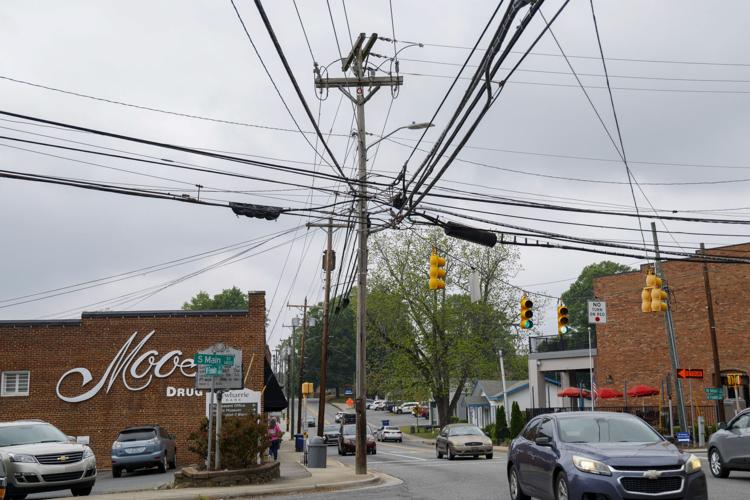
Utility poles and lines hang over the downtown April 24 in Mount Pleasant, N.C. The Trump administration's move to cut a federal grant program means that hundreds of communities like Mount Pleasant will miss out on projects to protect against natural disasters.
"This is a generational set of infrastructure projects that would set us up for the next hundred years and it just — poof — went away," said Erin Burris, assistant town manager for Mount Pleasant.
FEMA's elimination this month of the BRIC program revoked upwards of $3.6 billion in funding earmarked for communities like Mount Pleasant. Though President Donald Trump has openly questioned whether to shutter FEMA completely, local officials said they were blindsided by the move to end BRIC, established during the Republican president's first term.
Many affected communities are in Republican-dominated, disaster-prone regions. FEMA called the BRIC grants "wasteful" and "politicized" tools, but officials and residents say they were a vital use of government resources to proactively protect lives, infrastructure and economies.
Money would have gone toward strengthening electrical poles to withstand hurricane-force winds in Louisiana, relocating residents in Pennsylvania's floodplains and safeguarding water supply lines in Oklahoma's Tornado Alley.
Disasters affect the vast majority of Americans — 95% live in a county that has had a federally declared weather disaster since 2011, said Amy Chester, director of Rebuild by Design, a nonprofit focused on disaster prevention.
The BRIC program told communities, "We're going to help your community be stronger ahead of time," she said. "Cutting one of the sole sources of funding for that need is essentially telling Americans that it's OK that they're suffering."
Officials call FEMA's program imperfect but important

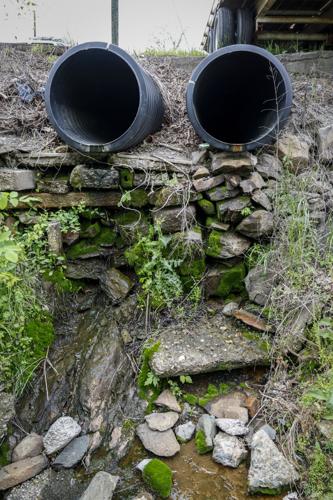
Storm water runoff pipes are seen in downtown Mount Pleasant, N.C., on April 24.
Across multiple states, officials said the BRIC program was far from perfect — they were often frustrated with the wait for funding.
But in southeastern Louisiana, Lafourche Parish President Archie Chaisson said despite his issues with FEMA's bureaucracy, he's seen firsthand that money invested to fortify homes and infrastructure works.
The hurricane-ravaged state receives the highest rate of federal disaster assistance per capita, with more than $8 billion pouring in since 2011, according to Rebuild by Design. Lafourche Parish has seen more than a dozen federally declared extreme weather disasters since 2011.
Chaisson, a Republican whose parish saw 80% of voters support Trump in November, said he backs efforts to streamline federal agencies — as long as funding continues to flow for disaster prevention.
"I'm hopeful that that's what the president's trying to do with this," he said. "Is there some other way to get the money so we can continue to do these projects? ... No matter where you sit on the political spectrum, the programs themselves and the dollars allocated make our communities more resilient."
Research backs him up: A 2024 study funded by the U.S. Chamber of Commerce found every $1 invested in disaster preparation saved $13 in economic impact, damage and cleanup costs.
Democratic officials in states that lost money have publicly expressed outrage. Few Republicans have joined in at a national level, even though about two-thirds of the top 15 states in total FEMA funds received, spending per person and number of federally declared disasters lean heavily Republican.
An exception has been Louisiana's senior U.S. senator, Bill Cassidy. He took to the Senate floor this month calling for BRIC's reinstatement, saying it's "a lifesaver and a cost-saver."
About $185 million intended for Louisiana evaporated, and officials had to shelve dozens of applications for hundreds of millions of dollars in new funding, according to data compiled by state and federal agencies.
"This isn't waste," Cassidy said. "To do anything other than use that money to fund flood mitigation projects is to thwart the will of Congress."
FEMA says more than $3.6 billion of BRIC funds will be returned to the federal Disaster Relief Fund, for disaster response and recovery, and an additional $882 million is being returned to the U.S. Treasury or reapportioned by Congress in the following fiscal year. Agency officials did not comment further for this story.

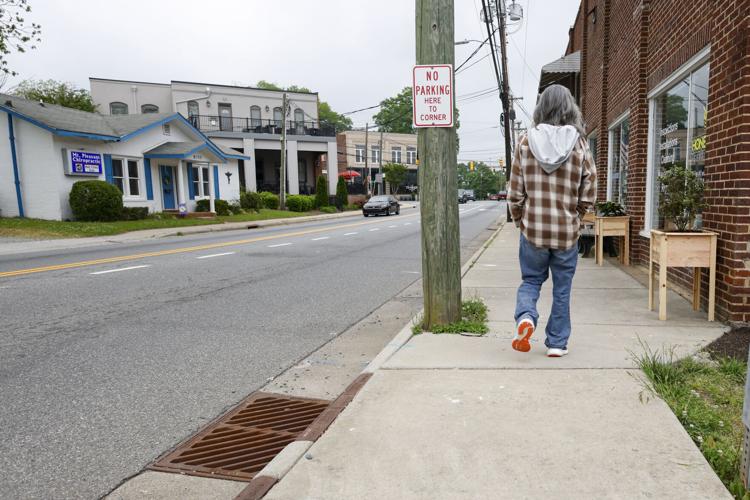
A pedestrian walks past a drain on Franklin Street on April 24 in downtown Mount Pleasant, N.C., in an area prone to flooding.
Some states fight to restore funds
Twenty-two mostly blue states and the District of Columbia have filed a lawsuit demanding the federal government release obligated funding, including FEMA grants.
The lawsuit highlights Grants Pass in conservative southern Oregon, where FEMA has refused to release BRIC funding awarded for a $50 million water treatment facility.
Flooding could knock out the water supply for 60,000 people for months, said Jason Canady, city public works director. Funding would have been used in part to build a modernized plant on higher ground.
"If you can't provide drinking water, hospitals, groceries, restaurants are going to have trouble. Economically, it would be devastating," he said. "It really is the cornerstone on which the community is built."

Utility poles and lines hang over downtown Mount Pleasant, N.C., on April 24.
In Stillwater, Oklahoma, Mayor Will Joyce spent two years working with FEMA on a BRIC application to overhaul and provide backup supply for a regional water system used by 100,000 people. Its 36-mile pipeline is at risk of damage from tornadoes and flooding. If it breaks, Stillwater has less than a day's worth of reserve drinking water.
"We can't just hope nothing bad happens," Joyce said. "This project is a necessity."
Without FEMA's support, he said, Stillwater will have to double the cost of water for residents to fund the project.
In an open letter, U.S. Rep. Rob Bresnahan Jr., a northeast Pennsylvania Republican, urged FEMA to revive BRIC, saying communities in his district would struggle to fund disaster adaptation work, including relocating families in flooded homes.
Bresnahan wrote that "programs like BRIC are not wasteful, but well within the purview of federal coordination of disaster relief efforts" and noted that Trump "promised not to leave the forgotten men and women of America behind."

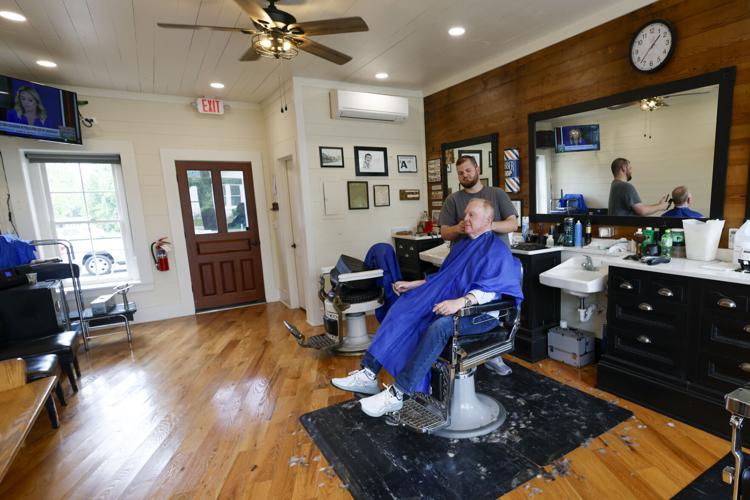
Bryan Sanders, back, cuts Eddie Plummer's hair April 24 at the Mt. Pleasant Barber Shop, a business in an area prone to flooding in Mount Pleasant, N.C.
Some towns fear their needs will be forgotten
Republican voters in Mount Pleasant embrace efforts to downsize government, but the perception is that cuts are focused on federal bureaucracy, related waste and redundancy, or diversity, equity and inclusion spending, said Jim Quick, vice chairman of the Cabarrus County Republican Party.
"It would be a surprise for us to learn that those budget cuts would be impacting a local municipality," Quick said. "The reality is all of us have to trim back."
Town voters are unlikely to retract their support for Trump, he said, noting that 80% supported him in November.
Burris, the assistant town manager, worries about flooding downtown. And she points to one vulnerable utility pole she's nicknamed Atlas — after the Greek god carrying the world on his shoulders — holding up the electricity, internet and telecommunications for the town's 1,700 people.
"It's a special community, and it deserves good things," Burris said, choking up. "I don't know what was political about Mount Pleasant — little, teeny, tiny Mount Pleasant — getting a little bit of help with some stormwater flooding."

States with the most historic sites at risk of flooding
States with the most historic sites at risk of flooding
Updated
Rising sea levels. Runoff from rapidly melting snow and ice. Rivers and streams overflowing their banks. As climate change continues to wreak havoc on the environmental norms humans widely take for granted, the frequency and severity of extreme weather has increased on a global scale. Floods, the most common and fatal natural disasters in the U.S., continue to get more destructive. Catastrophic flooding events once thought to occur every 100 years could become annual happenings. And the nation’s floodplains are projected to grow by roughly 45% by the end of the century.
Because of the deterioration and fragility of historical buildings, as well as long-term degradation of the natural environment around these structures, historic sites are often at serious risk of flooding. Stacker identified historic buildings of national significance across the U.S. located in census tracts with very or relatively high risk of flooding, using data from FEMA’s National Risk Index and the National Register of Historic Places. The National Park Service outlines six criteria for what makes a historic building on the registry nationally significant, a less rigorous designation than being considered a National Historic Landmark. FEMA calculated the risk of flooding for each census tract by combining geospatial and historic flood-event data from the National Flood Insurance Program and NOAA. For each state, a maximum of three historic sites are listed in order of their flood risk, though many states on this list have more at-risk sites in total. Colorado, Connecticut, and Idaho did not have nationally significant sites on the registry located in high-risk flood regions; as such they are absent from this list.
Stacker is also publishing the raw data it merged to produce this story, available at GitHub and data.world.
You may also like: Environmental impact of 20 foods

#47. Wyoming
Updated
- Historically significant buildings with risk of river flooding: 1
--- Wapiti Ranger Station, Wapiti (relatively high risk)
Abutting the east entrance of Yellowstone National Park, the Wapiti Ranger Station was the first ranger station in the U.S. to be built using federal funds. In 1985, Wyoming experienced its worst flood on record when two-inch hail combined with flash flooding, 70-mile-per-hour winds, and tornadoes, resulting in 12 deaths and 70 injuries.
#46. Rhode Island
Updated
- Historically significant buildings with risk of river flooding: 1
--- Flying Horse Carousel, Westerly (relatively high risk)
The Flying Horse Carousel, also known as the Watch Hill Carousel, is said to be the oldest continuously operating carousel in the U.S., having been in use since 1883. Located on the southern Rhode Island coastline, the carousel has come close to destruction with increasing frequency as hurricanes become more and more catastrophic. In 2012, Hurricane Sandy destroyed neighboring harbourfront shops and narrowly avoided damaging the historic site.
#45. North Dakota
Updated
- Historically significant buildings with risk of river flooding: 1
--- Fort Totten, Fort Totten (very high risk)
Fort Totten was built in 1867 as a military post before being converted in 1890 into a Native American boarding school, where Sioux children were brought to be forcefully “assimilated” into white American culture by having their hair cut, clothes taken, and Indigenous language and culture stolen. The school continued to operate until 1959, when it became a North Dakota historic site. Fort Totten is situated on the edge of Devils Lake, which has rapidly expanded and frequently floods due to the effects of climate change. According to scientists, the lake’s volume is nearly 32 times what it was in 1964, and continues to grow.
#44. New Hampshire
Updated
- Historically significant buildings with risk of river flooding: 1
--- Frost Place, Franconia (relatively high risk)
The former home of poet Robert Frost and his family, Frost Place has operated as a poetry and arts museum and nonprofit since the 1970s. As river flooding is the most common natural disaster in New Hampshire, Frost Place’s proximity to several rivers and brooks in the White Mountains creates some flood risk. Over the last decades, New Hampshire’s floodplain forests, which control erosion and contain flooding near rivers, have been cleared away for development and agricultural purposes, making the risk of flooding higher.
#43. Minnesota
Updated
- Historically significant buildings with risk of river flooding: 1
--- Bernard H. Pietenpol, Workshop and Garage, Spring Valley (relatively high risk)
Bernard H. Pietenpol was the “father of the homebuilt aircraft movement” in the U.S., designing over 20 airplanes in his Spring Valley workshop between 1923 and 1984. Heavy rains in Spring Valley in recent years have caused flooding and nearby rivers to overflow, causing damage to the city’s infrastructure and buildings.
You may also like: 10 ways nature and animals forecast the weather
#42. South Dakota
Updated
- Historically significant buildings with risk of river flooding: 2
--- Custer State Game Lodge, Custer (relatively high risk)
--- Harney Peak Tin Mining Company Buildings, Hill City (relatively high risk)
Custer State Game Lodge came to be known as the “Summer White House” after President Coolidge stayed there in 1927, and President Eisenhower visited in 1953. After an expedition led by Custer found gold in the sacred Black Hills of the Sioux and Arapaho Nations, the land was seized in violation of the 1868 Fort Laramie Treaty. One of the deadliest floods in U.S. history occurred in the Black Hills in 1972 after very heavy rainfall caused streams to surge and the nearby Canyon Lake Dam to overflow.
#41. Hawaii
Updated
- Historically significant buildings with risk of river flooding: 2
--- Hulihe‘e Palace, Kailua-Kona (very high risk)
--- Volcano Block Building, Hilo (relatively high risk)
Hulihe‘e Palace was built in 1838 and used as a summer home by members of the Hawaiian royal family before the U.S. overthrow of the constitutional monarchy and subsequent annexation of Hawaii in 1898. Today, it serves as a museum that recalls Hawaii’s pre-colonial sovereignty. In 2011, the palace’s basement flooded when a tsunami hit the western coast of the Big Island, but no damage was reported.
#40. Oklahoma
Updated
- Historically significant buildings with risk of river flooding: 3
--- Jefferson Gardner House, Eagletown (relatively high risk)
--- Murrell Home, Park Hill (relatively high risk)
--- Dewey Hotel, Dewey (relatively high risk)
The Murrell Home in Park Hill, also known as Hunter’s Home, is the last remaining pre-Civil War plantation home in Oklahoma. Now a museum, the Murrell plantation was owned by George Murrell, a wealthy white planter, and his wife, Minerva Ross, a member of an influential Cherokee family. Hunter’s Home survives as a testament to the little-known history of Cherokees enslaving African Americans in antebellum America.
#39. Nevada
Updated
- Historically significant buildings with risk of river flooding: 3
--- California Building, Reno (relatively high risk)
--- Senator Francis G. Newlands House, Reno (relatively high risk)
--- Bowers Mansion, Reno (relatively high risk)
The California Building in Reno is the only remaining building associated with the Transcontinental Highways Exposition of 1927, which celebrated the completion of creating paved, well-marked highways from coast to coast. The building was a gift from the state of California to commemorate those who died in combat during World War I, as well as to promote California tourism to Nevadans and those who were passing through. In 1997, Reno experienced catastrophic flooding when the Truckee River—which flows directly through the city—overflowed.
#38. Kansas
Updated
- Historically significant buildings with risk of river flooding: 3
--- Senator William A. Harris House, Linwood (relatively high risk)
--- John Brown Cabin, Osawatomie (relatively high risk)
--- William Allen White House, Emporia (relatively high risk)
The John Brown Cabin was the headquarters of the abolitionist John Brown and served as a stop on the Underground Railroad. Osawatomie, which is located right in between the Pottawatomie Creek and the Marais des Cygnes River, experienced a major flooding event in 2007 when both bodies of water overflowed and overtook the town.
You may also like: How climate change has affected each state
#37. Delaware
Updated
- Historically significant buildings with risk of river flooding: 3
--- Barratt’s Chapel, Frederica (relatively high risk)
--- Logan School House K-834, Kitts Hummock (relatively high risk)
--- New Castle County Court House, New Castle (relatively high risk)
The New Castle County Court House was built in 1732 and was Delaware’s first courthouse and state capitol. In 1776, Kent, New Castle, and Sussex counties formed the state of Delaware at the courthouse. A larger proportion of Delaware is at risk of coastal flooding than any of the other continental states, besides Louisiana and Florida.
#36. Vermont
Updated
- Historically significant buildings with risk of river flooding: 4
--- Robbins and Lawrence Armory and Machine Shop, Windsor (very high risk)
--- Vermont State House, Montpelier (very high risk)
--- Union Co-operative Store Bakery, Barre (relatively high risk)
The Vermont State House in Montpelier, Vermont’s capitol, still serves as the statehouse today, 160 years after its construction. Montpelier is prone to flooding throughout the year but is particularly susceptible in the spring when melting snow and ice create significant runoff from the mountains, and heavy rain and ice jams compound the issue. Over the course of the 20th century alone, Montpelier experienced three significant floods that caused dozens of deaths and millions of dollars worth of damage.
#35. Nebraska
Updated
- Historically significant buildings with risk of river flooding: 4
--- Richard E. Dill House, Alexandria (relatively high risk)
--- Dr. Susan Picotte Memorial Hospital, Walthill (relatively high risk)
--- Fairview, Lincoln (relatively high risk)
Dr. Susan La Flesche Picotte, a member of the Omaha tribe, is thought to be the first Indigenous woman to earn a medical degree, which she used to care for some 1,200 people on the Omaha reservation in Nebraska. She eventually opened a hospital, named the Dr. Susan LaFlesche Picotte Memorial Hospital, which has since undergone restoration and will house a museum in the completed building.
#34. Mississippi
Updated
- Historically significant buildings with risk of river flooding: 4
--- Grand Opera House, Meridian (relatively high risk)
--- Tallahatchie County Second District Courthouse, Sumner (relatively high risk)
--- Charles McLaran House, Columbus (relatively high risk)
Built by German-Jewish immigrants in 1889, the Grand Opera House opened in Meridian in 1890 and would go on to hold both theatrical stagings and, eventually, cinematic showings. The opera house was abandoned in 1927 and sat vacant until 1999, when the then-president of Mississippi State University planned a restoration project for the old theater, which reopened as the MSU Riley Center in 2006. Hurricane Ida of 2021, which hit Meridian and caused significant flooding, was only the latest in a long history of hurricanes battering the state.
#33. Michigan
Updated
- Historically significant buildings with risk of river flooding: 4
--- Commandant's Quarters, Dearborn (relatively high risk)
--- All Saints' Episcopal Church, Saugatuck (relatively high risk)
--- Herbert H. Dow House, Midland (relatively high risk)
Built in 1899, the Dow House and gardens belonged to Herbert Dow, the founder of Dow Chemical Company, and his wife, Grace. In 2020, the town of Midland experienced a 500-year flood event—an event only likely to occur every 500 years—that destroyed a power dam and forced over 10,000 people to evacuate their homes. The flooding also raised concerns for contamination when the floodwaters mixed with chemicals at the Dow Chemical plant, a location already designated a Superfund site.
You may also like: Fastest-warming cities in the US
#32. Maryland
Updated
- Historically significant buildings with risk of coastal flooding: 2
--- Old Lock Pump House, Chesapeake and Delaware Canal, Chesapeake City (relatively high risk)
--- Charles Sumner Post #25, Grand Army of the Republic, Chestertown (relatively high risk)
- Historically significant buildings with risk of river flooding: 3
--- Annie Oakley House, Cambridge (relatively high risk)
--- La Vale Tollgate House, La Vale (relatively high risk)
--- John Brown's Headquarters, Samples Manor (relatively high risk)
Designed by Annie Oakley, the iconic Wild West sharpshooter, the Annie Oakley House was built for Oakley and her husband’s retirement. While the architecture of the house is mostly standard for its time, Oakley specially designed the roof so she could access it from the upstairs windows in order to shoot game by the Choptank River. Flooding is increasing in frequency and severity in Maryland, particularly “sunny day” flooding, which is flooding unrelated to excessive rainfall, instead correlating with rising ocean levels and normal tidal changes.
#31. Virginia
Updated
- Historically significant buildings with risk of coastal flooding: 1
--- Christ Church, Irvington (relatively high risk)
- Historically significant buildings with risk of river flooding: 4
--- Christ Church, Irvington (relatively high risk)
--- Berry Hill, South Boston (relatively high risk)
--- Woodrow Wilson Birthplace, Staunton (Independent City) (relatively high risk)
Woodrow Wilson was born in the city of Staunton but spent only two years there before moving to Georgia during the Civil War. The house where Wilson was born now serves as a museum as well as his presidential library and research center. In 2020, the city of Staunton experienced severe flash flooding, which caused “horrific” damage to houses and businesses and turned streets into rivers.
#30. Maine
Updated
- Historically significant buildings with risk of river flooding: 5
--- Ogunquit Playhouse, Ogunquit (relatively high risk)
--- Winslow Homer Studio, Scarborough (relatively high risk)
--- Gehring Clinic, Bethel (relatively high risk)
Between 1883 and 1910, the iconic artist Winslow Homer lived and painted in his studio on the coast of Prouts Neck, Maine. In 2006, the Portland Museum of Art purchased the studio and restored it to how it would have looked during Homer’s life, opening it in 2012 as a museum. Because of its proximity to the coast, oceanic erosion, sea level rise, and tidal flooding all pose dangers to Homer’s studio and other coastal structures.
#29. Georgia
Updated
- Historically significant buildings with risk of river flooding: 5
--- Bonner-Sharp-Gunn House, Carrollton (relatively high risk)
--- Gordon-Lee House, Chickamauga (relatively high risk)
--- John Ross House, Rossville (relatively high risk)
The Gordon-Lee House was constructed of bricks that were made on-site between 1840-47 using the labor of enslaved people. During the Civil War, the house was used as Union Army headquarters before the Battle of Chickamauga. During the battle, it was converted into a hospital for Union soldiers. Major floods have plagued Chickamauga, with considerable flooding events occurring nearly every two years.
#28. Alabama
Updated
- Historically significant buildings with risk of river flooding: 5
--- Bethel Baptist Church, Parsonage, and Guardhouse, Collegeville (very high risk)
--- New Pilgrim Baptist Church, Birmingham (very high risk)
--- Government Street Presbyterian Church, Mobile (relatively high risk)
The New Pilgrim Baptist Church served as a community organizing space for Birmingham’s Civil Rights Movement. Led by Reverend Nelson H. Smith Jr., who was also the secretary of the Alabama Christian Movement for Human Rights, the church hosted meetings, radio broadcasts, and large gatherings in its auditorium. In 2021, Birmingham experienced deadly flash flooding that killed four people.
You may also like: 20 safety preparations for the weather this summer
#27. Utah
Updated
- Historically significant buildings with risk of river flooding: 6
--- Wells Fargo and Company Express Building, Silver Reef (very high risk)
--- Washington Cotton Factory, Washington (very high risk)
--- Jacob Hamblin House, Santa Clara (very high risk)
The Washington Cotton Factory was built between 1865-67 by early Mormon settlers to Utah. In an initiative led by Utah governor and LDS Church President Brigham Young to ensure Mormon self-sufficiency, settlers created and ran the cotton factory, likely using the forced labor of enslaved Black people. Flooding has posed problems for Utahns in Washington since before the settlers arrived, repeatedly washing away dams built to contain the waters and causing damage to crops and buildings.
#26. Tennessee
Updated
- Historically significant buildings with risk of river flooding: 7
--- Belle Meade, Nashville (very high risk)
--- Elvis Presley House, Memphis (relatively high risk)
--- First Presbyterian Church, Nashville (relatively high risk)
Not to be confused with Graceland, the Elvis Presley House is a modest ranch-style house situated in a residential neighborhood of Memphis. Elvis Presley lived here with his parents in 1956, the year his career would take off and propel him to international fame (he would go on to purchase the Graceland mansion in 1957). Severe flood events are increasing in frequency throughout Tennessee, with some regions experiencing flooding nearly every six months.
#25. Oregon
Updated
- Historically significant buildings with risk of river flooding: 7
--- Gold Beach Ranger Station, Gold Beach (very high risk)
--- Cedar Guard Station No. 1019, Cave Junction (relatively high risk)
--- Oregon Caves Chateau, Oregon Caves National Monument (relatively high risk)
The Oregon Caves Chateau opened in 1934 after being constructed with the help of the Civilian Conservation Corps, a Depression-era relief program which was part of FDR’s New Deal. The Chateau, standing at six stories tall, was built into a steep ravine, with much of the removed rock being repurposed to blend the building into the mountainside. The Chateau was nearly destroyed in a 1964 flood, and had to be largely rebuilt by Gust Lium, the original architect.
#24. Ohio
Updated
- Historically significant buildings with risk of river flooding: 7
--- John P. Parker House, Ripley (very high risk)
--- Manasseh Cutler Hall, Ohio University, Athens (relatively high risk)
--- Benjamin Lundy House, Mt. Pleasant (relatively high risk)
John Parker, a former enslaved person and inventor who aided enslaved people trapped in the “borderlands” of Kentucky, lived in Ripley, Ohio, where his home was a stop on the Underground Railroad starting in the 1850s. Ripley is at severe risk of flooding over the next 30 years, with a greater flood risk overall than 95% of all neighborhoods in the state.
#23. Montana
Updated
- Historically significant buildings with risk of river flooding: 7
--- Administration Building, Fort Peck (relatively high risk)
--- Employee’s Hotel and Garage, Fort Peck (relatively high risk)
--- Garage and Fire Station, Fort Peck (relatively high risk)
The Fort Peck Dam and surrounding buildings were constructed during the 1930s as a New Deal public works project, and were built by as many as 10,500 workers. Flooding in Montana sometimes occurs when snow from the Rocky Mountains rapidly melts due to above-average spring temperatures and larger-than-usual snowfall during the winter.
You may also like: How weather has shaped human history
#22. Indiana
Updated
- Historically significant buildings with risk of river flooding: 7
--- First Christian Church, Columbus (relatively high risk)
--- George Bentel House, New Harmony (relatively high risk)
--- Mattias Scholle House, New Harmony (relatively high risk)
The George Bentel House is one of a few houses remaining from when the Harmonists, a German religious group who immigrated to the U.S. to avoid persecution, arrived in Indiana in 1814. The Harmonists sought to create a utopian model society with a self-sufficient system of commerce and public facilities, though this society dissolved by 1828. The town of New Harmony sits on the bank of the Wabash River, which spans the entirety of Indiana and is the largest river in the state. This proximity has exposed the town to floodwaters as river levels continue to rise.
#21. Arkansas
Updated
- Historically significant buildings with risk of river flooding: 7
--- Confederate State Capitol, Washington (relatively high risk)
--- Goodlett Gin, Washington (relatively high risk)
--- Ferguson House, Pine Bluff (relatively high risk)
The Goodlett Gin is the only known operational steam-powered cotton gin in the country. It is now located in Historic Washington State Park, where it serves as a nonoperating exhibit. Arkansas experienced the most flood-related disasters out of any state with 17 between the years 2008-17, according to a Pew report on FEMA information.
#20. Louisiana
Updated
- Historically significant buildings with risk of coastal flooding: 1
--- Southdown Plantation, Houma (relatively high risk)
- Historically significant buildings with risk of river flooding: 7
--- Shadows-on-the-Teche, New Iberia (very high risk)
--- Maison Olivier (Acadian House), St. Martinville (very high risk)
--- Robert Penn Warren House, Prairieville (relatively high risk)
Built in 1905, the Robert Penn Warren House, also known as Twin Oaks, belonged to the famed poet and novelist starting in 1941. Warren lived there while teaching at Louisiana State University before he left to teach at the University of Minnesota. Unsurprisingly, the state of Louisiana faces the highest flood risk and has experienced some of the most catastrophic flood damage of any U.S. state.
#19. Wisconsin
Updated
- Historically significant buildings with risk of river flooding: 8
--- Astor Fur Warehouse, Prairie du Chien (relatively high risk)
--- Michael Brisbois House, Prairie du Chien (relatively high risk)
--- Dousman Hotel, Prairie du Chien (relatively high risk)
A fur-trading hub in the 18th century, Prairie du Chien became home to Jacob Astor’s American Fur Company, which dominated the Upper Mississippi fur trade. Prairie du Chien experienced such a destructive flood in 1965 that an entire neighborhood—what later became known as St. Feriole Island—had to be relocated to the mainland.
#18. Missouri
Updated
- Historically significant buildings with risk of river flooding: 8
--- Casa Alvarez, Florissant (relatively high risk)
--- Administration Building, Missouri State Fruit Experiment Station, Mountain Grove (relatively high risk)
--- Laura Ingalls Wilder House, Mansfield (relatively high risk)
Laura Ingalls Wilder began writing her acclaimed “Little House on the Prairie” series at the age of 65 while living at Rocky Ridge Farm. Now, the Laura Ingalls Wilder House serves as a museum that houses original manuscripts and other artifacts of Wilder’s life. Because of the state of Missouri’s positioning on the Mississippi and Missouri Rivers, it is a particularly flood-prone state, causing ecological and economic disasters throughout several centuries.
You may also like: US cities with the dirtiest air
#17. South Carolina
Updated
- Historically significant buildings with risk of river flooding: 10
--- Fort Fremont Hospital, Frogmore (relatively high risk)
--- The Oaks, Frogmore (relatively high risk)
--- Robert Simmons House, Frogmore (relatively high risk)
The Oaks is a plantation house on Saint Helena Island famous for its occupation by the Union Army during the Civil War. The house served as headquarters for the Port Royal Experiment, in which Northerners attempted to create a new Southern economic and political system separate from a system of slavery. After the war, The Oaks was turned into Penn Center, the first school in the South for formerly enslaved people, which still operates as an educational center and monument to Black history today.
#16. New Mexico
Updated
- Historically significant buildings with risk of river flooding: 10
--- Illinois Brewery, Socorro (very high risk)
--- Val Verde Hotel, Socorro (very high risk)
--- Sagrada Familia de Lemitar Church, Los Dulces Nombres, Lemitar (very high risk)
Now called the Hammel Museum, the former site of the Illinois Brewing Company contains exhibits on early Socorro and documents the history of the brewery. During Prohibition, the brewery became a soda bottling facility. A state of emergency was announced in Socorro as a result of severe flooding in late 2021.
#15. California
Updated
- Historically significant buildings with risk of river flooding: 10
--- Charles M. Pratt House, Ojai (relatively high risk)
--- Oak Grove Butterfield Stage Station, Oak Grove (relatively high risk)
--- Petaluma Adobe, Petaluma (relatively high risk)
Petaluma Adobe was the residence of Rancho Petaluma, a massive agricultural empire run by the powerful General Mariano Guadalupe Vallejo from 1834-46, before the cession of California from Mexico to the U.S. in 1848. A major flood event at Petaluma Adobe in 2005 revealed a hidden deposit of Mexican Republic-era materials, some associated with the smallpox epidemic of 1837-39. Some of the more valuable items recovered suggest the previous owners were of high status.
#14. Alaska
Updated
- Historically significant buildings with risk of river flooding: 10
--- Nenana Depot, Nenana (very high risk)
--- St. Nicholas Chapel, Ekuk (relatively high risk)
--- Transfiguration of Our Lord Chapel, Nushagak (relatively high risk)
The Nenana Depot is a railroad station built in 1922 to aid in transporting goods along the Yukon River. Between 1987 and 2017, it housed the Alaska State Railroad Museum, and there are plans to reopen it again; restoration work is ongoing. According to the Alaskan Department of Natural Resources, nine out of 10 Alaska Native villages experience flooding and erosion from coastal storm surges, ice jams, or runoff from snowmelt.
#13. Iowa
Updated
- Historically significant buildings with risk of river flooding: 11
--- George B. Douglas House, Cedar Rapids (very high risk)
--- Knapp-Wilson House, Ames (relatively high risk)
--- Old Capitol, Iowa City (relatively high risk)
In the carriage house of the George B. Douglas House, the artist Grant Wood painted “American Gothic” in 1930. Prior to Wood’s residence there, George B. Douglas, whose company would go on to become Quaker Oats, lived in the main house. Cedar Rapids has seen catastrophic flooding over the last two decades, particularly in 2008; flooding and tornadoes combined to result in FEMA’s sixth-largest emergency declaration, totaling $848 million in public recovery assistance.
You may also like: Average temperature change in every state over the past 100 years
#12. Washington
Updated
- Historically significant buildings with risk of coastal flooding: 9
--- Arctic Building, Seattle (very high risk)
--- Olympic Hotel, Seattle (very high risk)
--- Klipsan Beach Life Saving Station, Klipsan Beach (relatively high risk)
- Historically significant buildings with risk of river flooding: 5
--- Hulda Klager Lilac Gardens, Woodland (relatively high risk)
--- La Wis Wis Guard Station No. 1165, Packwood (relatively high risk)
--- North Fork Guard Station No. 1142, Randle (relatively high risk)
Designed for the use of a private club for wealthy tycoons associated with Alaska’s Klondike Gold Rush, the Arctic Building is adorned with vibrant terra cotta facing and fantastical walrus heads. These days, the building serves as a luxury hotel. According to a study by Zillow, roughly 27,300 homes could flood by the end of the century if sea levels rise at least 6 feet.
#11. North Carolina
Updated
- Historically significant buildings with risk of coastal flooding: 1
--- Palmer-Marsh House, Bath (relatively high risk)
- Historically significant buildings with risk of river flooding: 13
--- Market House, Fayetteville (relatively high risk)
--- All Souls Episcopal Church and Parish House, Asheville (relatively high risk)
--- Clarence Barker Memorial Hospital, Asheville (relatively high risk)
The Market House in Fayetteville has long been a site of controversy because of its past usage as a location where enslaved people were sold, as well as the building itself having been built by enslaved people. In 2020, following the murder of George Floyd by police, protestors called for the building to be torn down. In 2020, it was discovered that FEMA did not mark a neighborhood in Fayetteville that regularly floods as a flood zone, leaving many property owners in the area with serious flood damage without access to federal assistance.
#10. Illinois
Updated
- Historically significant buildings with risk of river flooding: 14
--- State Bank, Old Shawneetown (relatively high risk)
--- Ulysses S. Grant House, Galena (relatively high risk)
--- Elihu Benjamin Washburne House, Galena (relatively high risk)
The Ulysses S. Grant House was given to Ulysses Grant by citizens of Galena after his return from serving in the Civil War in 1865. Four years later, Grant would be elected president. To protect the city from near constant flooding, floodgates and a levee system were installed in the 20th and 21st centuries.
#9. West Virginia
Updated
- Historically significant buildings with risk of river flooding: 16
--- McDowell County Courthouse, Welch (very high risk)
--- West Virginia Independence Hall, Wheeling (relatively high risk)
--- Wheeling Baltimore and Ohio Railroad Passenger Station, Wheeling (relatively high risk)
The West Virginia Independence Hall was the site of the 1863 West Virginia Constitutional Convention, in which Union-supporting West Virginia seceded from Confederate-supporting Virginia. West Virginia is more vulnerable to worsening floods than any other place in the country.
#8. Massachusetts
Updated
- Historically significant buildings with risk of river flooding: 18
--- Adams Academy, Quincy (relatively high risk)
--- Thomas Crane Public Library, Quincy (relatively high risk)
--- Quincy Homestead, Quincy (relatively high risk)
Ranked #43 out of 150 in a poll on America’s Favorite Architecture, the Thomas Crane Library features a stained glass work called “Old Philosopher” by the artist John La Farge. Both inland and coastal areas in Massachusetts are expected to see an increase in flooding in the coming decades, as sea levels continue to rise and storms become more severe.
You may also like: States with the most hailstorms
#7. Kentucky
Updated
- Historically significant buildings with risk of river flooding: 18
--- Samuel Pate House, Lewisport (very high risk)
--- Fred M. Vinson Birthplace, Louisa (relatively high risk)
--- Wendover, Hyden (relatively high risk)
Built in 1822, the Samuel Pate House was the site of an 1827 trial, in which Abraham Lincoln was charged with operating a ferry across the Ohio River without a license. Lincoln defended himself and won his first case as a lawyer. Though the Ohio River allowed for the development of early Lewisport as a means of transportation and commerce, it has also led to destructive floods, including one in which an entire street was claimed.
#6. New Jersey
Updated
- Historically significant buildings with risk of coastal flooding: 5
--- Lucy, the Margate Elephant, Margate City (very high risk)
--- Twin Lights, Highlands (relatively high risk)
--- Fort Hancock, U.S. Life Saving Station, Highlands (relatively high risk)
- Historically significant buildings with risk of river flooding: 14
--- Trenton Jewish Community Center Bath House and Day Camp, Ewing (very high risk)
--- William Trent House, Trenton (very high risk)
--- Wallace House, Somerville (very high risk)
As the oldest roadside tourist attraction in the U.S., Lucy the Margate Elephant stands six stories tall, roughly five miles from Atlantic City. Built in 1882, Lucy has survived being struck by lightning, Hurricane Sandy, and plans to condemn her to demolition. Sea levels along the mid-Atlantic coast have been rising faster than in other areas, subjecting coastal areas like Atlantic City to increasingly severe flooding.
#5. Texas
Updated
- Historically significant buildings with risk of river flooding: 21
--- Ashton Villa, Galveston (very high risk)
--- George Sealy House, Galveston (very high risk)
--- Bishop's Palace, Galveston (very high risk)
Bishop’s Palace is a 19,000+ square foot Victorian castle built in 1887 for the lawyer Walter Gresham and his wife and nine children. It’s noted by the American Institute of Architects as one of the 100 most important buildings in America. In 1900, a catastrophic hurricane accompanied by a 15-foot storm surge hit Galveston, killing 8,000 people and making it the deadliest hurricane in U.S. history.
#4. Pennsylvania
Updated
- Historically significant buildings with risk of coastal flooding: 3
--- Fort Mifflin Hospital, Philadelphia (relatively high risk)
--- Gloria Dei (Old Swedes') Church National Historic Site, Philadelphia (relatively high risk)
--- 1724 Chester Courthouse, Chester (relatively high risk)
- Historically significant buildings with risk of river flooding: 19
--- John Harris Mansion, Harrisburg (very high risk)
--- Harrisburg Central Railroad Station and Trainshed, Harrisburg (very high risk)
--- Parsons-Taylor House, Easton (very high risk)
Built in 1698, Gloria Dei Church (known locally as Old Swedes’) is the oldest church in Pennsylvania and the oldest congregation in continuous existence in the U.S. It is also said to be the first church in colonial America to use an organ. A reported 600,000 properties in Pennsylvania are at risk of being flooded over the next 30 years.
#3. Arizona
Updated
- Historically significant buildings with risk of river flooding: 24
--- Brigham City, Winslow (very high risk)
--- Gila Pueblo, Globe (very high risk)
--- Harquahala Peak Observatory, Wenden (very high risk)
From the observatory at Harquahala Peak, one can reportedly see California, Nevada, and Mexico. The high elevation and views inspired the Smithsonian Astrophysical Observatory to build the Harquahala Peak Observatory to study the sun in 1920. Only in use for 25 years, the building is now largely deteriorated and accessible via hiking trail. Because of the high elevations of the surrounding mountains, as well as a nearby stream, the town of Wenden is susceptible to flooding.
You may also like: 15 wild weather phenomena
#2. New York
Updated
- Historically significant buildings with risk of river flooding: 28
--- James C. Beecher House, Oswego (very high risk)
--- 1964-1965 New York World's Fair New York State Pavilion, Flushing (relatively high risk)
--- George Westinghouse Jr. Birthplace and Boyhood Home, Central Bridge (relatively high risk)
The New York World’s Fair was the largest hosted in the U.S. Its New York State Pavilion was home to the world’s largest suspension roof, and boasted three huge observation towers. In 2019, a project to restore the towers got underway, the pavilion’s first restoration effort. During 2021’s Hurricane Ida, eight people died in record-breaking Queens flooding.
#1. Florida
Updated
- Historically significant buildings with risk of coastal flooding: 15
--- Central Instrumentation Facility, Kennedy Space Center (relatively high risk)
--- Headquarters Building, Kennedy Space Center (relatively high risk)
--- Launch Control Center, Kennedy Space Center (relatively high risk)
- Historically significant buildings with risk of river flooding: 17
--- Lindsley House, St. Augustine (relatively high risk)
--- Llambias House, St. Augustine (relatively high risk)
--- Rodriguez-Avero-Sanchez House, St. Augustine (relatively high risk)
After NASA’s founding in 1958, President John Kennedy’s 1961 Apollo Lunar Landing program spurred the purchase of land around existing launch pads at Cape Canaveral. Many of the most iconic U.S. space ventures have launched from Kennedy Space Center, including the Apollo 8 mission. Due to Cape Canaveral’s location on a barrier island, as well as rapid sea level rise due to climate change, flooding events there are predicted to increase to 80-180 days per year by the 2040s, according to NOAA.
You may also like: Fastest-warming cities in the US

