

At Taste of East African in Minneapolis, the manager and owner are the only employees who come to work now, serving new customers who aren't familiar with the food but are trying to support a restaurant challenged by a federal immigration enforcement surge.
Like the employees, the usual patrons are afraid to come to a restaurant in an area heavily populated by immigrants that has been a frequent target of immigration arrests.
"Even if you tell ICE (Immigration and Customs Enforcement) you're a citizen, they won't listen, so everyone is scared," said restaurant manager Hibaq Nimale, a U.S. citizen raised in Kenya as a refugee from Somalia.

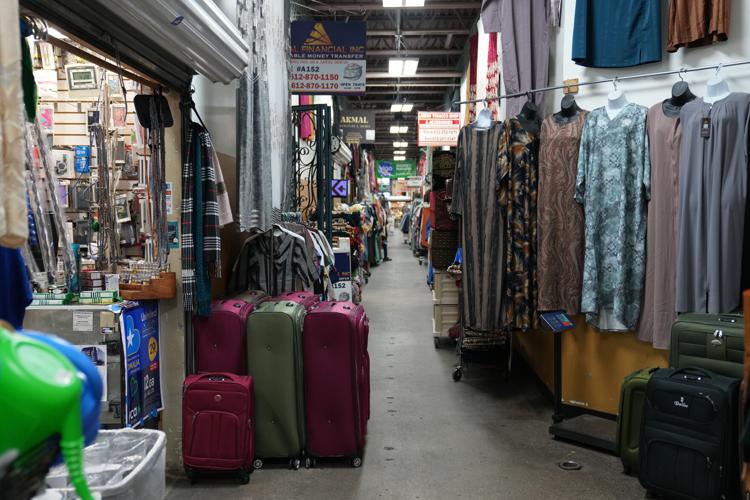
A view of the 24 Somali Mall in Minneapolis on Jan. 15.
Businesses across Minneapolis have taken a hit as President Donald Trump's administration carries out a massive immigration operation that has spurred protests. As staff and customers stay home and protesters target businesses they see as aiding federal immigration enforcement, countless stores have temporarily closed, canceled events or reduced hours.
The economic pressure shows no signs of abating as plans for a general strike on Friday to protest the immigration crackdown have gained momentum.
An already struggling economy
Minnesota and the Twin Cities cited devastating economic impacts in a lawsuit filed this month imploring a federal judge to halt immigration operations. The lawsuit asserted that some businesses have reported sales drops up to 80%.
An October report from the Minneapolis Federal Reserve noted sluggish economic indicators even before over 2,000 federal immigration officers began arriving in Minneapolis and St. Paul. But a January report emphasized that some Minnesota businesses experienced dampened sales and slower foot traffic out of "fear of immigration enforcement." Nearly 20% of all businesses surveyed reported lower employment head counts, citing similar concerns.
Fred Haberman, co-founder and CEO of a small marketing firm in Minneapolis, said his operations have been impacted because of disruptions to "support systems," like schools and day care programs, that employees rely on to maintain regular work schedules.
Uncertainty for hotels
Hotel chains have struggled to navigate the conflict. At least one location canceled reservations for federal immigration officers after frequent protests, only to reverse course after the DHS accused it of impeding law enforcement.
At least three Twin Cities hotels that protesters said housed immigration officers were not accepting reservations Wednesday.

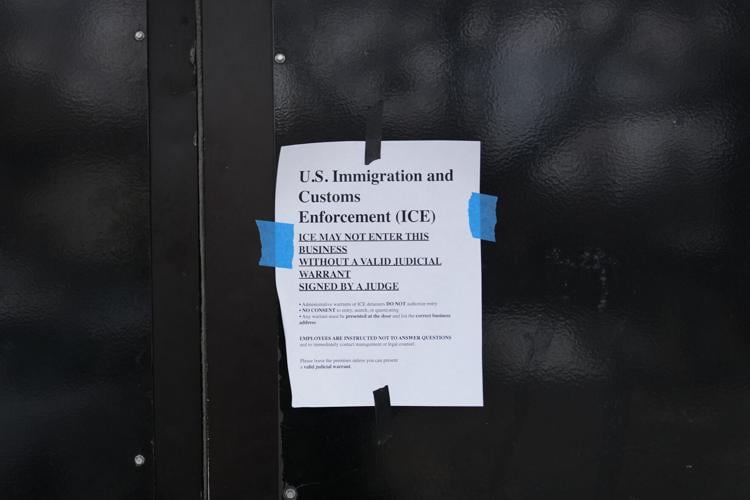
A sign is taped to the outside of the 24 Somali Mall in Minneapolis on Jan. 15.
An IHG InterContinental hotel front desk employee said it was closing for the safety of the staff but would not elaborate. Signs in front of the Hilton DoubleTree and InterContinental said they were "temporarily closed for business until further notice." The Hilton Canopy, which has been the site of noisy protests by anti-ICE demonstrators aimed at preventing federal officers from sleeping, was open but not accepting reservations.
Economic leverage as protest strategy
Faith leaders, labor unions and activists are calling for residents of the Twin Cities to not work, shop or go to school on Friday "to demand immediate cessation of ICE actions," according to the event's website.
Boycotts and economic protests are a familiar tactic in the area, where civil rights leaders called for a boycott of Target Corp. last year after it announced it would phase out a handful of diversity, equity and inclusion initiatives following Trump's push to dismantle DEI policies in government and schools.

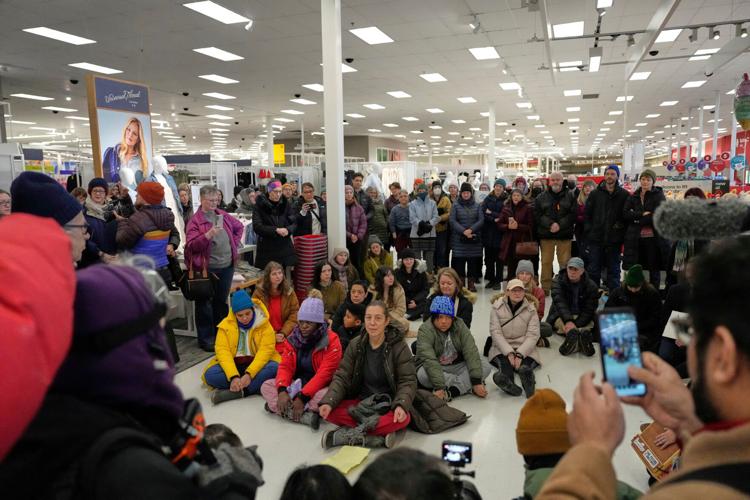
Community members and neighbors of people detained by ICE gather in protest at a Target store on Monday in St. Paul, Minn.
Last week, roughly 100 clergy protested at Target's downtown headquarters to demand the retailer take a stronger stand against federal law enforcement activity.
Videos have also shown demonstrators at Targets in St. Paul carrying signs calling for the abolition of ICE and accusing the retailer of allowing federal law enforcement to stage operations on its properties.
Legal protections in businesses
Anyone can legally enter public areas of a business, such as dining areas, parking lots, office lobbies and store aisles. In those places, immigration officials can question people, seize information and make arrests, according to John Medeiros of the Minneapolis-based law firm Nilan Johnson Lewis.
But workers and patrons have some legal protections. They can decline to talk to immigration enforcement officers, refuse to consent to searches or ask for an attorney.
ICE needs permission from the employer or a judicial warrant to enter private spaces of a business, such as a back office or an emergency room. A judicial warrant must be signed by a judge and list a specific authorizing court.
Help from neighbors offers reprieve
Nimale said Taste of East African's economic challenges have been at least temporarily offset by an outpouring of support from her neighbors. Before the crackdown, she estimates that close to 80% of her customers were Somali. Now, it's roughly 10%, with new customers who were previously unfamiliar with the cuisine filling in the gap.
Nimale said she is grateful for her neighbors' kindness but worries it's not a sustainable solution.
"We don't know how long we can get support," she said.
___
Associated Press reporter Wyatte Granthan-Philips contributed reporting.
Anti-ICE nationwide protests in photos

A protester yells at a Portland police officer outside the U.S. Immigration and Customs Enforcement facility on Thursday, Jan. 8, 2026, in Portland, Ore. (AP Photo/Jenny Kane)

An American flag burns outside the U.S. Immigration and Customs Enforcement facility on Thursday, Jan. 8, 2026, in Portland, Ore. (AP Photo/Jenny Kane)

Protesters gather during a demonstration calling for an end to federal immigration enforcement operations and U.S. attacks on Venezuela, Saturday, Jan. 10, 2026, in Los Angeles. (AP Photo/Jill Connelly)

A protester gestures during a demonstration calling for an end to federal immigration enforcement operations and U.S. attacks on Venezuela, Saturday, Jan. 10, 2026, in Los Angeles. (AP Photo/Jill Connelly)

People gather during a protest on Saturday, Jan. 10, 2026 in downtown Durham, NC. (AP Photo/Allen G. Breed)

Demonstrators protest outside the White House in Washington, Saturday, Jan. 10, 2026, against the Immigration and Customs Enforcement agent who fatally shot Renee Good in Minneapolis. (AP Photo/Jose Luis Magana)

Demonstrators protest outside the White House in Washington, Saturday, Jan. 10, 2026, against the Immigration and Customs Enforcement agent who fatally shot Renee Good in Minneapolis. (AP Photo/Jose Luis Magana)

Demonstrators protest outside the White House in Washington, Saturday, Jan. 10, 2026, against the Immigration and Customs Enforcement agent who fatally shot Renee Good in Minneapolis. (AP Photo/Jose Luis Magana)

Demonstrators protest outside the White House in Washington, Saturday, Jan. 10, 2026, against the Immigration and Customs Enforcement agent who fatally shot Renee Good in Minneapolis. (AP Photo/Jose Luis Magana)

Demonstrators march outside the White House in Washington, Saturday, Jan. 10, 2026, against the Immigration and Customs Enforcement agent who fatally shot Renee Good in Minneapolis. (AP Photo/Jose Luis Magana)

Protesters gather during a rally for Renee Good, who was fatally shot by an ICE officer earlier in the week, Saturday, Jan. 10, 2026, in Minneapolis. (AP Photo/John Locher)

People line Dodge Street during a protest against Immigration and Customs Enforcement in Omaha, Neb., on Saturday, Jan. 10, 2026. (Chris Machian/Omaha World-Herald via AP)

Protesters gather during a demonstration calling for an end to federal immigration enforcement operations and U.S. attacks on Venezuela, Saturday, Jan. 10, 2026, in Los Angeles. (AP Photo/Jill Connelly)

People gather around a makeshift memorial honoring Renee Good, who was fatally shot by an ICE officer, near the site of the shooting in Minneapolis, Friday, Jan. 9, 2026. (AP Photo/John Locher)

People march to the U.S. Immigration and Customs Enforcement facility in honor of victims of ICE shootings Friday, Jan. 9, 2026, in Portland, Ore. (AP Photo/Jenny Kane)

A sign for Renee Good, who was fatally shot by an ICE officer in Minneapolis earlier in the week, is seen on the ground alongside candles as people gather outside the U.S. Immigration and Customs Enforcement facility Friday, Jan. 9, 2026, in Portland, Ore. (AP Photo/Jenny Kane)

Minnesota State Patrol officers are seen during a protest and noise demonstration calling for an end to federal immigration enforcement operations in the city, Friday, Jan. 9, 2026, in Minneapolis. (AP Photo/John Locher)

Two people sit in the street with their hands up in front of Minnesota State Patrol during a protest and noise demonstration calling for an end to federal immigration enforcement operations in the city, Friday, Jan. 9, 2026, in Minneapolis. (AP Photo/John Locher)

Minnesota State Patrol officers are seen during a protest and noise demonstration calling for an end to federal immigration enforcement operations in the city, Friday, Jan. 9, 2026, in Minneapolis. (AP Photo/John Locher)

A protester holds up a sign outside the Bishop Henry Whipple Federal Building in Minneapolis, Saturday, Jan. 10, 2026. (AP Photo/Adam Gray)

Rep. Kelly Morrison D-Minn., center, Rep. Ilhan Omar, D-Minn., second from the right, and Rep. Angie Craig, D-Minn., far right, at the Bishop Whipple Federal Building, Saturday, Jan. 10, 2026, in Minneapolis. (AP Photo/Adam Gray)

