

WASHINGTON — While completing a master's degree in data analysis, Palwasha Zahid moved from Dallas to a town near Silicon Valley. The location made it easy to visit the campuses of tech stalwarts including Google, Apple and Nvidia.
Zahid, 25, completed her studies in December, but so far she hasn't found a job in the industry that surrounds her.
"It stings a little bit," she said. "I never imagined it would be this difficult just to get a foot in the door."
Young people graduating from college this spring and summer face one of the toughest job markets in more than a decade. The unemployment rate for degree holders ages 22 to 27 reached its highest level in a dozen years, excluding the COVID-19 pandemic. Joblessness among that group is now higher than the overall unemployment rate, and the gap is larger than it has been in more than three decades.
The rise in unemployment worried many economists as well as officials at the Federal Reserve because it could be an early sign of trouble for the economy. It suggests businesses are holding off on hiring new workers because of uncertainty stemming from the Trump administration's tariff increases, which could slow growth.
"Young people are bearing the brunt of a lot of economic uncertainty," said Brad Hersbein, senior economist at labor-focused think tank Upjohn Institute. "The people that you often are most hesitant in hiring when economic conditions are uncertain are entry-level positions."
The growth of artificial intelligence may play an additional role by eating away at positions for beginners in white-collar professions such as information technology, finance and law.
Higher unemployment for younger graduates also renewed concerns about the value of a college degree. More workers than ever have a four-year degree, which makes it less of a distinguishing factor in job applications. Murat Tasci, an economist at JPMorgan, calculates that 45% of workers have a four-year degree, up from 26% in 1992.
While the difficulty of finding work demoralizes young people like Zahid, most economists argue that holding a college degree still offers clear lifetime benefits. Graduates earn higher pay and experience much less unemployment over their lifetimes.
The overall U.S. unemployment rate is a still-low 4.2%, and the government's monthly jobs reports show the economy is generating modest job gains. However, the additional jobs are concentrated in health care, government, and restaurants and hotels. Job gains in professions with more college grads — such as information technology, legal services and accounting — languished in the past 12 months.
The unemployment rate stayed low mostly because layoffs are still relatively rare. The actual hiring rate — new hires as a percentage of all jobs — fell to 2014 levels, when the unemployment rate was much higher, at 6.2%. Economists call it a no-hire, no-fire economy.

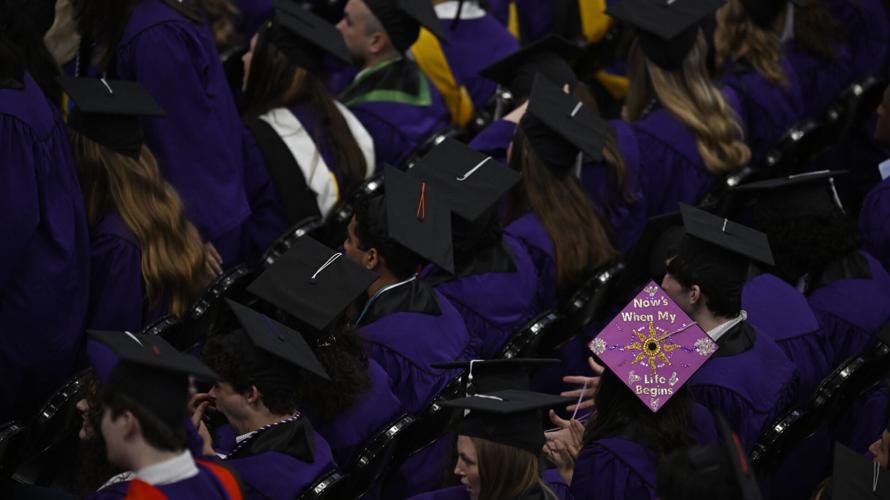
A graduate with a message on her hat is seen June 15 during Northwestern University's graduation in Chicago.
For college graduates 22 to 27 years old, the unemployment rate was 5.8% in March — the highest, excluding the pandemic, since 2012 and far above the nationwide rate.
Lexie Lindo, 23, saw how reluctant companies were to hire while applying for more than 100 jobs last summer and fall after graduating from Clark Atlanta University with a business degree and 3.8 GPA. She had several summer internships in fields such as logistics and real estate while getting her degree, but no offer came.
"Nobody was taking interviews or responding back to any applications that I filled out," Lindo, who is from Auburn, Georgia, said.
She returned to Clark for a master's program in supply chain studies and has an internship this summer at a Fortune 500 company in Austin, Texas. She's hopeful it will lead to a job next year.
Artificial intelligence could be a culprit, particularly in IT. Matthew Martin, senior U.S. economist at Oxford Economics, calculated that employment for college graduates 28 and above in computer science and mathematical occupations increased a slight 0.8% since 2022. For those ages 22 to 27, it fell 8%.
Company announcements further fueled concerns.
Tobi Lutke, CEO of online commerce software company Shopify, said in an April memo that before requesting new hires, "teams must demonstrate why they cannot get what they want done using AI."
Amazon CEO Andy Jassy recently said AI likely would reduce the company's corporate workforce over the next few years.
Zahid worries that AI is hurting her chances. She remembers seeing big billboard ads for AI at the San Francisco airport that asked, "Why hire a human when you could use AI?"
Still, many economists argue that blaming AI is premature. Most companies are in the early stages of adopting the technology.
Professional networking platform LinkedIn categorized occupations based on their exposure to AI and did not see big hiring differences between professions where AI was more prevalent and where it wasn't, said Kory Kantenga, the firm's head of economics for the Americas.
"We don't see any broad-based evidence that AI is having a disproportionate impact in the labor market or even a disproportionate impact on younger workers versus older workers," he said.
He added that the Federal Reserve's interest rate hikes also slowed hiring in tech.

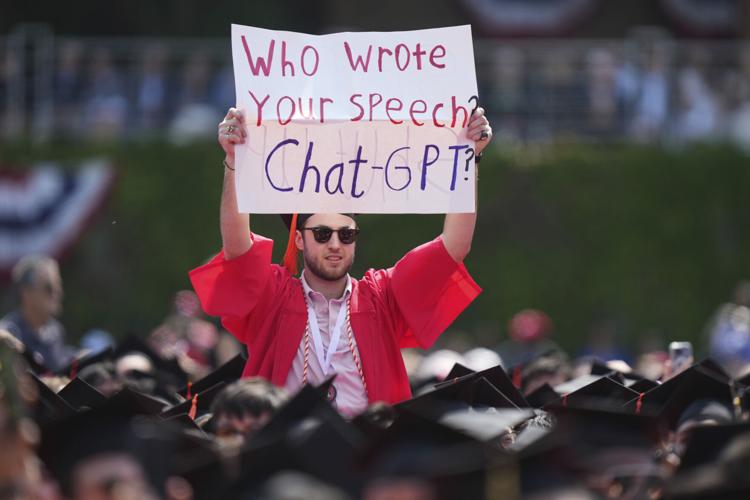
A person in a graduation cap and gown holds a sign during an address by David Zaslav, president and CEO of Warner Bros. Discovery, at Boston University commencement ceremonies May 21, 2023, in Boston.

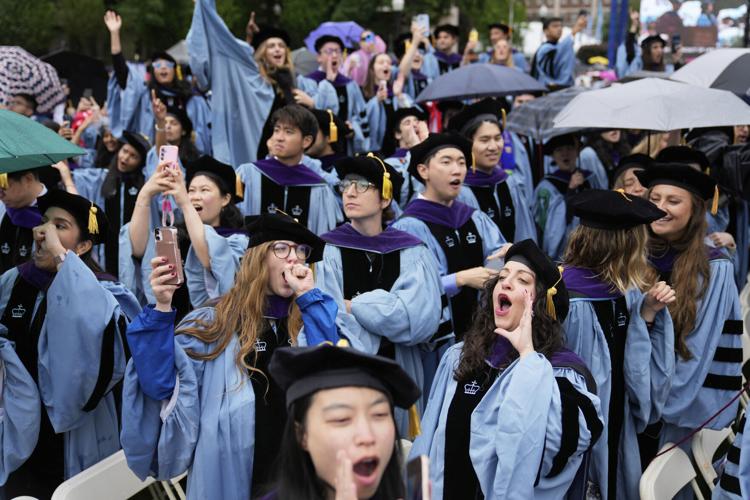
Graduates cheer during the Columbia University commencement ceremony May 21 on Columbia's main campus in Manhattan, New York.
Higher education, higher earnings? Here's where advanced degrees pay off the most.
Higher education, higher earnings? Here's where advanced degrees pay off the most.
Updated
A college degree has often been viewed as a ticket to the middle class and a requirement for the increasingly high-tech, high-skill jobs of tomorrow. Software developers, registered nurses, and accountants are some of the occupations requiring a college education that are projected to grow quickly, according to the Bureau of Labor Statistics.
Indeed, jobs that require a bachelor's degree are projected to grow faster than the average across all jobs, with 3.3 million openings each year. The share of jobs that will need at least a college education is also expected to rise: by 2031, 42% of jobs will require a bachelor's degree or higher compared to 36% in 2021, according to the Georgetown University Center on Education and the Workforce.
As demand for highly educated workers increases, the share of Americans with a college degree has also gone up. In 2022, more than 38% of Americans 25 years and older had completed four or more years of college, while in 2000, less than 26% had. Some states had even higher shares of college graduates—over 45% of those living in Colorado and Massachusetts had a bachelor's degree or higher, per the Federal Reserve Bank of St. Louis. Those two states trailed only Washington D.C. in having the most highly educated population—nearly two-thirds of the residents in the nation's capital are college graduates.
Having a bachelor's degree not only helps qualify graduates for more jobs, but it also qualifies them for higher-paying positions. Those with college degrees enjoy a significant pay increase over those with only a high school diploma. But the size of that increase is not equal everywhere. Best Colleges analyzed Census data to determine the wage boost a college education provides both nationally and by state.

College degrees provide a significant earnings boost
Updated
Nationally, college graduates earn significantly more than those with only a high school education or less. This wage gap has widened over time, too. An analysis by the Federal Reserve Bank of St. Louis found that in 1980, a college-educated worker earned about $10,000 more annually than a high school-educated worker by mid-career. But in 2020, this gap had grown to $18,000. Much of this difference is because jobs that high school graduates work in don't have much wage growth, whereas college graduates might see their salary increase significantly over the course of their career, according to a study by Harvard University's David J. Deming, published in the National Bureau of Economic Research.
Even within the same occupation, those with a college degree tend to earn more than those with just a high school diploma. A 2023 College Board analysis of jobs that employed a significant number of both high school graduates and college graduates found that the earnings gap ranged from 12% for bookkeeping, accounting, and auditing clerks to 78% for supervisors of nonretail sales workers. The median salary for a nonretail sales supervisor with a college degree was $95,000 compared to just $53,400 for a supervisor with only a high school diploma.
Of course, not all college graduates will earn equally high salaries. What one studies can significantly impact one's financial outcome, as earnings vary significantly across different fields. Those who studied engineering, economics, or finance tended to have a mid-career annual median wage of $100,000 or more, while education, social services, and theology and religion majors had the lowest median wages, earning $60,000 or less annually, according to Census data analyzed by the Federal Reserve Bank of New York.
The wage boost is bigger in some states than others
Updated
How much of a wage boost a college degree provides also varies by state. The median earnings of college graduates range from around $52,000 in Mississippi, the lowest in the country (except for Puerto Rico), to over $95,000 in Washington D.C. While college graduates earn more than high school graduates in all states, the pay bump is larger in some places, such as D.C., New Jersey, New York, and California, and smaller in others like Vermont, Maine, and Montana.
Some of what drives these differences in educational pay gaps is related to the share of residents employed in high-paying jobs and industries. States with the biggest gaps tend to have a larger share of workers in occupations that both require high levels of education and are well compensated. For example, D.C. has a large number of lawyers (49 out of every 1,000 jobs, per the Bureau of Labor and Statistics), a profession that both pays well (average salary of nearly $240,000 in D.C.) and requires an advanced degree.
Not only do these jobs pay more, but workers might also earn some of the highest salaries in their field in states with larger wage boosts. In New Jersey, the average salary of registered nurses, one of the top five jobs in the state, is among the highest in the nation, at nearly $102,000. Similarly, in New York, general and operations managers—the third largest occupation in the state—earn nearly the highest average salaries in their field.
States with larger wage gaps also predict that there will be a growing demand for workers with a college degree. California, for example, projects that some of its fastest-growing occupations will be nurse practitioners, physician assistants, medical managers, data scientists, and information security analysts—all jobs that typically require a college education at minimum.
Vermont, on the other hand, forecasts its future job openings will mainly be for waitstaff, carpenters, sales representatives, and fitness trainers—these jobs are ones that do not typically require a bachelor's degree. Without strong local demand for their skills and knowledge, it makes sense that college graduates would not earn as much in states like Vermont.
An additional factor that may influence how much of a wage boost a college education provides is institutional prestige. Several studies have shown that graduates from more selective institutions tend to have higher earnings. An analysis of data from more than 1,500 schools by PayScale found that early-career median pay for Ivy League graduates was over $86,000, compared to around $58,000 for graduates from other institutions—and that the gap grows even wider by mid-career.
Opportunity Insights studied anonymized admissions data and income tax records and found that attending such selective colleges also substantially increases the odds of being in the top 1% of earners. However, research from Mathematica Policy Research and Princeton University points out that the advantage that attending a highly prestigious institution provides in terms of earnings disappears once academic performance and SAT/ACT scores are controlled for, suggesting that it isn't so much the quality of the school as much as the quality of the students that affects future earnings.
Although having a college degree can significantly boost one's wages, attending college comes with a hefty price tag, too. In 2023, 1 out of every 4 U.S. young adults had student loan debt, owing a median amount of $20,000 to $25,000, according to an analysis of Federal Reserve Board data by the Pew Research Center. It also found that college graduates with student loan debt tend to have lower household incomes than those without debt (though they do still earn more than noncollege graduates).
Perhaps it is not surprising that doubts are growing as to whether attending college is worth it. Four out of 5 Americans now think that someone without a degree could potentially get a well-paying job in today's economy, and roughly half feel having a degree is less helpful than it was 20 years ago. As college enrollment declines from a peak of 70% in 2009 to 61% in 2021, it seems that the perceived financial benefits of a college degree may not be as clear-cut as before.
Story editing by Carren Jao. Additional editing by Elisa Huang. Copy editing by Tim Bruns.
This story originally appeared on Best Colleges and was produced and distributed in partnership with Stacker Studio.

