

NEW YORK — If someone left a government job with a literal black eye, ran a company with shrinking profits and suddenly had federal investigators crawling over their business, you might say they're having a bad year.
But most people are not Elon Musk.
The world's richest man has only gotten richer this year and shareholders at Tesla, his electric car company, may make him wealthier yet by approving a trillion-dollar pay package in a bet he will succeed with new plans for a "robot army" and other technological breakthroughs even as some past promises remain unfulfilled.
"The genius of Elon Musk is keeping investors focused on what the company might look in like 5 or 10 years — while ignoring very near-term challenges," marvels Garrett Nelson of CFRA Research. Or put more bluntly by Zacks Investment's Brian Mulberry, "Your average CEO would likely not survive this."

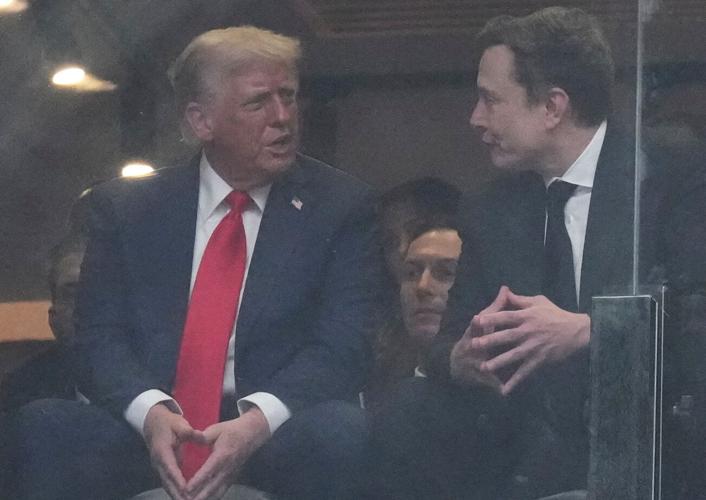
President Donald Trump, left, and Elon Musk talk Sept. 21 during a memorial for Charlie Kirk at State Farm Stadium in Glendale, Ariz.
Musk started out the year with a side hustle — promising to cut $2 trillion in government spending as head of President Donald Trump's Department of Government Efficiency, before cutting that pledge in half. In the end, DOGE posted only $240 billion in savings, according to its own notoriously unreliable estimates, and it's not even clear those savings will hold as the Trump administration scrambles to refill many essential jobs that DOGE shouldn't have cut.
"There is a pattern of them announcing great big firings, and then turning about and saying, 'No, that's a mistake,'" said Elaine Kamarck, a Brookings Institute senior fellow who has compiled a list of 17,000 positions being refilled. "They cut without a plan, without regard to function."

Musk used the same slash-and-burn tactics after he took over Twitter, and evidence of that backfiring also emerged this year.
In the past two months, he settled a pair of lawsuits filed by 2,000 former Twitter employees and executives alleging they were pushed out under false pretenses or never given severance as promised. The amount the ex-workers got was undisclosed, but if they received even a fraction of the combined $628 million they demanded, the cost will cut deeply for a company whose advertising plunged since his takeover.
More bad news for Musk came last week, when Tesla announced earnings plunged 37% in the third quarter. Vehicle sales rose 6% as customers rushed to take advantage of a federal tax credit before it expired last month, but the figure for the full year is expected to drop significantly as car buyers turned off by Musk's right-wing political stances boycotted the business.
This time a year ago, Musk told investors sales could grow 20% to 30%.
The stock fell earlier this year as the bad news piled up. But after Musk appeared in the Oval Office in May for his farewell to DOGE sporting a shiner, it has doubled and is now posting a year-to-date gain of nearly 9%.


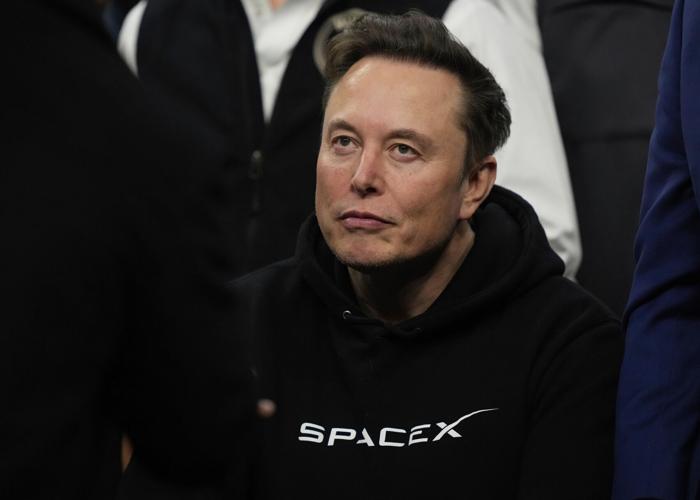
Elon Musk attends the finals for the NCAA wrestling championship March 22 in Philadelphia.
His net worth also jumped — up $62 billion this year to $483 billion, according to Forbes magazine.
Investors are mostly buying Musk's line that plunging car sales don't matter as much now because the future of the company lies more with his new driverless robotaxis service, the energy storage business and building robots for the home and factory. To make his task worthwhile, Tesla's directors asked shareholders to sign off on his enormous new pay package at an annual meeting next month.
Still, there are big questions surrounding these endeavors, particularly the driverless cabs.
Musk's robotaxis, which began picking up passengers in Austin, Texas, and San Francisco this summer, can't yet be called driverless because they still require "safety monitors" who are ready to seize control in case something goes wrong, which occasionally happens. One of them drove down the opposing lane, for example.
The robotaxi plans need regulative approval in various states even as the regulators in Washington swarmed the company.
They opened four investigations into Tesla so far this year, including one into why it hasn't reported accidents involving its self-driving software quickly to the government as required. Another launched this month is looking into dozens of reported accidents in which Teslas using self-driving software ran red lights and broke other traffic rules, occasionally crashing into other vehicles and causing injuries.
Musk disappointed before, talking big and missing deadlines, only to deliver for shareholders eventually. Tesla investors who held on through a tough 2018 as the company struggled to produce its Model 3 vehicle at a profit, eventually saw their stock soar as sales jumped.

One money manager who rode that earlier surge then bought again earlier this year, says she's confident Musk's magic is still there and he can pull off the seemingly impossible again.
"He frequently teeters on the edge of disaster," Nancy Tengler said in a statement, "and then pulls back just in the nick of time."
One difference now is most other Tesla investors also believe this and bought up the stock, leaving little room for error.
Shares of U.S. companies in the S&P 500 index are valued at 24 times what investors expect them to earn next year. By contrast, Tesla is trading at 250 times expected profits.
Photos: Elon Musk saw turbulent time in US politics

FILE - Elon Musk reacts as President-elect Donald Trump speaks at a rally ahead of the 60th Presidential Inauguration, Jan. 19, 2025, in Washington. (AP Photo/Alex Brandon, File)

FILE - Elon Musk gestures as President Donald Trump addresses a joint session of Congress at the Capitol in Washington, March 4, 2025. (AP Photo/Alex Brandon, File)

FILE - Elon Musk, center, listens as President Donald Trump speaks during a cabinet meeting at the White House, April 30, 2025, in Washington. (AP Photo/Evan Vucci, File)

FILE - President Donald Trump speaks with Elon Musk as his son X Æ A-Xii looks on as they arrive on Marine One at the South Lawn of the White House in Washington, April 13, 2025. (AP Photo/Jose Luis Magana, File)

FILE - President Donald Trump, left, and Elon Musk depart the White House to board Marine One en route to New Jersey, March 21, 2025, in Washington. (AP Photo/Mark Schiefelbein, File)

FILE - In this picture taken through a window, President-elect Donald Trump, from left, Trump's pick for the planned Department of Government Efficiency Elon Musk and Vice President-elect JD Vance attend the NCAA college football game between Army and Navy at Northwest Stadium in Landover, Md., Dec. 14, 2024. (AP Photo/Stephanie Scarbrough, File)

FILE - Elon Musk holds up a chainsaw he received from Argentina's President Javier Milei, right, as they arrive to speak at the Conservative Political Action Conference, CPAC, at the Gaylord National Resort & Convention Center, Feb. 20, 2025, in Oxon Hill, Md. (AP Photo/Jose Luis Magana, File)

FILE - Elon Musk carries his son X Æ A-Xii as they arrives on Air Force One with President Donald Trump, not pictured, at Miami International Airport, April 12, 2025, in Miami, Fla. (AP Photo/Manuel Balce Ceneta, File)

FILE - Elon Musk speaks at a town hall, March 30, 2025, in Green Bay, Wis. (AP Photo/Jeffrey Phelps, File)

FILE - Elon Musk, left, shakes hands with President Donald Trump at the finals for the NCAA wrestling championship, March 22, 2025, in Philadelphia. (AP Photo/Matt Rourke, File)

FILE - Elon Musk flashes his t-shirt that reads "DOGE" to the media as he walks on South Lawn of the White House, in Washington, March 9, 2025. (AP Photo/Jose Luis Magana, File)

FILE - Elon Musk, departs a lunch between President Donald Trump and Saudi Crown Prince Mohammed bin Salman at the Royal Palace in Riyadh, Saudi Arabia, May 13, 2025. (AP Photo/Alex Brandon, File)

FILE - President Donald Trump and Tesla CEO Elon Musk speak to reporters as they sit in a red Model S Tesla vehicle on the South Lawn of the White House, March 11, 2025, in Washington. (Pool via AP, File)

FILE - Google CEO Sundar Pichai and Elon Musk watch during the 60th Presidential Inauguration in the Rotunda of the U.S. Capitol in Washington, Jan. 20, 2025. (AP Photo/Julia Demaree Nikhinson, Pool, File)

Elon Musk attends news conference with President Donald Trump in the Oval Office of the White House, Friday, May 30, in Washington.

President Donald Trump, right, shakes the hand of Elon Musk during a news conference in the Oval Office of the White House, Friday, May 30, 2025, in Washington. (AP Photo/Evan Vucci)

President Donald Trump speaks during a news conference with Elon Musk in the Oval Office of the White House, Friday, May 30, 2025, in Washington. (AP Photo/Evan Vucci)

FILE - Former first lady Melania Trump greets Elon Musk before Republican presidential nominee former President Donald Trump arrives at a campaign rally at Madison Square Garden, Oct. 27, 2024, in New York. (AP Photo/Evan Vucci, File)

FILE - Republican presidential nominee former President Donald Trump, left, claps as Tesla and SpaceX CEO Elon Musk prepares to depart after speaking at a campaign event at the Butler Farm Show, on Oct. 5, 2024, in Butler, Pa. (AP Photo/Alex Brandon, File)

FILE - Elon Musk jumps on the stage as Republican presidential nominee former President Donald Trump speaks at a campaign rally at the Butler Farm Show, Oct. 5, 2024, in Butler, Pa. (AP Photo/Evan Vucci, File)

FILE - President-elect Donald Trump listens as Elon Musk explains the operations ahead of the launch of the sixth test flight of the SpaceX Starship rocket, Nov. 19, 2024, in Boca Chica, Texas. (Brandon Bell/Pool via AP, File)

FILE - Tesla and SpaceX CEO Elon Musk, left, and Republican presidential nominee former President Donald Trump attend a campaign event at the Butler Farm Show, Oct. 5, 2024, in Butler, Pa. (AP Photo/Alex Brandon, File)

