

Automakers Hyundai and Kia must offer free repairs to millions of models under a settlement announced Tuesday by Minnesota's attorney general, who led an effort by dozens of states that argued the vehicles weren't equipped with proper anti-theft technology, leaving them vulnerable to thefts.

The Hyundai company logo is displayed Sept. 12, 2021, in Littleton, Colo.
Under the nationwide settlement, the companies will offer a free repair to all eligible vehicles at a cost that could top $500 million, Minnesota Attorney General Keith Ellison said. Hyundai and Kia also must outfit all future vehicles sold in the U.S. with a key piece of technology called an engine immobilizer and pay up to $4.5 million of restitution to people whose vehicles were damaged by thieves.
The settlement was reached by 35 states, including California, New Jersey, New York and Pennsylvania. The vehicles eligible for fixes date as far back as 2011 and as recently as 2022. About 9 million eligible vehicles were sold nationwide.
Thefts of Hyundai and Kia vehicles soared in part because, beginning in 2021, videos posted to TikTok and other social media demonstrated how someone could steal a car with just a screwdriver and a USB cable. Minneapolis reported an 836% increase in Hyundai and Kia thefts from 2021 to 2022. Ellison announced an investigation into the automakers in early 2023.
Ellison said the two companies installed engine immobilizers on cars sold in Mexico and Canada, but not widely in the U.S., leading to car thefts, crimes and crashes that injured and even killed people, including teenagers.
"This crisis that we're talking about today started in a boardroom, traveled through the internet and ended up in tragic results when somebody stole those cars," Ellison said at a news conference.

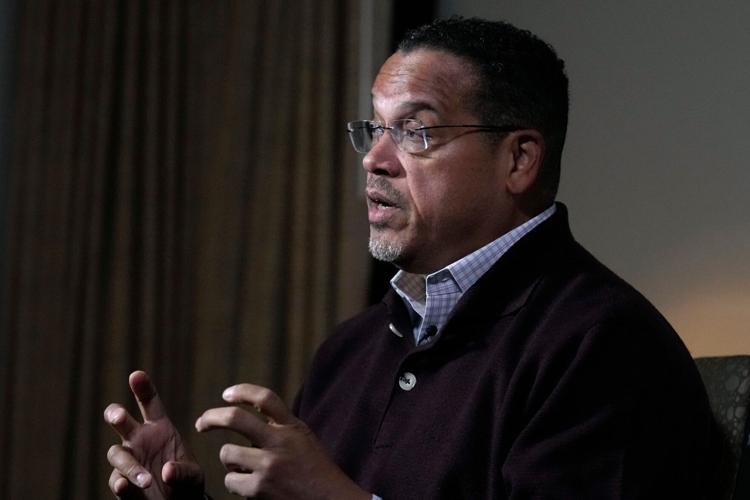
Keith Ellison, attorney general of Minnesota, answers a question Nov. 15, 2023, during an interview at the State Attorneys General Association meetings in Boston.
He was joined by Twin Cities officials, a woman whose mother was killed when a stolen Kia crashed into her parents' vehicle and a man whose car was stolen nine times — as recently as Monday night — including seven times after a previous software fix.
Under the settlement, Hyundai and Kia will install a zinc sleeve to stop would-be thieves from cracking open a vehicle's ignition cylinder and starting the car.
Eligible customers will have one year from the date of the companies' notice to get the repair at an authorized dealership. The repairs are expected to be available from early 2026 through early 2027.
In separate statements, the automakers said the agreement is one of multiple anti-theft efforts they took to help customers.
"Kia is eager to continue working with law enforcement officers and officials at federal, state, and local levels to combat criminal car theft, and the role social media has played in encouraging it, and we remain fully committed to upholding vehicle security," the company said.
"We will continue to take meaningful action to support our customers and ensure peace of mind," Hyundai said.
Why more drivers are leaving the dealership with a lease and not a loan
Why more drivers are leaving the dealership with a lease and not a loan
Updated
For many Americans, access to a personal vehicle is a necessity, but like most other consumer goods, the price of owning one has risen. Last year, car buyers sought to lease vehicles instead of obtaining traditional car loans, with the former option accounting for about 25% of new vehicle purchases, according to Experian's State of the Automotive Finance Market Q3 2024 report.
This continues a rising trend from 2023, when leases comprised approximately 20% of new vehicle purchases versus about 17% in 2022. This purchasing shift follows a drastic increase in vehicle loan interest rates, nearly doubling throughout 2022 after sitting at historic lows.
The debate about leasing or purchasing a car depends heavily on a consumer's situation and plans for the vehicle. Leasing can provide an attractive option to consumers with lower down and monthly payments while offering a commitment to shorter terms than a traditional automotive loan. Leasing can also grant consumers more immediate access to higher-end vehicles they would not usually be able to buy with the terms of a traditional loan, allowing them more flexibility in obtaining payments compatible with their finances. Since leased vehicles are only in a consumer's possession for a certain length of time, they can also save on maintenance costs over the vehicle's lifespan.
On the other hand, purchasing a car allows consumers to fully own a vehicle without the need to watch out for any mileage restrictions. Buyers also won't need to fret over potential additional costs for wear and tear beyond the typical scratch. Owners can also sell their vehicles or trade them for credit toward their next car purchase.
Buyers are only beginning to see a shift in car prices and interest rates, finally cooling off after going into post-COVID-19 pandemic overdrive. With vehicle prices and financing rates remaining relatively high, more people will likely consider leasing instead of buying.
The General used data from the consumer analytics firm Experian to illustrate how leasing has grown in popularity over the past two years and how much money leasing can save consumers each month.

Consumers increasingly favor leasing amid elevated interest rates
Updated
Vehicle finance rates and the prevalence of leasing reached a historic low in 2022 after the economic disruption from the pandemic. As the Federal Reserve enacted several rate cuts between 2022 and 2024, vehicle financing rates rose, and the number of consumers seeking leases rebounded.
Finance rates for new and used vehicles increased, and the prevalence of leasing rose from prime to subprime borrowers, indicating an increased popularity of leasing among the buying public. Prime borrowers have good credit and are considered the least likely to default on loans; in contrast, subprime borrowers have a higher risk of nonpayment due to limited or damaged credit histories.
Monthly payments on leases also fell throughout 2024, making them more appealing to consumers attempting to offset higher monthly financing rates with lower monthly payments. Consumers are also looking to avoid being locked into longer-term loans by holding off on their next car purchases or opting for shorter-term financing with tolerable interest rates, which allow them more flexibility on buying their next vehicle and credit.
Monthly savings add up on lease payments compared to loans
Updated
Among the most commonly leased vehicles of 2024, consumers saved an average of approximately $148 per month. The actual dollar amount varied across cars, with the Tesla Model Y having an average savings of $75 and the Ford F-150 having an average monthly savings of $356. Differences can vary widely for vehicles that are not commonly leased.
The Honda CR-V was the most popularly leased vehicle of the year, with the Tesla Model Y, Jeep Grand Cherokee, Honda HR-V, and Chevrolet Equinox also ranking in the top 10, exhibiting a large shift for consumers toward SUV models, which accounted for over 61% of all newly financed vehicles in the third quarter of 2024.
The Chevrolet Silverado 1500 and Ford F-150 were also among the most popular vehicles to lease, which shows that consumers in need of pickup trucks can obtain access to the vehicles despite their high overall cost and financing rates. Electric vehicles were also popular to lease, with the Tesla Model Y and Model 3 among the top 10 most popular.
EV leases can save consumers even more
Updated
EV buyers saw even bigger savings on leases than purchases, with the average savings on an EV lease being $198. This was a $50 savings over the average monthly lease for gas vehicles. Since EVs usually have a higher average price overall, they tend to have higher monthly payments than leases.
Among the most commonly leased EVs, such as the Kia EV9, Cadillac Lyriq, Hyundai Ioniq 5, and Nissan Ariya, an average monthly lease payment was over $300 less than an average monthly payment on a loan. The Chevrolet Blazer EV saw one of the biggest differences, with an average monthly lease of only $429. In contrast, an average monthly loan payment was nearly double that, at $822, for an average monthly savings of $393. Meanwhile, the Tesla Model Y saw a much smaller difference, with an average savings of $75 per month.
Leasing is especially attractive for EVs
Updated
EVs accounted for 17.3% of all new leases in 2024 and grew 30% compared to 2023. Nearly 45% of new EV transactions were leasing, a continued rise from just about 25% in 2023 and 10% in the third quarter of 2022.
According to TransUnion, numerous factors contributed to the increased popularity of EV leasing. The days of supply shortages of lithium batteries have passed, and inventory levels have stabilized at dealerships. More lower-priced models and new dealer leasing incentives contributed to this increase.
Additional incentives, such as tax credits from the Inflation Reduction Act of 2022 granted toward the lease of EVs in January 2023, also helped boost interest. Potential buyers can receive up to $7,500 in tax credits, which can be applied to the purchase of the vehicle for an even larger savings on the vehicle's overall price. According to Reuters, these credits may disappear in the Trump administration as part of a broader tax reform program, which may put the EV's popularity in contention.
Story editing by Carren Jao. Copy editing by Paris Close.
This story originally appeared on The General and was produced and distributed in partnership with Stacker Studio.

