

WASHINGTON — Defense Secretary Pete Hegseth has accused the independent watchdog for the Pentagon of being “weaponized” and says he's overhauling the inspector general’s office, upending the way that service members report abuse and other problems in the ranks.
Hegseth unveiled the plans during a speech at an unusual gathering of hundreds of top military leaders last week. He also signed a memo ordering the inspector general to identify anyone who makes a complaint instead of letting them be anonymous, to dismiss any complaints the inspector general deems “non-credible,” and to set new, tighter timelines for complaints to be filed and investigations to be completed.
Along with a decree stating that the military's policy on “hazing, bullying, and harassment is overly broad,” Hegseth's directives have raised concerns among advocates and experts who say the changes would undo years of progress that have helped protect women and minorities from abuse and would shutter avenues to file legitimate complaints.
It is part of a broader push by the Trump administration to radically reshape the community of inspectors general tasked with rooting out waste, fraud and abuse at government agencies. More than a dozen watchdogs were fired in January amid a larger dismantling of public integrity guardrails since President Donald Trump took office.

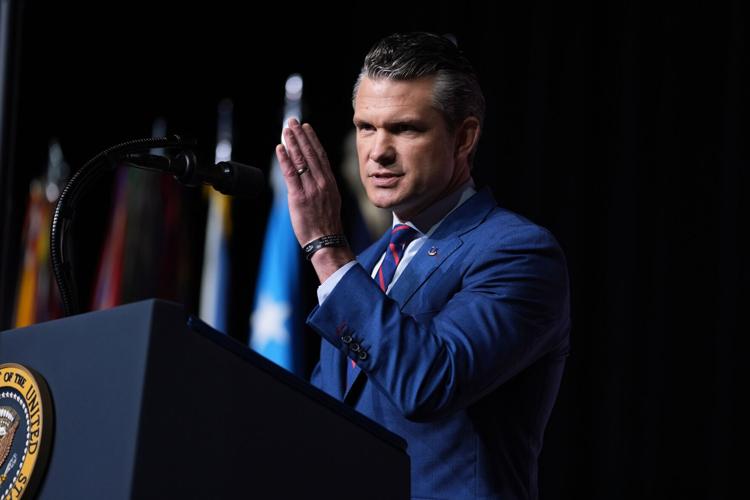
Defense Secretary Pete Hegseth speaks to a gathering of top U.S. military commanders at Marine Corps Base Quantico on Tuesday, Sept. 30 in Quantico, Va.
The changes are necessary to fix a process that “has been weaponized — putting complainers, ideologues and poor performers in the driver’s seat,” Hegseth told military leaders Tuesday, without offering evidence.
Hegseth is overhauling the office as he himself is under investigation by the inspector general over his use of the Signal messaging app, where he shared sensitive information about military strikes in a group chat that inadvertently included a journalist. He also shared the information in other chats that included his wife and brother.
Pentagon press secretary Kingsley Wilson told reporters in August that Hegseth had made a statement as part of that investigation — one of the last steps in the process.
Don Christensen, a former chief prosecutor for the Air Force and a Virginia-based attorney who often represents people who file complaints with the inspector general, questioned the need for Hegseth’s directive.
“This is based upon people that he hangs out with complaining about the process versus any kind of study or data that shows that the IG takes too long or there’s this problem with serial complainers,” Christensen said. He added, “I don’t know of any data that shows there’s a crisis of serial complaints.”
Rachel VanLandingham, a former Air Force lawyer and military justice advocate, said she worries the changes will have a major chilling effect on troops coming forward to report sexual harassment, bullying and racism.
She noted that by eliminating anonymous reporting, Hegseth is planning to shut down a process that has been "proven to bring to light significant issues that affect morale and discipline within units."
“Survey after survey after survey has shown that service members are afraid of their own command chain, and when they’re afraid of their own command chain, problems go on unsolved,” she said.

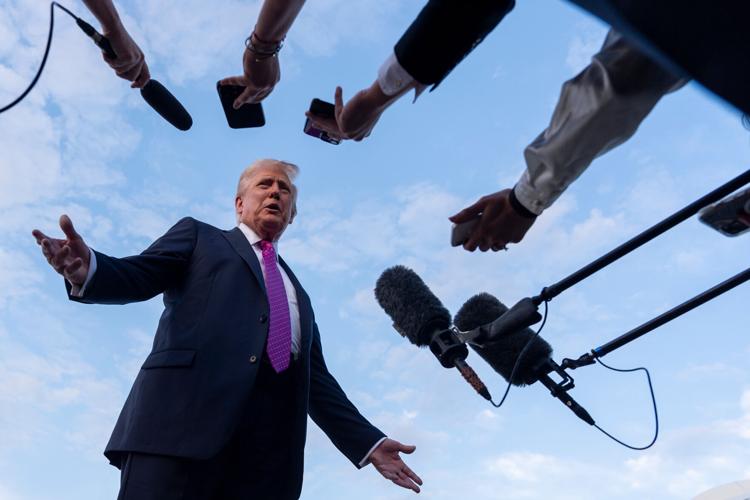
President Donald Trump speaks with reporters before he departs on Air Force One at Morristown Airport on Sunday, Sept. 14 in Morristown, N.J.
Despite years of messaging and establishing specialized response teams, the military has continued to struggle with sexual assault and violence toward women.
In a recent case, Army Spc. Vanessa Guillen's dismembered remains were discovered after she had been missing for more than two months from Fort Hood in Texas in 2020. The killing sparked a movement of women speaking out about sexual abuse in the military and led to changes in how they can report it.
An Army investigation later found that, among other issues, there was a climate that tolerated sexual harassment and assault, and that there was a significant lack of confidence in the command chain, and therefore reluctance to report abusive behavior.
In his speech this week, Hegseth seemed to anticipate criticism of his changes and stressed to the assembled military brass that “of course, being a racist has been illegal in our formation since 1948 — the same goes for sexual harassment — both are wrong and illegal.” He said “those kinds of infractions will be ruthlessly enforced.”
While VanLandingham acknowledged Hegseth’s position, she said he is making “changes to systems that have been shown to help reduce sexual harassment and sexual assault” and were created in response to widespread systemic racial and sexual discrimination and harassment.
Hegseth’s memo also pointedly noted that an article of the Uniform Code of Military Justice — the legal code that governs military personnel — prohibits false statements and that violators “will be held appropriately accountable.”
Both Christiansen and VanLandingham said such wording will almost certainly discourage people from reporting concerns and complaints.
“The people who are coming forward are taking a huge risk for their career already, and now he’s making it worse by putting a target on their back,” Christensen said.
VanLandingham added: “That’s not how you instill confidence in a system to be able to report things that absolutely need to be reported."



